
09.12.2025 by Sascha Riegler
How High-Force Dynamic Mechanical Analysis Helps Understand Real Material Behavior
Rubber components used in aerospace, mining, defense, and motorsport face extreme mechanical loads in real operation—far beyond what standard testing can replicate. High-Force DMA makes it possible to measure and simulate these stresses, revealing critical behaviors such as heat build-up, fatigue, and the Payne and Mullins effects. With advanced testing technology, manufacturers can better predict performance, prevent failure, and design safer, longer-lasting rubber materials.
The Behavior of Rubber Under Heavy Load
Whether it's aircraft tires, mining conveyor belts, military track pads, or Formula 1 racing tires – rubber is often exposed to extreme mechanical StressStress is defined as a level of force applied on a sample with a well-defined cross section. (Stress = force/area). Samples having a circular or rectangular cross section can be compressed or stretched. Elastic materials like rubber can be stretched up to 5 to 10 times their original length.stress. But how does this complex material behave under real-world conditions? And how can manufacturers reliably test and simulate these loads? This is where High-Force Dynamic Mechanical Analysis (DMA) by NETZSCH becomes essential.
Why High-Force DMA?
DMA is a non-destructive testing method used to analyze the dynamic mechanical behavior of viscoelastic solids. While conventional DMAs are suitable for small samples and linear viscoelastic testing, they reach their limits when materials are exposed to high forces, high frequencies, or large deformations –- all of which are common in real-world applications.
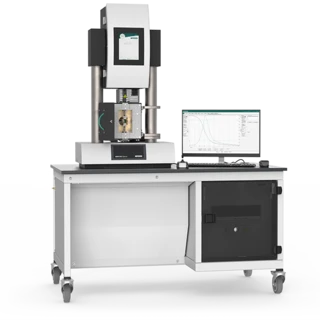
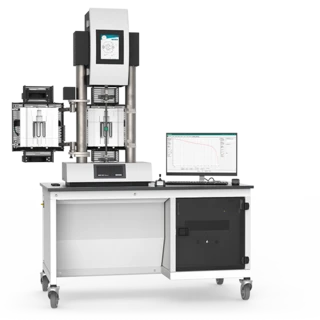
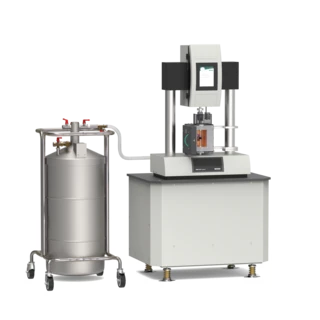
NETZSCH offers high-force DMA instruments like the DMA 503 Eplexor® and DMA 523 Eplexor®, capable of applying static forces up to 6000 N and dynamic forces up to 4000 N. These systems make it possible to test large specimens and simulate realistic loading conditions –from heavy-duty tires to VibrationA mechanic process of oscillation is called vibration. Vibration is a mechanical phenomenon whereby oscillations occur about an equilibrium point. In many cases, vibration is undesirable, wasting energy and creating unwanted sound. For example, the vibrational motions of engines, electric motors, or any mechanical device in operation are typically unwanted. Such vibrations could be caused by imbalances in the rotating parts, uneven friction, or the meshing of gear teeth. Careful designs usually minimize unwanted vibrations.vibration dampers.
Discover the NETZSCH High-Force DMA Product Range
Heat Build-Up & Blow-Out – Pushing Elastomers to the Limit
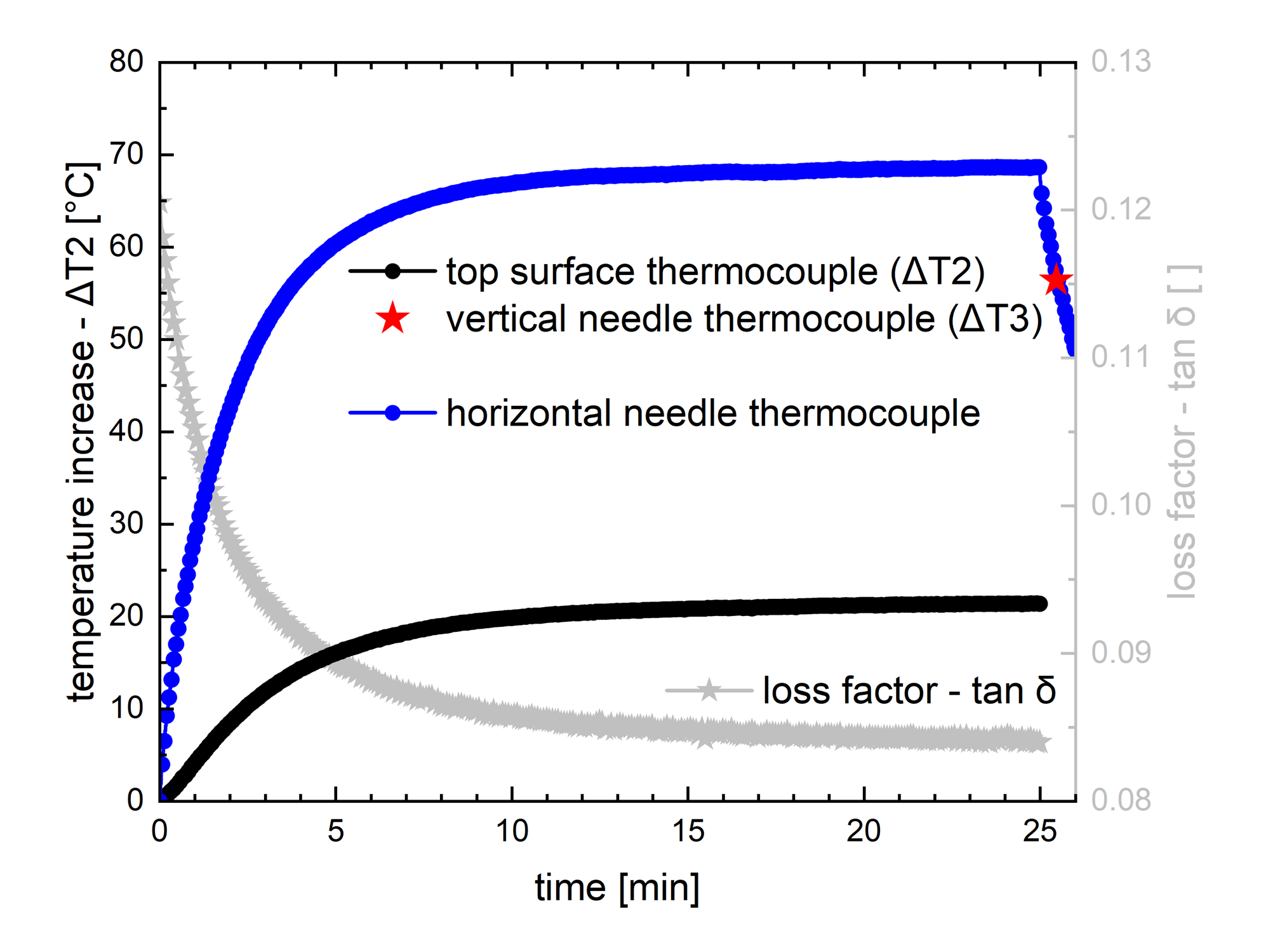
One of the major challenges in rubber testing is heat accumulation under cyclical loading. Elastomers have poor Thermal ConductivityThermal conductivity (λ with the unit W/(m•K)) describes the transport of energy – in the form of heat – through a body of mass as the result of a temperature gradient (see fig. 1). According to the second law of thermodynamics, heat always flows in the direction of the lower temperature.thermal conductivity. When subjected to high dynamic StressStress is defined as a level of force applied on a sample with a well-defined cross section. (Stress = force/area). Samples having a circular or rectangular cross section can be compressed or stretched. Elastic materials like rubber can be stretched up to 5 to 10 times their original length.stress, more heat is generated than can be dissipated, leading to internal temperature rises – a phenomenon known as Heat Build-Up (HBU).
Blow-Out tests go a step further: the sample is dynamically stressed until it fails. With High-Force DMA, it’s possible to measure not just temperature rises, but also the viscoelastic properties such as storage modulus, Viscous modulusThe complex modulus (viscous component), loss modulus, or G’’, is the “imaginary” part of the samples the overall complex modulus. This viscous component indicates the liquid like, or out of phase, response of the sample being measurement. loss modulus, and damping behavior (tan δ) – all in one test.
A practical example revealed that while a surface thermocouple measured only a 20°C temperature increase, the internal temperature – captured using a needle thermocouple – rose by up to 70°C. Such insights are crucial, as internal overheating can lead to cavity formation, crack growth, and ultimately, catastrophic failure.
The Payne EffectThe Payne effect is the decrease in the of a filled, crossed-linked elastomer system with increasing deformation amplitude.Payne Effect – When Rubber Softens with Movement
The Payne effect describes the decrease in stiffness (storage modulus) of filled elastomers under increasing dynamic StrainStrain describes a deformation of a material, which is loaded mechanically by an external force or stress. Rubber compounds show creep properties, if a static load is applied.strain. This effect becomes relevant when rubber components such as tires, windshield wipers, or VibrationA mechanic process of oscillation is called vibration. Vibration is a mechanical phenomenon whereby oscillations occur about an equilibrium point. In many cases, vibration is undesirable, wasting energy and creating unwanted sound. For example, the vibrational motions of engines, electric motors, or any mechanical device in operation are typically unwanted. Such vibrations could be caused by imbalances in the rotating parts, uneven friction, or the meshing of gear teeth. Careful designs usually minimize unwanted vibrations.vibration dampers are subjected to repeated deformation.
Using the NETZSCH DMA 503 Eplexor®, a load sweep test demonstrated how the storage modulus remained constant in the Linear Viscoelastic Region (LVER)In the LVER, applied stresses are insufficient to cause structural breakdown (yielding) of the structure and hence important micro-structural properties are being measured.linear viscoelastic region, then dropped significantly – by nearly two-thirds – once nonlinear behavior began. The loss factor (tan δ) rose initially, peaked when the internal filler networks were most damaged, before falling again.
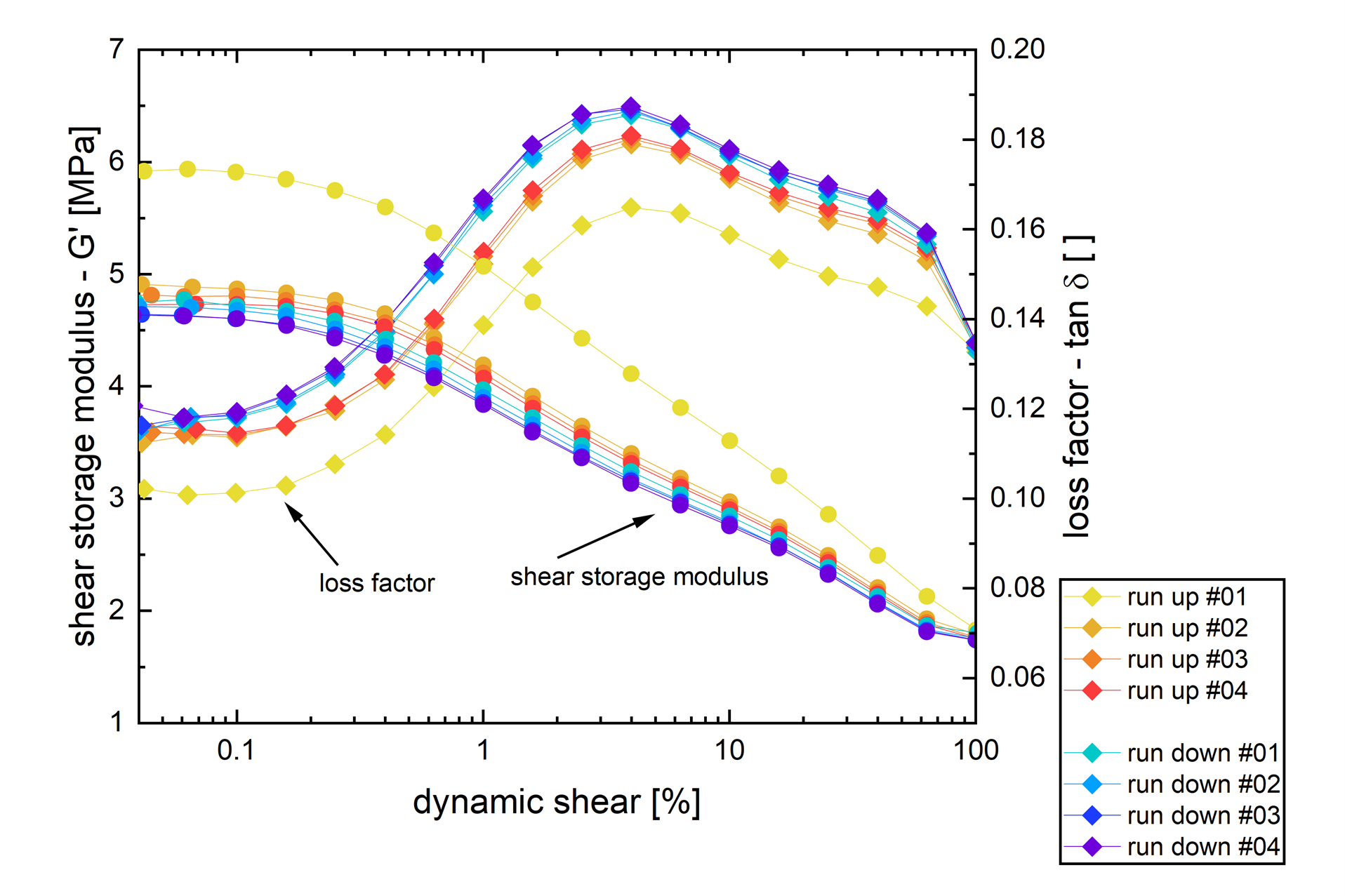
When the dynamic StrainStrain describes a deformation of a material, which is loaded mechanically by an external force or stress. Rubber compounds show creep properties, if a static load is applied.strain was reduced, the material did not return to its original state. Instead, it exhibited hysteresis: partial recovery, but not full restoration. This proves that the Payne effect is only partially reversible in the short term – full recovery requires longer rest periods as filler-filler bonds re-agglomerate.
Mullins EffectThe Mullins effect describes a phenomenon typical for rubber materials.Mullins Effect – Irreversible Softening
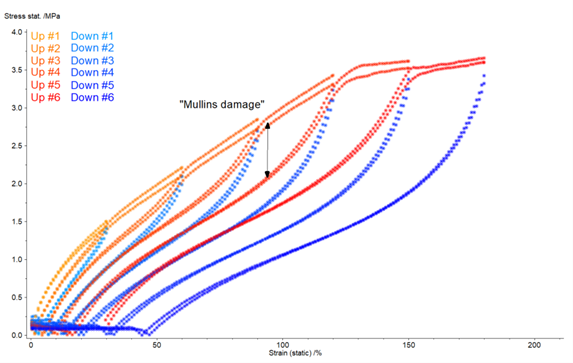
While the Payne effect is reversible over time, the Mullins effect describes permanent softening of a filled elastomer after repeated loading and unloading under quasi-static conditions.
This effect plays a critical role in applications such as:
- Tire break-in behavior
- Long-term seal performance of O-rings
- Changes in damping performance of VibrationA mechanic process of oscillation is called vibration. Vibration is a mechanical phenomenon whereby oscillations occur about an equilibrium point. In many cases, vibration is undesirable, wasting energy and creating unwanted sound. For example, the vibrational motions of engines, electric motors, or any mechanical device in operation are typically unwanted. Such vibrations could be caused by imbalances in the rotating parts, uneven friction, or the meshing of gear teeth. Careful designs usually minimize unwanted vibrations.vibration mounts
High-Force DMA testing shows that after an initial loading cycle, subsequent stress-strain curves follow softer paths. This indicates irreversible structural changes, including damage to polymer-filler bonds and rearrangement of polymer chains. The difference between original and subsequent stress-strain curves is known as Mullins damage – a key parameter for predictive modeling and material simulations.
Final Thoughts
Rubber is a highly versatile yet complex material. Its behavior under StressStress is defined as a level of force applied on a sample with a well-defined cross section. (Stress = force/area). Samples having a circular or rectangular cross section can be compressed or stretched. Elastic materials like rubber can be stretched up to 5 to 10 times their original length.stress involves a combination of mechanical, thermal, and microstructural effects – all interacting simultaneously. Understanding these requires advanced testing techniques.
High-Force DMA systems by NETZSCH Analyzing & Testing enable engineers and researchers to simulate real-world loading conditions and capture critical data about fatigue, heat build-up, damping performance, and microstructural changes.
As famed Formula 1 designer Adrian Newey once said:
“These bits of rubber that actually transmit grip to the tarmac are probably the least well understood – yet they’re the most crucial.”
At NETZSCH, we may not have all the answers, but we provide the tools that help take material testing – and understanding of rubber – one step further.
Interested in learning more about high-force DMA and testing solutions? Feel free to reach out!

Local Contact
Watch these webinars to learn more:



Share this article: