08.04.2026 by Aileen Sammler
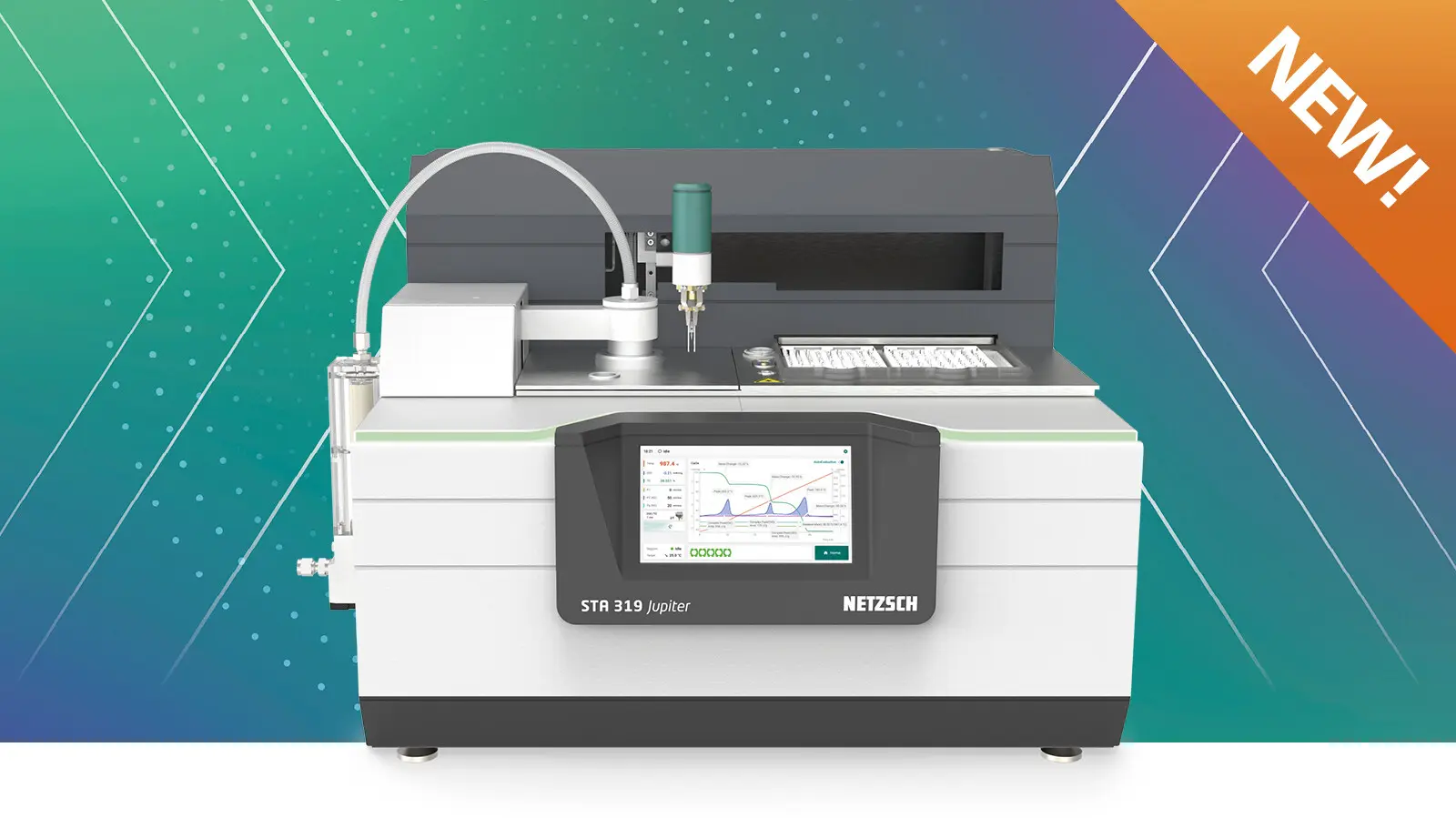
Brand-new: The NETZSCH STA 319 Jupiter® – The Cost Effective Solution for Reliable Simultaneous Thermal Analysis to 1100°C
The new NETZSCH STA 319 Jupiter® analysis instrument delivers reliable TGA and thermal‑effect signals, fast heating up to 300 K/min, water cooling and 1100°C performance at lower cost.
Looking for Simultaneous Thermal Analysis Without Unnecessary Complexity? Not Need to Look any Further!
When selecting a simultaneous thermal analyzer (STA), many laboratories automatically consider high‑temperature systems such as the STA 509 Jupiter® series. However, in everyday practice, high-temperature capability is not always required.
Instead, users frequently prioritize:
- Reliability
- High sample throughput
- Ease of use
- Lower total cost of ownership
The new NETZSCH STA 319 Jupiter® was developed specifically to meet these needs. It combines thermogravimetric analysis (TGA) and a simple thermal‑effect signal (DSC/DTA) in a cost‑efficient, robust, and easy‑to‑operate STA system, covering a temperature range from 10°C to 1100°C. At heating rates of up to 300 K/min, this new instrument enables exceptionally fast measurement cycles and significantly increases sample throughput.

Why the STA 319 Jupiter® Was Developed
For many routine and applied applications, such as polymers, organics, life sciences, and quality control, the full temperature range and modularity of high‑end STA systems are not necessary.
We received the following customer feedback:
- “We rarely measure above 1000°C.”
- “We need reliable results with minimal setup.”
- “Throughput matters more than maximum specifications.”
The STA 319 Jupiter®addresses exactly this gap: It delivers practical STA performance for many standard applications, without any unnecessary additional features.

New Ring‑Based TGA‑DSC Sensor: Designed for Stability and Reproducibility
A key innovation of the STA 319 Jupiter® is the new ring‑based TGA‑DSC sensor.
How It Works
Instead of using a second reference crucible, the system features a fixed reference ring integrated into the sensor design.
Key Benefits
- Only one crucible required → simpler handling
- Defined reference conditions for every measurement
- Robust design using Type‑S thermocouples, proven in higher‑end STA systems
The STA 319 Jupiter® delivers a quantifiable and reproducible thermal signal, that is well-suited for a wide range of routine STA applications.
This design choice supports ease of use, robustness, and long‑term stability – key points for a reliable thermal analysis system and proven NETZSCH quality.
Key Features of the NETZSCH STA 319 Jupiter® Analysis Instrument
Despite its focus on simplicity and affordability, the STA 319 Jupiter® delivers strong technical performance:
- Temperature range:10°C to 1100°C
- Robust ceramic furnace
- Heating rates up to 300 K/min
- Water cooling for fast cooling and high throughput
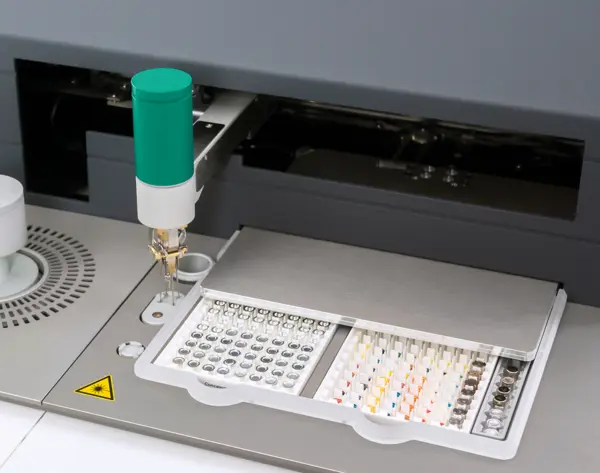
- 192‑position autosampler (ASC) for unattended operation
- Maximum sample weight: up to 2 g with dedicated sample carriers
- Excellent balance resolution and long‑term stability: 20-ng resolution
- Compatibility with evolved gas analysis systems (QMS, FT‑IR, GC‑MS)
- Optional integrated VibrationA mechanic process of oscillation is called vibration. Vibration is a mechanical phenomenon whereby oscillations occur about an equilibrium point. In many cases, vibration is undesirable, wasting energy and creating unwanted sound. For example, the vibrational motions of engines, electric motors, or any mechanical device in operation are typically unwanted. Such vibrations could be caused by imbalances in the rotating parts, uneven friction, or the meshing of gear teeth. Careful designs usually minimize unwanted vibrations.vibration damping system to eliminate environmental effects
- Powered by the Proteus® software with automated evaluation and peak analysis by means of AutoEvaluation, Identify and PeakSeparation functions
- We also offer Unlimited Warranty for this new instrument!
These features make the STA 319 Jupiter® a high‑throughput STA system optimized for routine and applied thermal analysis.
Who Is the STA 319 Jupiter® for?
The NETZSCH STA 319 Jupiter® analysis instrument is the right choice if:
- You primarily need a TGA, but you sometimes wish to have simple simultaneous thermal‑effect signals
- Your applications are mainly below 1100°C
- You value ease of use and automation
- You are looking for a lower‑cost alternative to high‑end STA systems without compromising on reliability, speed, or durability
If you need reliable simultaneous thermal analysis without the complexity and cost of a full high‑temperature STA, the NETZSCH STA 319 Jupiter® is the ideal solution.
Typical Applications
- Polymer characterization (melting, Decomposition reactionA decomposition reaction is a thermally induced reaction of a chemical compound forming solid and/or gaseous products. decomposition, additives)
- Organic and biomass materials
- Life sciences-related samples
- Inorganic materials below 1100°C
- Routine quality control and method development
Practical STA Performance Where It Matters Most
The STA 319 Jupiter® is not designed to maximize specifications. It is designed to maximize value.
By focusing on reliability, throughput, ease of use and cost efficiency, this completely new instrument offers a smart entry point into simultaneous thermal analysis for laboratories that want dependable results without unnecessary complexity.
Learn more
Become an Expert with our Free E-Learning Courses
All NETZSCH E-Learning Basic Courses are free of charge! The content is created by our laboratory method experts, who share their personal experiences with you. Take advantage of flexible online learning, fully adapted to your training needs!