02.06.2026 by Aileen Sammler
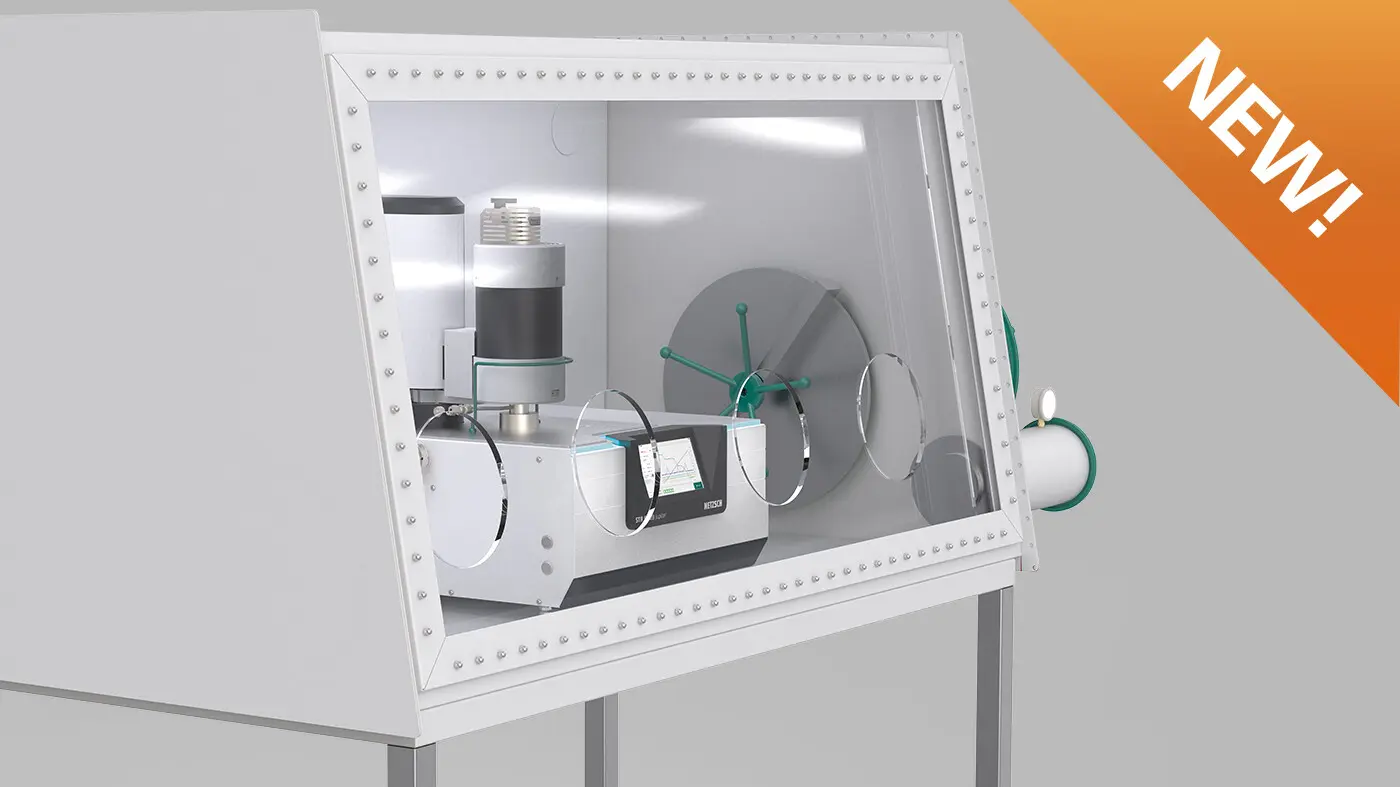
STA 509 Jupiter®-Glovebox and DSC 500 Pegasus®-Glovebox: Thermal Analysis Under Controlled Atmospheres
Sensitive, reactive or hazardous materials require a controlled environment for safe and reliable analysis. Here comes NETZSCH into play.
With the new glovebox versions of the STA 509 Jupiter® and DSC 500 Pegasus®, NETZSCH expands its portfolio for thermal analysis under specialized safety and atmosphere conditions.
These instruments are designed for applications where materials must not come into contact with ambient air or moisture, or where operator and environmental protection is essential.
Why Working in a Glovebox Matters
Many materials are highly sensitive to environmental conditions. Typical examples include:
- Hygroscopic salts
- Oxygen-sensitive compounds
- Reactive metal powders
- Battery materials
- Radioactive or toxic substances
For these materials, a controlled atmosphere is essential. That’s what a glovebox exactly provides.
A glovebox is a sealed enclosure that allows materials to be handled in a defined atmosphere, often filled with inert gases such as argon or nitrogen.
Two main types of glovebox systems are commonly used:
- Personnel Protection Systems
operate under negative pressure to prevent hazardous substances from escaping into the environment. - Material Protection Systems
operate under positive pressure to prevent air or moisture from entering the system.
Why Thermal Analysis Instruments Are Installed in a Glovebox
When sensitive materials are handled under ambient conditions, even very brief exposure to air can alter their properties.
For example, a hygroscopic salt can absorb measurable amounts of moisture within seconds. In one experiment, exposure to ambient conditions resulted in a mass change of approximately 0.2% relative to the initial sample mass.
Such changes can:
- distort measurement results
- alter material composition
- reduce reproducibility
Integrating a thermal analysis instrument directly into a glovebox eliminates these issues, enabling measurement, storage, and sample processing entirely within a controlled atmosphere.
👉 For more details, please read our new application note:
A Possible Reason to Place a TGA Inside the Glovebox - NETZSCH Analyzing & Testing

The New NETZSCH Glovebox Instruments
NETZSCH now offers dedicated solutions for thermal analysis in controlled environments.
Available instruments include:
- STA 509 Jupiter®-Glovebox (Select or Supreme models)
- DSC 500 Pegasus®-Glovebox
Glovebox versions are also available for:
This allows a wide range of thermal analysis methods to be performed under strictly controlled atmospheric conditions.
Separated Design for Optimal Glovebox Operation
A key feature of the glovebox instruments is their separated system design. The instrument consists of two components:
1) Measurement unit
- installed inside the glovebox
- optimized for handling with glovebox gloves
2) System electronics
- control system, display and user interface
- installed outside the glovebox
This configuration offers several advantages:
- reduced space requirements inside the glovebox
- improved accessibility
- Service can be performed more easily
- comfortable operation
Full Flexibility for Glovebox Applications
Just like the standard instruments, the glovebox versions support numerous configuration options.
These include:
- different furnace types
- furnace cooling
- coupling to evolved gas analysis
- operation with corrosive gases
- a wide range of crucibles and accessories
This flexibility allows users to tailor the system to their specific research or industrial applications.

Typical Applications for Glovebox Thermal Analysis
Glovebox versions of thermoanalytical instruments are widely used in fields such as:
- battery research
- energy storage
- nuclear technology
- metal powders and additive manufacturing
- highly reactive chemical systems
- hygroscopic materials
Combining controlled atmosphere handling with high-precision thermal analysis allows for reliable and reproducible results.
Request Your Individual Configuration
Are you working with oxygen- or moisture-sensitive materials, or do you require special safety conditions for your analysis?
Contact us to discuss your individual glovebox instrument configuration.

Local Contact
Become an Expert with our Free E-Learning Courses
All NETZSCH E-Learning Basic Courses are free of charge! The content is created by our laboratory method experts, who share their personal experiences with you. Take advantage of flexible online learning, fully adapted to your training needs!