Highlights
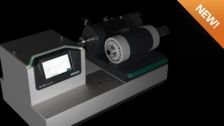
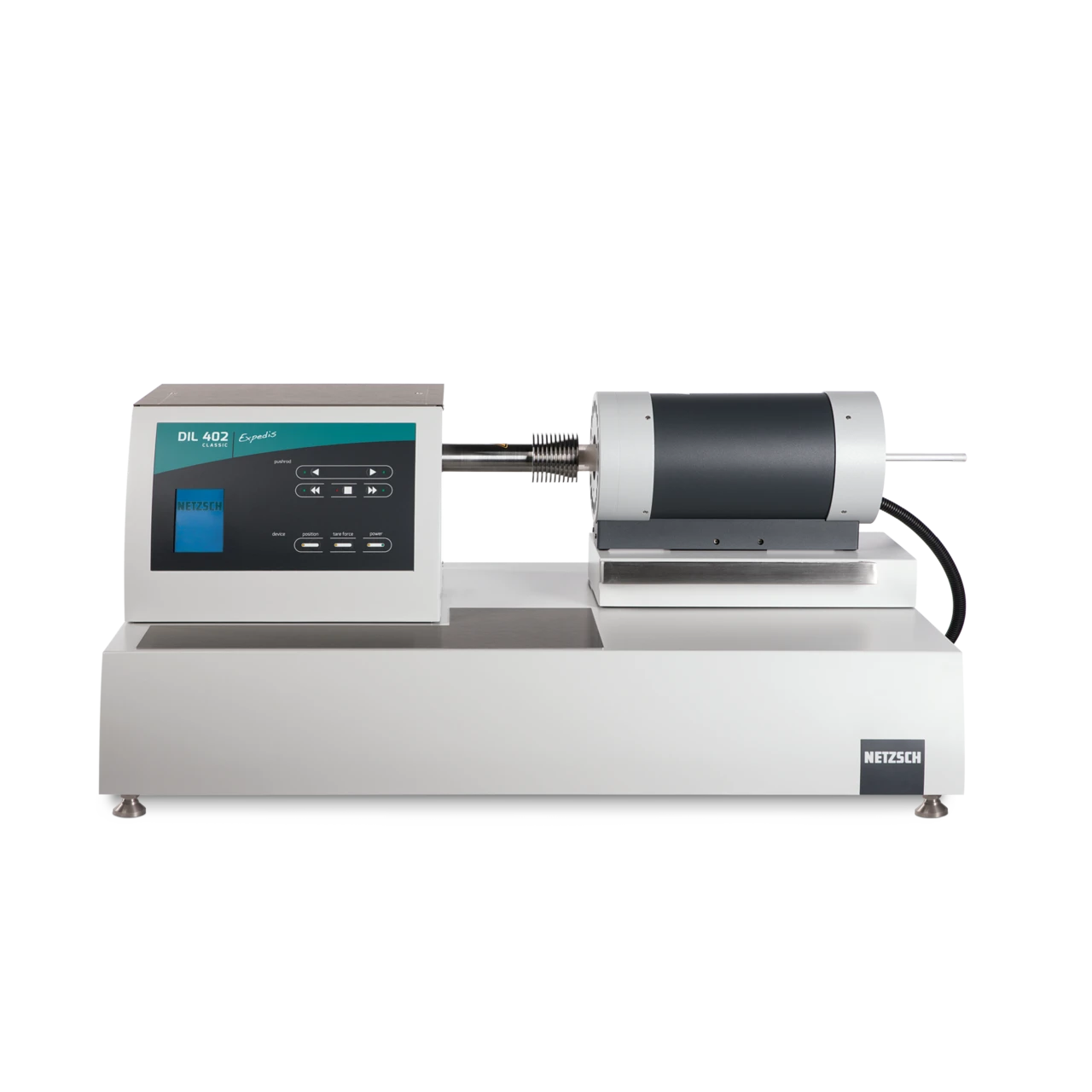
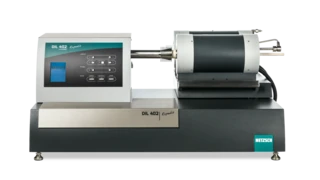
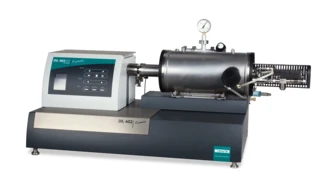
The dilatometer DIL 402 Expedis®Classic offers state-of-the-art dilatometer technology and is designed for sophisticated applications.
Easy to Use
by using method-bases test routines, predefined by the operator. With the MultiTouch function, the sample is placed into the optimum position using a unique tail-like motion.
Exchanging the furnace is quite simple - so the measurement can be started only with a few clicks.
All-in-One Design
incorporating all hardware componends for a precise dilatometers using. DIL Expedis® Classic is available as a single or dual system.
No inconveniend cable tangle nor an external chiller are needed.
Long Life Cycle
with a maintenance-free operation, low work load, simplified and safe operation. Our optimized system design includes effortless exchanging of the sample holder system.
Best Sample Conditions
by having a gas-tight design and superior insulation. The gases can be directed through the measuring cell and sample compartment.

NanoEye - A New Dimension in Measuring Range and Accuracy
A drive applies a controlled force and adjusts the push rod in line with the variable sample length.
The elastic force sensor records the contact force.
An optical encoder measures the initial length of the sample and the associated change in length.
The green components (see adjacent diagram) move backwards with the aid of a linear guide (blue marking) when a sample expands in length. The optical encoder measures the corresponding change in length directly on the scale.
Method
The Method for Determination of Dimensional Changes
Dilatometry is a measurement technique for quantitatively determining the thermal change in length or volume of a material as a function of temperature. It makes it possible to determine the linear or volumetric coefficient of thermal expansion, which is a measure of the expansion of a material when heated. This method is used in materials science, metallurgy, ceramics and polymer research to analyze the thermal properties of materials.

Specifications
| Furnaces |
|
|---|---|
| Sample dimensions | Sample length max.: 52 mm
|
Temperature accuracy / precision / resolution | 1 K / 0.1 K / 0.001 K |
| Force range (load at the sample) | 0.01 N … 3 N (valid for compressive and tensile force depending on the sample holder) |

Proven Excellence in Service
At NETZSCH Analyzing & Testing, we offer a comprehensive range of services globally to ensure the optimal performance and longevity of your thermoanalytical equipment. With a track record of proven excellence, our services are designed to maximize the effectiveness of your devices, extend their lifespan, and minimize downtime.
Unlock the full potential of your equipment with our tailored solutions, backed by years of industry expertise and innovation.
Software
Proteus® - Best Practice for Measurement and Evaluation
The unique Proteus® 7 dilatometer software offers everything a user could ever want and need: It runs smoothly, provides reliable results, and it is fast and efficient. It provides a large range of functions, but – at the same time – offers a clearly-arranged user interface. Additionally, it is intuitive and thus easy to learn. But ... that’s not all. There are some more options inside which impress even the most experienced operators – particularly the Density Determination, the patented c-DTA and the new, innovative Identify software features.
Density Determination
This program add-on allows determination of the density change of samples with varying consistency, i.e., solids, viscous materials such as pastes, liquids or melts as well as the volumetric expansion of isotropic materials.
c-DTA
The c-DTA signal gives the opportunity for simultaneous analysis of length changes and endothermal/exothermal effects. It can also be used for temperature calibration.
Identify
The unparalleled Identify, for the identification and interpretation of DIL measurements includes several NETZSCH libraries with hundreds of entries from the ceramic, inorganic, metal, alloy, and polymer or organic fields. Additionally, user-specific libraries can be created. They can be shared with other users within a computer network.
Identify allows the identification of unknown samples from the absolute values, the slope or the shape of a measured curve. This will also open up the opportunity to compare known samples against a variety of other samples, enabling one to make a statement about material quality. Finally, all measurements can be stored in the extensive database and are always available for identification or quality comparison.
E-Learning
Become an Expert with our Free E-Learning Courses
All NETZSCH E-Learning Basic Courses are free of charge! The content is created by our laboratory method experts, who share their personal experiences with you. Take advantage of flexible online learning, fully adapted to your training needs!
Related Devices

Consultancy & Sales
Do you have further questions about the instrument or the method and would like to speak to a sales representative?
Service & Support
Do you already have an instrument and need technical support or spare parts?