PFA: Perfluoroalkoxy

HTRTP

High-Temperature Resistant Thermoplastics

General Properties

Short Name: PFA

Name: Perfluoroalkoxy


Perfluoroalkoxy polymers (PFA in short) are entirely fluorinated plastics with a high-molecular structure. In contrast to PTFE, PFA has side chains of perfluorinated alkoxy groups.

Structural Formula

A modern contact us icon representing communication, ideal for websites focused on analytics and testing.

Properties

Glass Transition TemperatureThe glass transition is one of the most important properties of amorphous and semi-crystalline materials, e.g., inorganic glasses, amorphous metals, polymers, pharmaceuticals and food ingredients, etc., and describes the temperature region where the mechanical properties of the materials change from hard and brittle to more soft, deformable or rubbery.Glass Transition Temperature-
Melting Temperatures and EnthalpiesThe enthalpy of fusion of a substance, also known as latent heat, is a measure of the energy input, typically heat, which is necessary to convert a substance from solid to liquid state. The melting point of a substance is the temperature at which it changes state from solid (crystalline) to liquid (isotropic melt).Melting Temperature285 to 305°C
Melting Temperatures and EnthalpiesThe enthalpy of fusion of a substance, also known as latent heat, is a measure of the energy input, typically heat, which is necessary to convert a substance from solid to liquid state. The melting point of a substance is the temperature at which it changes state from solid (crystalline) to liquid (isotropic melt).Melting Enthalpy20 to 30 J/g
Decomposition reactionA decomposition reaction is a thermally induced reaction of a chemical compound forming solid and/or gaseous products. Decomposition Temperature353 to 550°C
Young's Modulus800 MPa
Coefficient of Linear Thermal Expansion (CLTE/CTE)The coefficient of linear thermal expansion (CLTE) describes the length change of a material as a function of the temperature.Coefficient of Linear Thermal Expansion120 *10-6/K
Specific Heat Capacity-
Thermal ConductivityThermal conductivity (λ with the unit W/(m•K)) describes the transport of energy – in the form of heat – through a body of mass as the result of a temperature gradient (see fig. 1). According to the second law of thermodynamics, heat always flows in the direction of the lower temperature.Thermal Conductivity-
DensityThe mass density is defined as the ratio between mass and volume. Density2.14 to 2.16 g/cm³
MorphologySemi-crystalline polymer
General propertiesLow friction value. High chemical resistance. Extremely low adhesion. Non-inflammability
ProcessingExtrusion, injection molding
ApplicationsHoses and fittings. Construction of chemical plants (corrosion-resistant lining). Nonstick coating, corrosion protection

NETZSCH Measurement

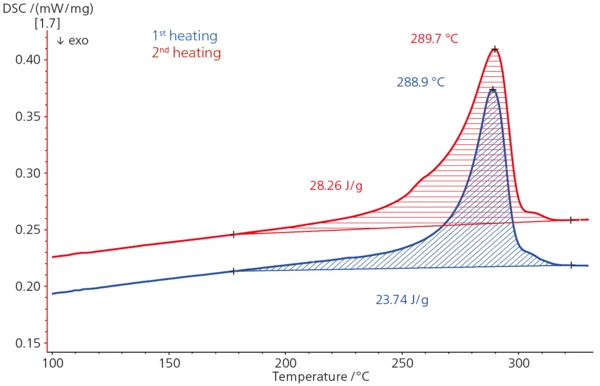
DSC analysis graph displaying heat flow (mW/mg) against temperature (°C) with notable peaks at 289.7°C and 288.9°C.
Sample Mass16.07 mg
Heating Rates10 K/min
CrucibleAl, pierced lid
AtmosphereN2 (40 ml/min)

Evaluation

Although PFA belongs to semi-crystalline materials, in the present example only the melting transition is evident in the DSC curve with peak temperatures of 289°C (1st heating, blue) and 290°C (2nd heating, red). The absence of a Glass Transition TemperatureThe glass transition is one of the most important properties of amorphous and semi-crystalline materials, e.g., inorganic glasses, amorphous metals, polymers, pharmaceuticals and food ingredients, etc., and describes the temperature region where the mechanical properties of the materials change from hard and brittle to more soft, deformable or rubbery.glass transition signal indicates that the change in specific heat Δcp associated with the transition from the hard, brittle into the flexible state, is too small to be detected by DSC.

AI Overview
An error occurred. Please try again.