General Properties
Short Name: PVF
Name: Polyvinylfluoride
Polyvinyl fluoride (PVF), just like PTFE, belongs to the semi-crystalline thermoplastic fluoroplastics. In structure, it is related to PVC, but polyvinyl fluoride features a higher chemical and physical stability than polyvinyl chloride since the bonding between fluorine and carbon is stronger than between chlorine and carbon.
Structural Formula

Properties
NETZSCH Measurement
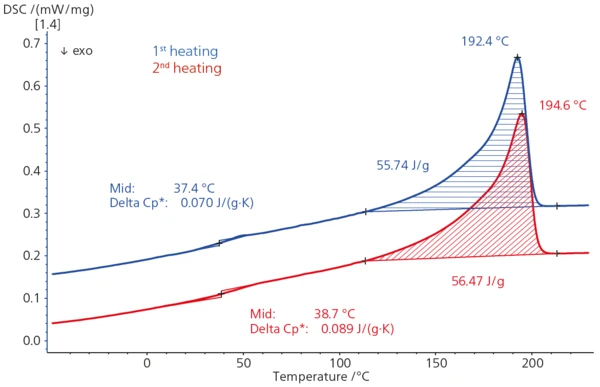
| Sample Mass | 8.79 mg |
| Heating Rates | 10 K/min |
| Crucible | Al, pierced lid |
| Atmosphere | N2 (40 ml/min) |
Evaluation
PVF is semi-crystalline and shows, along with a Glass Transition TemperatureThe glass transition is one of the most important properties of amorphous and semi-crystalline materials, e.g., inorganic glasses, amorphous metals, polymers, pharmaceuticals and food ingredients, etc., and describes the temperature region where the mechanical properties of the materials change from hard and brittle to more soft, deformable or rubbery.glass transition at approx. 39°C in the 2nd heating (red, midpoint), a melting transition with a peak temperature of 195°C (2nd heating). The melting enthalpy of approx. 56 J/g was similar in the two heatings. The Glass Transition TemperatureThe glass transition is one of the most important properties of amorphous and semi-crystalline materials, e.g., inorganic glasses, amorphous metals, polymers, pharmaceuticals and food ingredients, etc., and describes the temperature region where the mechanical properties of the materials change from hard and brittle to more soft, deformable or rubbery.glass transition steps with 0.07 J/(g*K) (1st heating, blue) and 0.09 J/(g*K) (2nd heating, red) are very small.