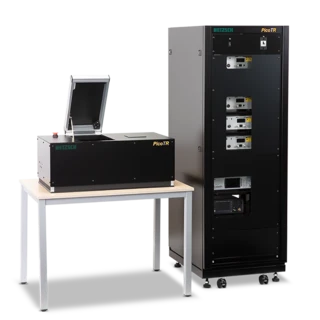
NanoTR
Time DomainA time domain analysis is based on changes in physical signals related to time. A time-domain graph shows how a signal changes over time. In the case of thermoreflectance or the laser flash method, the detector signal (voltage change) is recorded – at a minimum – over the time range between the energy input and the signal maximum (e.g., RF mode) or as a function of the expected heat diffusion time (e.g., FF mode).Time Domain ThermoreflectanceThermoreflectance is a method for determining the thermal diffusivity and thermal conductivity of thin films with thicknesses in the nanometer range.Thermoreflectance by Pulsed Light Heating
Highlights
The Method for the Determination of Thermal DiffusivityThermal diffusivity (a with the unit mm2/s) is a material-specific property for characterizing unsteady heat conduction. This value describes how quickly a material reacts to a change in temperature.Thermal Diffusivity in the Thickness Range of Nanometer
Time DomainA time domain analysis is based on changes in physical signals related to time. A time-domain graph shows how a signal changes over time. In the case of thermoreflectance or the laser flash method, the detector signal (voltage change) is recorded – at a minimum – over the time range between the energy input and the signal maximum (e.g., RF mode) or as a function of the expected heat diffusion time (e.g., FF mode).Time Domain ThermoreflectanceThermoreflectance is a method for determining the thermal diffusivity and thermal conductivity of thin films with thicknesses in the nanometer range.Thermoreflectance Methods
The Method for the Determination of Thermal DiffusivityThermal diffusivity (a with the unit mm2/s) is a material-specific property for characterizing unsteady heat conduction. This value describes how quickly a material reacts to a change in temperature.Thermal Diffusivity in the Thickness Range of Nanometer
With the significant progress in the design of electronic devices and the associated need for an efficient thermal management, accurate Thermal DiffusivityThermal diffusivity (a with the unit mm2/s) is a material-specific property for characterizing unsteady heat conduction. This value describes how quickly a material reacts to a change in temperature.thermal diffusivity / Thermal ConductivityThermal conductivity (λ with the unit W/(m•K)) describes the transport of energy – in the form of heat – through a body of mass as the result of a temperature gradient (see fig. 1). According to the second law of thermodynamics, heat always flows in the direction of the lower temperature.thermal conductivity measurements in the nanometer range are more than ever crucial.
The National Institute of Advanced Industrial Science and Technology (AIST), Japan, already responded to industrial requirements with the development of a “pulsed light heating ThermoreflectanceThermoreflectance is a method for determining the thermal diffusivity and thermal conductivity of thin films with thicknesses in the nanometer range.thermoreflectance method” in the early 90’s. PicoTherm Corporation was established in 2008 with the launch of a nano-second ThermoreflectanceThermoreflectance is a method for determining the thermal diffusivity and thermal conductivity of thin films with thicknesses in the nanometer range.thermoreflectance apparatus “NanoTR” and a pico-second ThermoreflectanceThermoreflectance is a method for determining the thermal diffusivity and thermal conductivity of thin films with thicknesses in the nanometer range.thermoreflectance apparatus “PicoTR”, which allows for absolute measurements of the Thermal DiffusivityThermal diffusivity (a with the unit mm2/s) is a material-specific property for characterizing unsteady heat conduction. This value describes how quickly a material reacts to a change in temperature.thermal diffusivity of thin films in a thickness range of several 10 μm down into the nanometer range.
In October 2020, PicoTherm joined the NETZSCH Group as a subsidiary of NETZSCH Japan. In combination with our LFA systems, NETZSCH can now offer the solution for thin films in the nanometer range up to bulk materials in the range of mm.
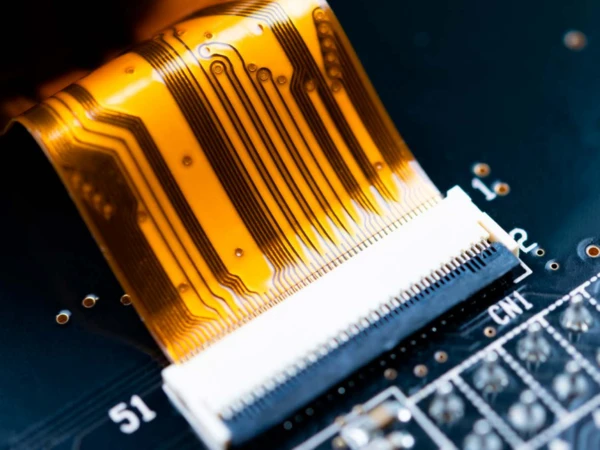
With the significant progress in the design of electronic devices and the associated need for an efficient thermal management, accurate Thermal DiffusivityThermal diffusivity (a with the unit mm2/s) is a material-specific property for characterizing unsteady heat conduction. This value describes how quickly a material reacts to a change in temperature.thermal diffusivity / Thermal ConductivityThermal conductivity (λ with the unit W/(m•K)) describes the transport of energy – in the form of heat – through a body of mass as the result of a temperature gradient (see fig. 1). According to the second law of thermodynamics, heat always flows in the direction of the lower temperature.thermal conductivity measurements in the nanometer range are more than ever crucial.
The National Institute of Advanced Industrial Science and Technology (AIST), Japan, already responded to industrial requirements with the development of a “pulsed light heating ThermoreflectanceThermoreflectance is a method for determining the thermal diffusivity and thermal conductivity of thin films with thicknesses in the nanometer range.thermoreflectance method” in the early 90’s. PicoTherm Corporation was established in 2008 with the launch of a nano-second ThermoreflectanceThermoreflectance is a method for determining the thermal diffusivity and thermal conductivity of thin films with thicknesses in the nanometer range.thermoreflectance apparatus “NanoTR” and a pico-second ThermoreflectanceThermoreflectance is a method for determining the thermal diffusivity and thermal conductivity of thin films with thicknesses in the nanometer range.thermoreflectance apparatus “PicoTR”, which allows for absolute measurements of the Thermal DiffusivityThermal diffusivity (a with the unit mm2/s) is a material-specific property for characterizing unsteady heat conduction. This value describes how quickly a material reacts to a change in temperature.thermal diffusivity of thin films in a thickness range of several 10 μm down into the nanometer range.
Method
Time DomainA time domain analysis is based on changes in physical signals related to time. A time-domain graph shows how a signal changes over time. In the case of thermoreflectance or the laser flash method, the detector signal (voltage change) is recorded – at a minimum – over the time range between the energy input and the signal maximum (e.g., RF mode) or as a function of the expected heat diffusion time (e.g., FF mode).Time Domain ThermoreflectanceThermoreflectance is a method for determining the thermal diffusivity and thermal conductivity of thin films with thicknesses in the nanometer range.Thermoreflectance Methods – The Laser Flash method for thin films
NanoTR’s state-of-the-art signal processing technology allows high speed measurements. With this ThermoreflectanceThermoreflectance is a method for determining the thermal diffusivity and thermal conductivity of thin films with thicknesses in the nanometer range.thermoreflectance apparatus, a laser pulse of 1 ns pulse width is periodically (20 μs) irradiated to the sample.
The resulting temperature response is applied to a CW laser (probe laser). Excellent s/n ratio can be attained by high speed integration of repetitive signals. It can be easily switched between the RF and FF configurations though the software for a wide variety of samples.
NanoTR is in accordance with JIS R 1689, JIS R 1690, and SI traceable by the thin film standard of heat diffusion time (RM1301-a), supplied from AIST.

Thermoreflectance Methods
Ultrafast Laser Flash Method – Rear Heating/Front Detection (RF)
Determination of Thermal DiffusivityThermal diffusivity (a with the unit mm2/s) is a material-specific property for characterizing unsteady heat conduction. This value describes how quickly a material reacts to a change in temperature.Thermal Diffusivity and Interfacial Thermal Resistance
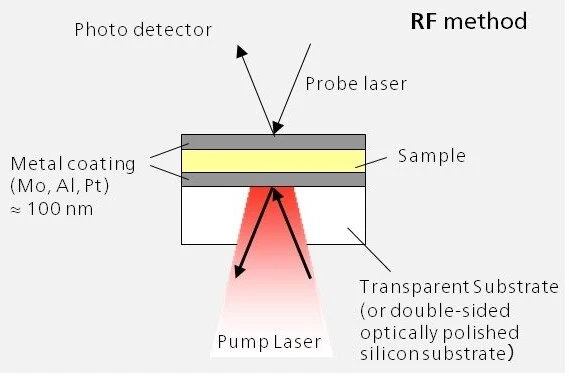
The fact that the thermophysical properties of thin layers and films differ considerably from those of the corresponding bulk material requires a technique which overcomes the limitations of the classical laser flash method (LFA). This so-called ultrafast laser flash technique is also known as the rear heating/front detection method.
The measurement setup is similar to the conventional LFA: detector and laser are on opposite sides of the sample which is located on a transparent substrate. The measured thermal diffusivity is the component through the thickness perpendicular to the sample’s surface. The pump laser irradiates the sample’s rear side.
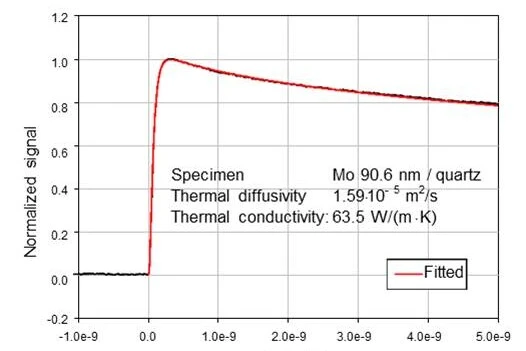
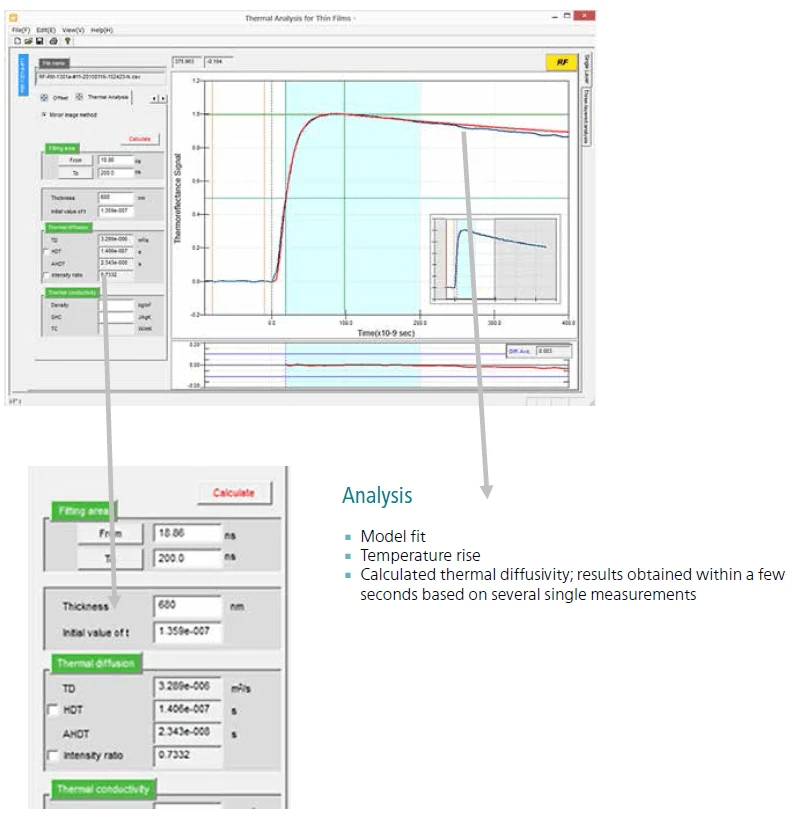
As the sample heats up, its surface ThermoreflectanceThermoreflectance is a method for determining the thermal diffusivity and thermal conductivity of thin films with thicknesses in the nanometer range.thermoreflectance varies. The thermal diffusivity is calculated from the temperature rise (lower plot). Here, the thermal diffusivity of a thin metal film (Mo) was determined to 1.59 • 10-5 m2/s.
Time DomainA time domain analysis is based on changes in physical signals related to time. A time-domain graph shows how a signal changes over time. In the case of thermoreflectance or the laser flash method, the detector signal (voltage change) is recorded – at a minimum – over the time range between the energy input and the signal maximum (e.g., RF mode) or as a function of the expected heat diffusion time (e.g., FF mode).Time Domain ThermoreflectanceThermoreflectance is a method for determining the thermal diffusivity and thermal conductivity of thin films with thicknesses in the nanometer range.Thermoreflectance - Front Heating/Front Detection (FF)
Determination of Thermal DiffusivityThermal diffusivity (a with the unit mm2/s) is a material-specific property for characterizing unsteady heat conduction. This value describes how quickly a material reacts to a change in temperature.Thermal Diffusivity and Thermal Effusivity
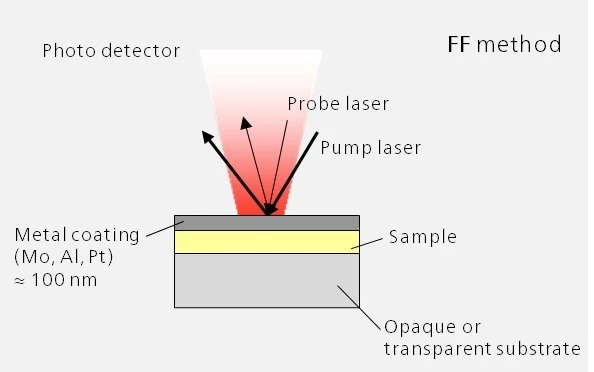
In addition to the RF method, measurements can also be made in a front heating/front detection (FF) configuration. The term “front” refers to the open surface of the thin film deposited on a substrate, while “rear” refers to the boundary between the thin film and the substrate.
In the FF measurement setup (upper picture), the detector and laser are on the same side of the sample. An area of the front face of the thin film with a diameter of several tens of micrometers is heated by a pump laser, and a probe laser points at the same position. The change in the surface temperature is observed.
This method can be applied to thin layers on non-transparent substrates for which the RF technique is not suitable.
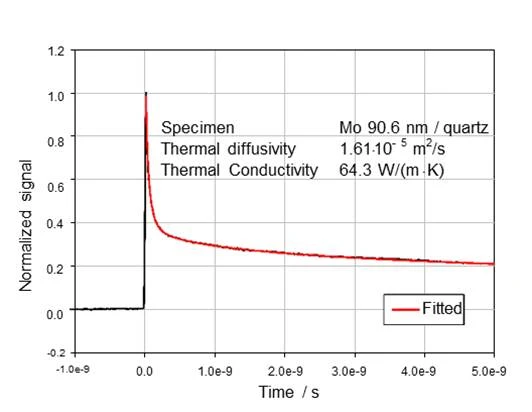
In the example on the left, the thermal diffusivity of a thin metal film (Mo) was determined to 1.61 • 10-5 m2/s by applying the FF method. The results prove the high agreement between RF and FF modes (deviation < 2%).
NanoTR is in accordance with JIS R 1689, JIS R 1690, and SI traceable by the thin film standard of heat diffusion time (RM1301-a), supplied from AIST.
- JIS R 1689 “Determination of thermal diffusivity of fine ceramic films by pulsed light heating ThermoreflectanceThermoreflectance is a method for determining the thermal diffusivity and thermal conductivity of thin films with thicknesses in the nanometer range.thermoreflectance method”
- JIS R 1690 “Determination of interfacial thermal resistance between fine ceramic film and metal film”
“Light Pulse Heating Thermoreflectance Methods for Thermophysical Property Measurements of Thin Films”
Tetsuya BABA
“Development of thin film reference material for thermal diffusivity”
Takashi YAGI, Naoyuki TAKETOSHI, Tetsuya BABA
“Direct observation of thermal energy transfer across the thin metal film on silicon substrates by a rear heating front detection thermoreflectance technique ”
Shakhawat H. FIROZ, Takashi YAGI, Naoyuki TAKETOSHI, Kazuko ISHIKAWA, Tetsuya BABA
“Thermal diffusivity measurement in a diamond anvil cell using a light pulse thermoreflectance technique”
Takashi YAGI, Tetsuya BABA, et al.
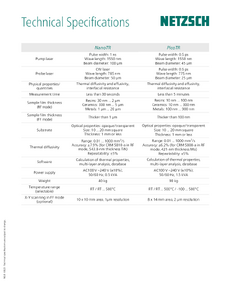
Specifications
| NanoTR | ||
|---|---|---|
| Pump Laser | Pulse width Wave length Beam diameter | 1 ns 1550 nm 100 μm |
| Probe Laser | Pulse width Wave length Beam diameter | continuous 785 nm 50 μm |
| Measurement items | Thermal DiffusivityThermal diffusivity (a with the unit mm2/s) is a material-specific property for characterizing unsteady heat conduction. This value describes how quickly a material reacts to a change in temperature.Thermal diffusivity and effusivity, interfacial resistance | |
| Sample Film Thickness (RF method) | Resin Ceramics Metal | 30 nm ... 2 μm 300 nm ... 5 μm 1 μm ... 20 μm |
| Sample Film Thickness (FF method) | Thicker than 1 μm | |
| Substrate | Material Size Thickness | Opaque/Transparent 10 ... 20 mm square 1 mm max. |
| Thermal DiffusivityThermal diffusivity (a with the unit mm2/s) is a material-specific property for characterizing unsteady heat conduction. This value describes how quickly a material reacts to a change in temperature.Thermal diffusivity | Range | 0.01 ... 1000 mm²/s |
| Accuracy | ± 6.2% with 40 min measurement time, for CRM 5808A in RF Mode, 400 nm thickness | |
| Repeatability | ± 5% | |
| Software | Calculation of thermal properties, multilayer analysis, database |
Software
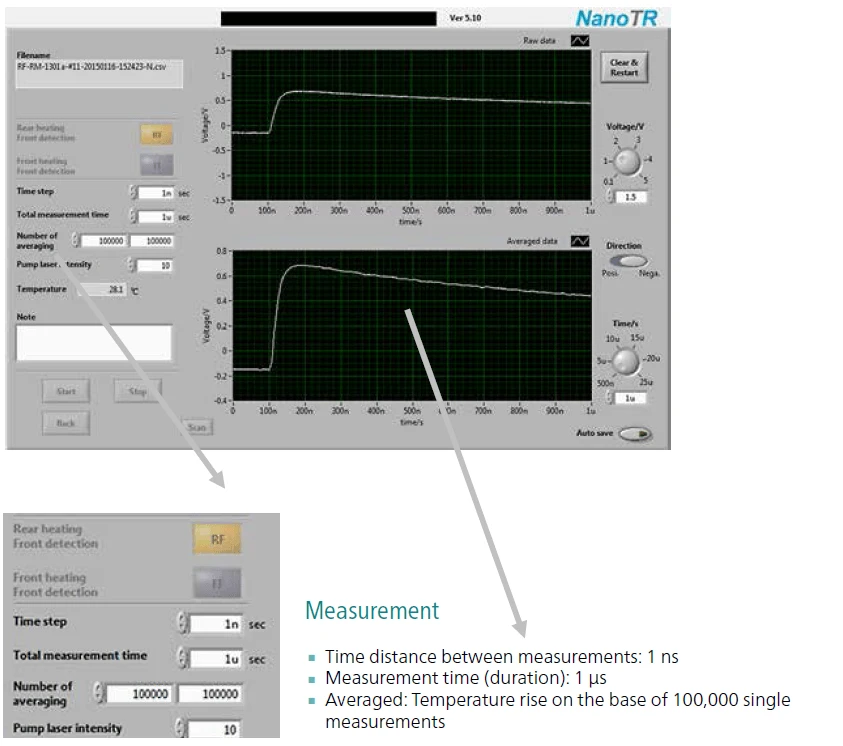
In-situ display and analyzing 100,000 shots
The state-of-the-art measurement/analysis software of NanoTR/PicoTR has an easy-to-handle user interface which allows for a precise determination of the thermal properties of thin films. The laser beam focusing can be adjusted by the software and CCD picture can be obtained.
NanoTR/PicoTR software runs under Microsoft Windows.
The plot shows that in 1 μs measurement time one measurement curve can be obtained.
Obtaining results in minutes
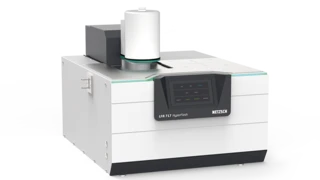
Related Devices