Introduction
The Japanese National Institute of Advanced Industrial Science and Technology (AIST) has developed a measurement technique called "pulsed light heating ThermoreflectanceThermoreflectance ist eine Methode zur Bestimmung der Temperaturleitfähigkeit und Wärmeleitfähigkeit von Proben mit Dicken im Nano- und Mikrometer-Bereich.thermoreflectance method", which is a faster version of the laser flash method, and has thus succeeded in measuring the thermophysical properties of thin films ahead of other companies in the world.
The pulsed light heating ThermoreflectanceThermoreflectance ist eine Methode zur Bestimmung der Temperaturleitfähigkeit und Wärmeleitfähigkeit von Proben mit Dicken im Nano- und Mikrometer-Bereich.thermoreflectance method, one of the Time Domain ThermoreflectanceThermoreflectance ist eine Methode zur Bestimmung der Temperaturleitfähigkeit und Wärmeleitfähigkeit von Proben mit Dicken im Nano- und Mikrometer-Bereich.Thermoreflectance (TDTR) methods, is a technique in which a thin film formed on a substrate is instantaneously heated by irradiating it with a picosecond or nanosecond pulsed laser, and the high-speed temperature change due to thermal diffusion after heating is measured by the reflected intensity change of laser light for temperature measurement.
The unique feature of the TDTR developed by AIST is its broad observation time range of up to 50 ns via a unique electrical delay system, whereas most TDTR systems use an optical delay system capable of observing phenomena for only up to 10 ns; this obligates the user to carry out a very difficult optical adjustment every time.
Rear Heating/Front Heating Versus Front Heating/Front Detection
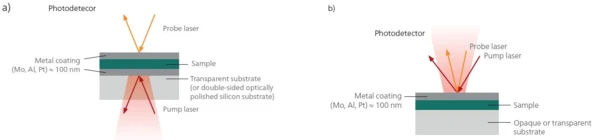
There are two types of this method: An arrangement in which the sample is heated from the transparent substrate side (in the case of infrared light, Si is also a transparent substrate) and the temperature rise of the sample surface is measured (Rear heating / Front detection (RF) mode, figure 1a), and an arrangement in which the sample surface is heated and the temperature rise of the same location on the sample surface is measured (Front heating / Front detection (FF) mode, fig. 1b).
In principle, the RF mode is identical to the laser flash method, which is the standard thermal diffusivity measurement method for bulk materials, and features excellent quantitative reliability. Contrary to the RF mode, the FF mode can measure thin films on opaque substrates and is important as a practical measurement technique.
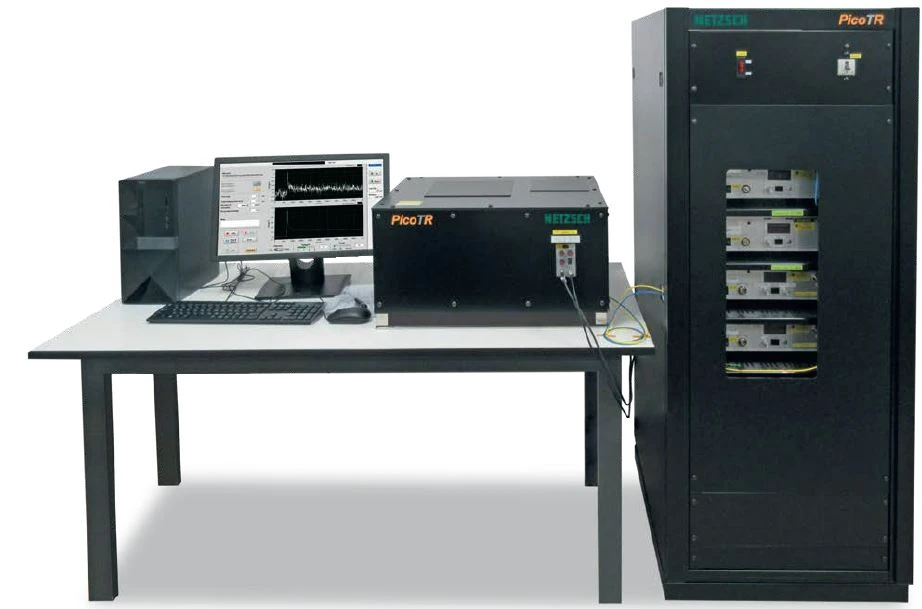
In this example, a diamond film of 4 μm thickness was measured by means of PicoTR (figure 2) based on the principle of TDTR.
The diamond film features unparalleled high thermal conductivity, which is promising for implementation in high-current density power devices such as heat spreaders.
The sample was fabricated on an alkali-free glass with a thickness of 1 mm. A 100-nm thick Mo film was sputtered onto the diamond surface.
The key point of this measurement was to determine whether the surface was smooth or not. If the surface is rough, the probe laser scatters and the reflected light cannot be detected. As shown in figure 3, although the surface of the diamond film is a little rough, it was possible to achieve a good S/N thermal reflectance signal.

Measurement Results
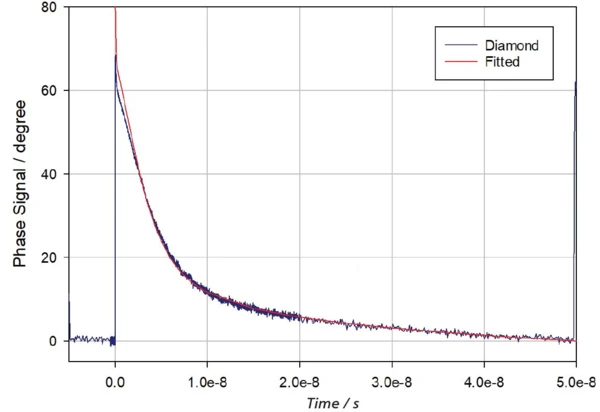
The measurement was performed in the FF mode and analyzed with the PicoTR Thermal Simulator software (table 1). From the three-layer analysis, the thermal conductivity of the diamond layer was calculated to be 90 W/(m·K), and the interface thermal resistance be-tween the Mo and diamond layers was determined to be 6.0x10⁻⁹ m2·K/W.
The heat diffusion time of the diamond film can be estimated to be 200 ns by the equation of:
Heat of diffusion time = (thickness)2/(thermal diffusivity)
which represents the cooling time of this layer.
Table 1: Analysis results
Sample name | Mo/Diamond Interfacial thermal resistance Rm-f m²·K/W | Diamond Thermal effusivity bf J/(m²·s0.5·K) | Diamond Thermal conductivity λf W/(m·K) | Diamond/Glass Interfacial thermal resistance Rf-s m²·K/W |
|---|---|---|---|---|
Diamond | 6.0 x 10⁻⁹ | 21700 | 190 | 1.0 x 10⁻⁹ |
Conclusion
The thermal conductivity of a diamond film of 4 μm thickness on a glass substrate was measured by means of PicoTR.
As can be seen in figure 4, the obtained thermal conductivity is 1/10 of the literature value for bulk material of diamond. This is to be expected because of the phonon scattering between the grain boundaries of diamond or imperfect structure. This example shows the importance of thin film measurement for the accurate thermal design of electric devices.
Due to the high thermal conductivity of diamond, this sample can only be measured in the FF mode of the PicoTR.
When measuring diamond films with the NanoTR, coating both sides of the diamond layer with molybdenum makes it possible to use the RF method.