Introduction
Polyvinyl chloride (PVC) is used in numerous applications where increased fire safety requirements apply, such as electrical cables, building products and engineering plastic components. Due to its high chlorine content, PVC exhibits relatively good intrinsic flame retardancy along with distinct residue formation during thermal Decomposition reactionA decomposition reaction is a thermally induced reaction of a chemical compound forming solid and/or gaseous products. decomposition compared to many other thermoplastics.
However, smoke generation poses a particular safety challenge in the event of a fire. Dense smoke can significantly impair visibility and complicate evacuation efforts.
Furthermore, the gaseous and particulate Decomposition reactionA decomposition reaction is a thermally induced reaction of a chemical compound forming solid and/or gaseous products. decomposition products contained in the smoke can pose health risks to people and emergency personnel.
To specifically reduce smoke production, the composition of PVC materials is often carefully adjusted.
Cone calorimetry in accordance with ISO 5660-1 is one of the established methods for quantitatively evaluating the fire behavior of materials. Considered one of the most meaningful laboratory methods for the experimental analysis of fire processes, it provides reproducible parameters for ignition behaviour, heat release, smoke generation and mass loss under defined heat-flow conditions.
This Application Note presents the test results for four PVC-based materials. One sample serves as a reference, while variants A, B and C represent modified formulations designed to reduce smoke generation. The study aims to compare the fire and smoke behavior of these materials under identical test conditions using cone calorimetry.
Measurement Conditions
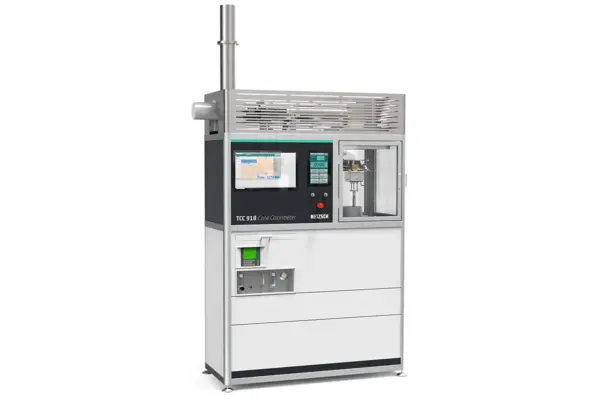
The tests were conducted using the NETZSCH TCC 918 Cone Calorimeter (see Figure 1) in accordance with ISO 5660-1. This is a well-established testing device for carrying out experimental analyses of fire behavior under defined heat-flow conditions.
The specimens were positioned horizontally and subjected to a constant heat-flow DensityThe mass density is defined as the ratio between mass and volume. density of 50 kW/m². During the measurement, the heat release rate (HRR)1, mass loss and parameters describing smoke generation, particularly the smoke production rate (SPR) and total smoke release (TSR), were continuously recorded.
The key test parameters are summarised in Table 1.
1The heat release rate is a measure of a fire‘s intensity and the rate at which heat is released (kW/m²).
Table 1: Measurement conditions
| Sample holder | Horizontal |
| Heat flow | 50 kW/m2 |
| Nominal heat-flow rate | 24.0 l/s |
| Distance to the cone heater | 25 mm |
| Sample mass | 42.8 g - 51.5 g |
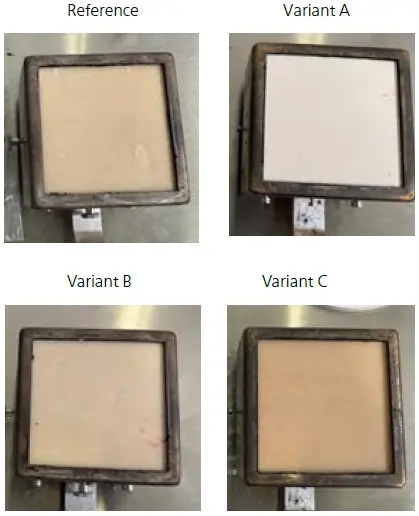
Figure 2 shows the specimens in the specimen holder prior to the measurement.
Ignition Behavior and Heat Release
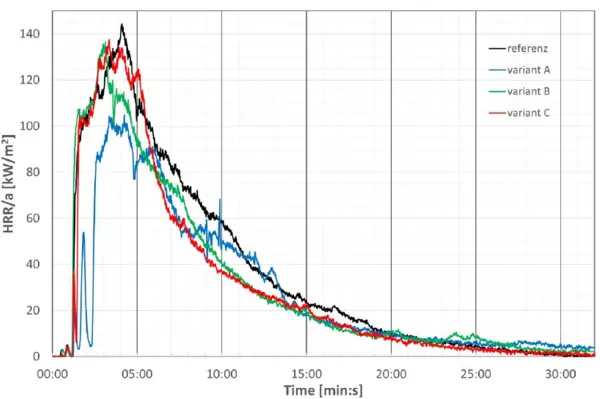
All of the tested materials ignited within a time range of approximately 16 to 20 seconds. This ignition behavior is typical of PVC systems subjected to an external heat-flow DensityThe mass density is defined as the ratio between mass and volume. density of 50 kW/m².
Overall, the heat release rates remain at a moderate level (figure 3). The main differences are evident in the maximum heat release rate (HRRmax). The reference material exhibits the highest HRRmax, while variant A has the lowest.
Overall, however, the differences are limited, meaning the basic combustion behavior of the examined PVC systems can be considered comparable. This suggests that material modifications primarily influence smoke behavior, while basic combustion processes remain largely unchanged.
Smoke Production as a Key Differentiating Parameter
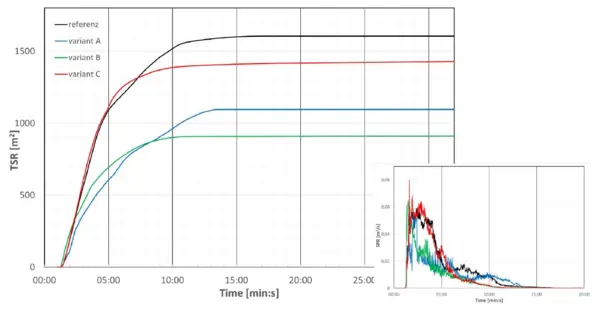
Figure 4 shows that the most pronounced differences between the materials tested are evident in smoke production.
The reference material (black curve) exhibits the highest total smoke release (TSR2), while variant (green curve), in particular, shows significantly lower smoke emission. Compared to the reference material, the total smoke release is reduced by up to approximately 43%.
Reduced smoke release can improve visibility in the event of a fire, facilitating evacuation and emergency response efforts. In real-world fire scenarios, lower smoke production can help maintain critical visibility conditions for longer, thus expanding the available evacuation time.
In addition to the total smoke release, the smoke production rate (SPR) indicates how quickly smoke is released during the development of a fire. This parameter is relevant to safety as it influences how quickly critical visibility conditions can arise in the event of a fire.
Despite comparable ignition times and similar heat release rates, the materials differ significantly in their smoke behavior. The results demonstrate that targeted material modifications can significantly reduce smoke release without substantially altering the fundamental combustion behavior of PVC systems.
2TSR (total smoke release) refers to the cumulative amount of smoke produced during combustion and is derived from measurements of laser light transmittance, evaluated based on light attenuation according to Bouguer-Lambert’s law.
Mass Loss
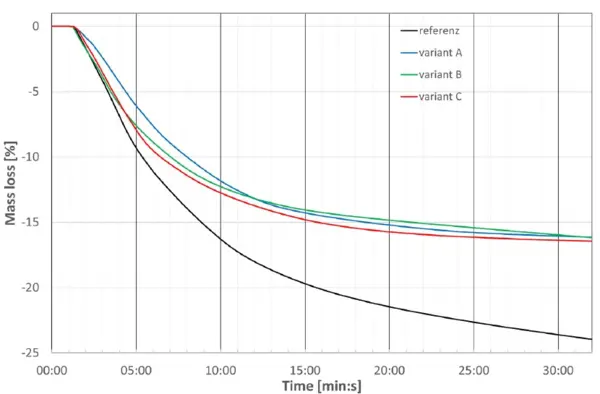
The relative mass loss describes the thermal degradation of materials during exposure to fire and enables conclusions to be drawn about their Decomposition reactionA decomposition reaction is a thermally induced reaction of a chemical compound forming solid and/or gaseous products. decomposition behavior.
The reference material exhibits the highest relative mass loss, at 23.95%. In contrast, variants A through C show very similar values of approximately 16.45% (figure 5).
The time-dependent courese of the mass loss curves is generally comparable, suggesting that the materials undergo thermal Decomposition reactionA decomposition reaction is a thermally induced reaction of a chemical compound forming solid and/or gaseous products. decomposition in a similar manner. However, the lower mass loss of the modified variants indicates greater residue formation during combustion.
Increased residue formation can reduce the amount of volatile PyrolysisPyrolysis is the thermal decomposition of organic compounds in an inert atmosphere.pyrolysis products and thus influence smoke generation. Pronounced residue formation is characteristic of PVC systems and is often associated with inorganic components, as well as charring processes, during fire exposure.
Condition of the Samples after the Measurement
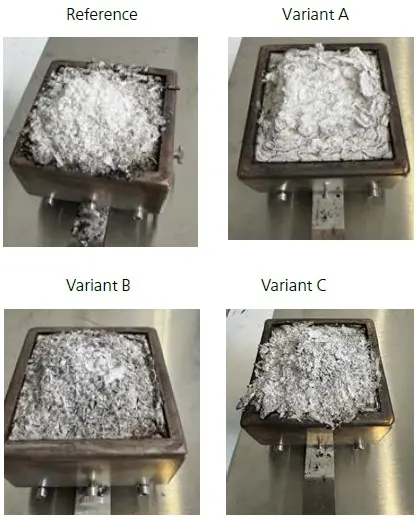
Upon completion of the measurements, the samples showed clear differences in the structure and stability of the remaining residues (see figure 6). While all materials exhibited characteristic charring, the extent and surface structure of the residues differed between the reference material and the modified variants.
These differences reflect the previously observed variations in material degradation and smoke emission. Notably, the modified variants sometimes exhibit more compact residue structures, potentially indicating altered thermal Decomposition reactionA decomposition reaction is a thermally induced reaction of a chemical compound forming solid and/or gaseous products. decomposition and greater stabilization of the remaining material during fire exposure. These observations are consistent with the previously discussed differences in mass loss and smoke release.
Summary
Cone calorimetry revealed significant differences in the smoke behavior of the investigated PVC materials, while ignition behavior and heat release rates remained largely comparable under identical test conditions. All materials ignited within a time range of approximately 16 to 20 seconds and exhibited moderate heat release rates.
The most significant difference among the materials tested was observed in smoke development. In particular, variant B exhibited significantly reduced total smoke release, achieving a reduction of up to 43% compared to the reference material. Reduced smoke emission can improve visibility in the event of a fire, facilitating evacuation procedures and the work of emergency personnel.
The modified variants also exhibited lower mass loss values than the reference material. This indicates increased residue formation during combustion, which may be associated with a lower release of volatile Decomposition reactionA decomposition reaction is a thermally induced reaction of a chemical compound forming solid and/or gaseous products. decomposition products, and thus reduced smoke generation.
These results demonstrate that targeted adjustments to the material composition can significantly influence the fire and smoke behavior of PVC systems. Cone calorimetry enables the reproducible, quantitative characterization of key fire parameters under defined test conditions.
The NETZSCH Cone Calorimeter TCC 918 thus offers a powerful method for the comparative evaluation of different material formulations and supports development processes aimed at optimizing the fire and smoke behavior of polymer materials.