
TCC 918
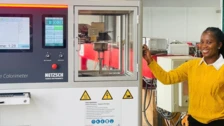
Cone Calorimeter
Highlights
For Fire Testing and Fire Safety Engineering in Accordance with ISO 5660-1 and ASTM E1354
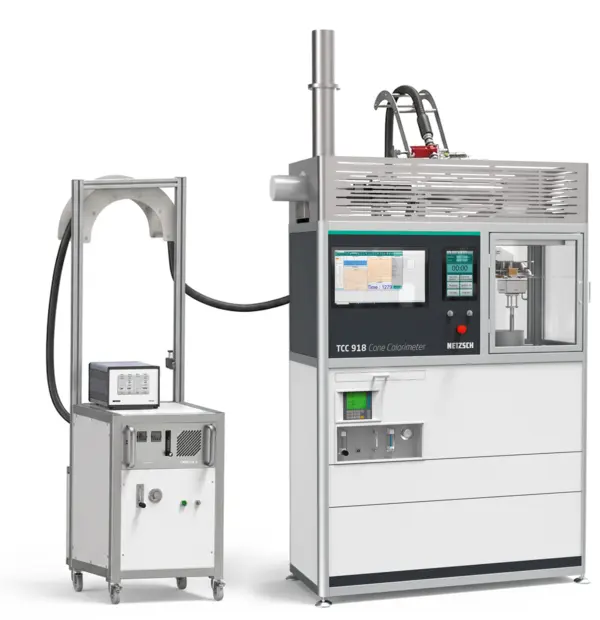
A Cone Calorimeter is used to perform a “reaction to fire” test, which is described in the ISO standard 5660-1. In this test a specimen of 100 by 100 mm and a maximum height of 50 mm is placed into the instrument’s load cell. The material is then exposed to controlled levels of irradiance by the cone heater, ignited by sparks and consequently burned. The TCC 918 analyzes the combustion gases and measures the smoke produced from a test specimen that is being exposed to a certain heat flux. The principle is known as the “oxygen consumption principle” and is among the methods of calorimetry. Accuracy can be improved by analyzing carbon monoxide and carbon dioxide concentrations.
The TCC 918 is in accordance with all established standards including ISO 5660-1, ASTM E1354, ASTM E1474; ASTM E1740, ASTM F1550, etc.
Expert talk
From Fire Behavior to Gas Composition:
FT-IR Coupling on the TCC 91
Method
Analysis of Gases and Measurement of Smoke Density
The combustion gases produced pass through the heating cone and are collected by an exhaust duct system with a centrifugal fan and hood. A laser photometric beam determines the amount of smoke produced. The TCC 918 is equipped with the robust Siemens ULTRAMAT/ OXYMAT 6E, featuring corrosion-resistant materials in the gas channel. It serves for the detection of two infrared components, CO and CO2, as well as O2 in accordance with the standards.


Determination of the Heat Release Rate (HRR)
The HRR is the driving force of a fire. Therefore, the higher the HRR, the higher the flammability and the consequential fire hazard. The TCC 918 measures the gas flow and oxygen concentration to calculate the quantity of heat release per unit of time and surface area. It is calculated from the oxygen concentration in the flue gases (percentage of oxygen consumed during combustion). The heat release rate (HRR) is expressed in J/s or W. The development of HRR as a function of time is typically used to analyze fire properties.
Features that Make the TCC 918 Cone Calorimeter Outstanding
- Exhaust system and burning chamber designed for extended lifetime
- Robust, fast moving igniter with variable pulse width and duration to investigate ignition behavior
- Effective Peltier device for gas cooling without mechanical parts and drying without toxic drying agent
- Stable and robust laser system for smoke production measurement
- Mass flow controller for methane
- Integrated computer system with two touch panels for parameter definition and visualization. No additional PC required.
- No monthly payment for software licensing and free updates
- Gas Analyzer SIEMENS ULTRAMAT/OXYMAT 6E for measurement of O2, CO and CO2 components
- Sartorius high precision balance
- Adapter for FT-IR coupling


Coupling to FT-IR Gas Analysis
To better understand toxic gases released during fire testing, the TCC 918 Cone Calorimeter can be equipped with an FT-IR spectrometer connected via a heated capillary (200°C) and gas cell (180°C). This setup allows for the reliable transfer of flue gases for precise analysis. The 5m optical path length in the gas cell enables high sensitivity and quantification in the ppm range.
FAQs FT-IR Integration
Many materials can emit toxic gases when burned. The OMEGA 5 gas analyzer can identify and quantify those gases.
When burning material is analyzed, important questions arise:
- What are people potentially exposed to?
- What is the concentration of this exposure?
- How long does the exposure last?
Integrating the OMEGA 5 FT-IR system with the TCC 918 Cone Calorimeter provides users with a seamless and highly efficient solution for advanced fire testing and gas analysis. The tight, time-synchronized integration of the two systems combines TCC and FT-IR data on one shared time axis. This makes it much easier to correlate material behavior with released gases and gain clearer, faster insights. A sophisticated sampling and transfer setup with a heated transfer line ensures reliable gas handling and supports accurate, consistent measurements. Additionally, both instruments can be operated through one interface, which simplifies workflows, reduces training effort, and makes day-to-day testing more convenient and efficient.
Quantification of more than 350 gases , about 30 simultaneously, e.g.
- HF
- HCN
- N2O
- NO
- NO2
- SO2
- CO2
- CO
- CH4
- Ethen
- H2O
- HBr
- HCl
- Acrolein
- Formaldehyde
- Ammonia
- Ethyne
- Benzene
- Phenol
Individual adaption of gases without calibration
The integration provides a comprehensive view of fire behavior by linking heat release, smoke production, and gas composition over time. This makes it easier to identify critical gases early on, understand how materials behave under fire conditions, and confidently compare different materials. The result is more robust data, clearer insights, and a stronger basis for reliable evaluations and decisions.
The coupling :
- Allows one to fulfill norms and standards for fire-resistant materials
- Helps with material development (e.g., fire retardant materials)
- Helps with troubleshooting
- Supports quality assurance
- Shows gas-phase chemistry during a fire event
Video
TCC 918 Cone Calorimeter plus Bruker OMEGA 5
Specifications
| Measurement method | Reaction-to-fire tests - Heat release rate (cone calorimeter method) and smoke production rate (dynamic measurement) according to ISO 5660-1 and ASTM E 1354 |
|---|---|
| Heating unit |
|
| Load cell |
|
| Burner |
|
| Sample holder |
|
| FT-IR Gas Analysis | Can be connected to a Bruker OMEGA 5 gas analyzer |

Proven Excellence in Service
At NETZSCH Analyzing & Testing, we offer a comprehensive range of services globally to ensure the optimal performance and longevity of your thermoanalytical equipment. With a track record of proven excellence, our services are designed to maximize the effectiveness of your devices, extend their lifespan, and minimize downtime.
Unlock the full potential of your equipment with our tailored solutions, backed by years of industry expertise and innovation.
Software
- Display of all Relevant Data and Measuring Results as Graphs And Tables - freely configurable in the form of tables, diagrams, text or graphs
- Operator-Guided Test Control
- Graphical schedule for test control
- Dialogues with system-specific operator notifications
- Dialogue for the entry of all relevant data/ information in accordance with the standard
- Dialogue for automated execution of the adjustment of the gas analysis
- Recording of pre-test data (300 s)
- Measuring Point Configuration
- Assignment of name, measuring range and adjustment factor to each channel
- Assignment and evaluation of limit values for each channel
- Display of all data calculated in accordance with the standard

Downloads and Media
Application Literature
Our latest blog articles about the TCC
- 28.07.2026
Beyond Heat and Smoke: Why Gas Analysis Matters in Modern Fire Testing
- 21.04.2026
More Transparency in Combustion Gas Analysis: OMEGA 5 FT-IR Coupling on the NETZSCH TCC 918 Cone Calorimeter
- 23.09.2025
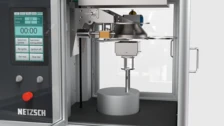
How Material Thickness Influences Fire Testing – Key Insights by Means of Cone Calorimeter Analysis
- 12.08.2024
Fire Resistance Testing and Fire Safety Engineering
- 22.06.2023
The New FT-IR OMEGA 5 Toxicity Test System ‒ The Advanced Gas Analyzer for the TCC 918 Cone Calorimeter

- 16.08.2022
Expandable Graphite: A Sustainable Solution for Flame Retardants in Plastics
