Introduction
Traditional insulation materials, such as expanded polypropylene and rock wool, are typically available in panel form. However, blow-in and loose-fill insulation for floors and roofs are also widely used.
One example is an insulation and leveling fill made of bituminized hemp shives. In addition to mechanical and processing advantages, a material's thermophysical properties also play a decisive role in its performance. Thermal conductivity determines how effectively heat is transported through or retained by the insulation, which is important for energy efficiency and living comfort. Furthermore, the Specific Heat Capacity (cp)Heat capacity is a material-specific physical quantity, determined by the amount of heat supplied to specimen, divided by the resulting temperature increase. The specific heat capacity is related to a unit mass of the specimen.specific heat capacity indicates how much heat the material can store and release over time. Therefore, precise understanding of these properties is essential for optimally designing the floor structure and reliably meeting building physics requirements.
Method
Many measurement systems have difficulty characterizing the thermophysical properties of bulk materials, such as Thermal ConductivityThermal conductivity (λ with the unit W/(m•K)) describes the transport of energy – in the form of heat – through a body of mass as the result of a temperature gradient (see fig. 1). According to the second law of thermodynamics, heat always flows in the direction of the lower temperature.thermal conductivity and Specific Heat Capacity (cp)Heat capacity is a material-specific physical quantity, determined by the amount of heat supplied to specimen, divided by the resulting temperature increase. The specific heat capacity is related to a unit mass of the specimen.specific heat capacity. One challenge is the form of the material, and another is its relatively high degree of inhomogeneity.
The Thermal ConductivityThermal conductivity (λ with the unit W/(m•K)) describes the transport of energy – in the form of heat – through a body of mass as the result of a temperature gradient (see fig. 1). According to the second law of thermodynamics, heat always flows in the direction of the lower temperature.thermal conductivity of insulation materials can be quickly and precisely determined using the HFM (heat flow meter) method. In this method, a sample, typically solid, is placed between hot and cold plates, each maintained at a specific temperature. The resulting heat flux is measured using heat-flux sensors. Along with the sample's thickness and previously determined calibration factors, the Thermal ConductivityThermal conductivity (λ with the unit W/(m•K)) describes the transport of energy – in the form of heat – through a body of mass as the result of a temperature gradient (see fig. 1). According to the second law of thermodynamics, heat always flows in the direction of the lower temperature.thermal conductivity of the sample is determined at various temperature points. Figure 1 shows a typical temperature profile, including Thermal ConductivityThermal conductivity (λ with the unit W/(m•K)) describes the transport of energy – in the form of heat – through a body of mass as the result of a temperature gradient (see fig. 1). According to the second law of thermodynamics, heat always flows in the direction of the lower temperature.thermal conductivity.
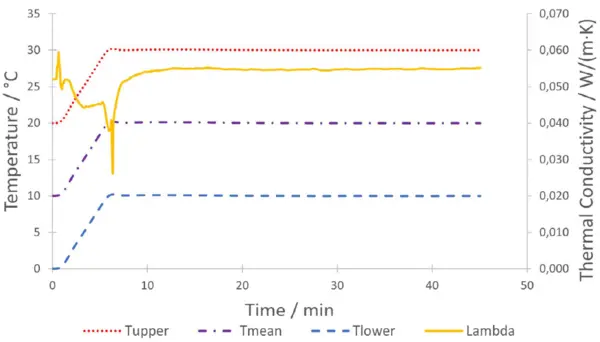
Like panel-shaped insulation materials, loose, bulk insulation materials are measured in a frame with a thin base. The base is so thin that its thermal resistance can be considered negligible. The frame is outside the measurement area so that it does not influence the measurement.
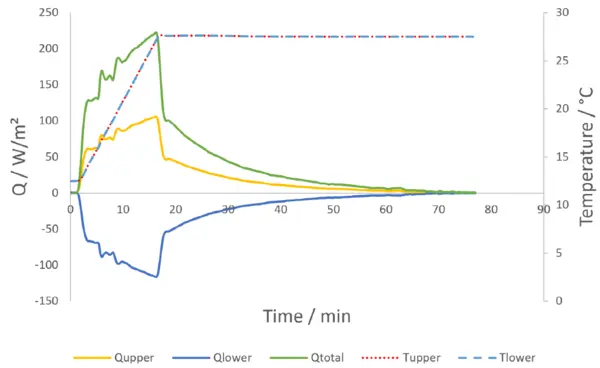
The DSC (differential scanning calorimetry) method is most commonly used to determine the Specific Heat Capacity (cp)Heat capacity is a material-specific physical quantity, determined by the amount of heat supplied to specimen, divided by the resulting temperature increase. The specific heat capacity is related to a unit mass of the specimen.specific heat capacity. However, the sample size is comparatively small, with a diameter of approximately 4 mm and a thickness of only 1 mm for insulation materials. Additionally, precise measurements require a high initial weight and good contact between the sample and the crucible. These three factors make measuring the Specific Heat Capacity (cp)Heat capacity is a material-specific physical quantity, determined by the amount of heat supplied to specimen, divided by the resulting temperature increase. The specific heat capacity is related to a unit mass of the specimen.specific heat capacity of loose-fill insulation using the DSC method impractical and difficult. The HFM offers the right solution for this type of sample. The HFM can analyze a large volume (e.g., several liters). This makes the measurement more representative. Additionally, the HFM method is steady-state. When determining the Specific Heat Capacity (cp)Heat capacity is a material-specific physical quantity, determined by the amount of heat supplied to specimen, divided by the resulting temperature increase. The specific heat capacity is related to a unit mass of the specimen.specific heat capacity, the contact between the plates and the sample is less critical than for a DSC measurement. For the cp determination, both plates are held at the same temperature (Zero ΔT) until the heat flux is zero. Then, a temperature jump of 10 K, for example, is initiated for both plates, and the system is allowed to reach the final temperature until the heat flux is zero again. The amount of heat that is added when the temperature changes can be used to measure the sample's specific heat capacity. Figure 2 shows the temperature profile of this measurement. Here, Qupper is the heat flux through the sensor on the upper plate, Qlower is the heat flux through the sensor on the lower plate, and Qtotal is the sum of the heat fluxes from both sensors. The area under Qtotal is used to calculate the specific heat capacity.
Experimental
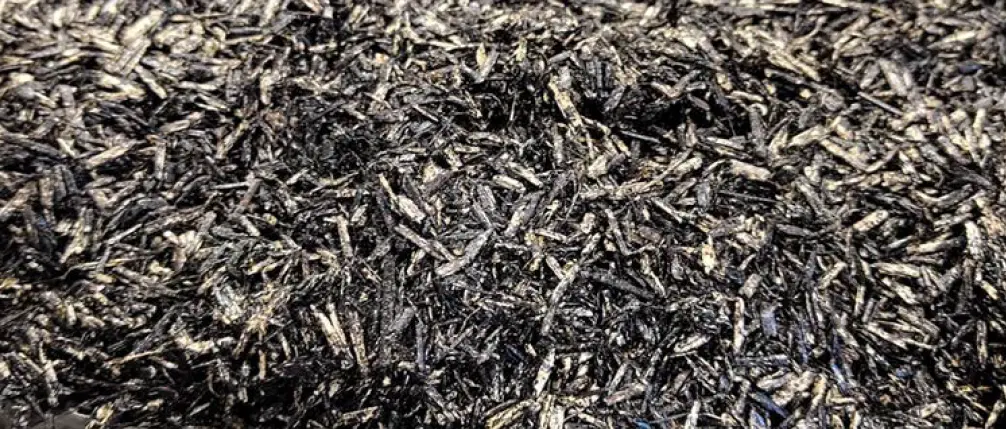
Insulation materials used for HFM measurements are usually supplied in panel form. However, these materials are also frequently available as bulk materials, such as the insulation material based on bituminized hemp shives examined here (see Figure 3).
The thermal conductivity and specific heat capacity of these materials can also be determined. To determine the thermal conductivity, the bulk material is placed in a frame. This frame is located outside the measurement area and is therefore negligible during the measurement.
In addition, the DensityThe mass density is defined as the ratio between mass and volume. density can also be determined based on the defined geometry. The DensityThe mass density is defined as the ratio between mass and volume. density or compaction of the material significantly influences the thermal conductivity and, in the case of insulation materials in general, should always be recorded alongside the results to allow for comparison. In the case of specific heat capacity, however, a frame can have a non-negligible influence on the measurement due to its mass, which is also heated during the stepwise measurement. For this reason, the bulk material is placed in a very thin plastic bag. The mass of the plastic bag is many times smaller than the mass of the sample and is therefore negligible. The other measurement conditions are summarized in Table 1.
Table 1: Measurement conditions for the thermal conductivity and specific heat capacity of the insulation fill of bitmunized hemp shives
| Thermal ConductivityThermal conductivity (λ with the unit W/(m•K)) describes the transport of energy – in the form of heat – through a body of mass as the result of a temperature gradient (see fig. 1). According to the second law of thermodynamics, heat always flows in the direction of the lower temperature.Thermal Conductivity | Specific Heat Capacity | |
| Auxiliary means | Frame | Plastic bag |
| DensityThe mass density is defined as the ratio between mass and volume. Density during the measurement | ~ 178 kg/m³ | k.A. |
| Sample input | ~ 693 g | ~ 693 g |
| Temperature program | 20°C + 35°C, ΔT = 20 K | 20°C + 35°C, ΔT = 15 K |
Results
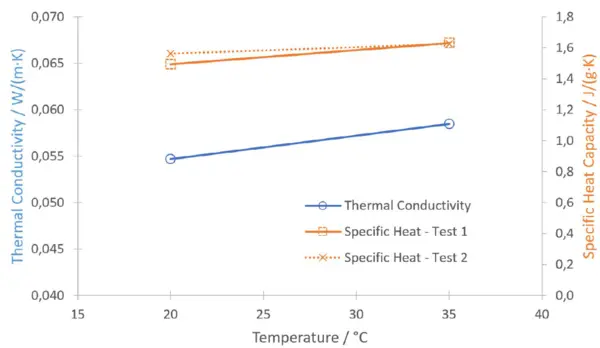
As illustrated in Figure 4, the results demonstrate the thermal conductivity and specific heat capacity of bituminized hemp shives when used as a bulk material. The thermal conductivity of the bituminized hemp shive insulation fill increases slightly with rising temperature, which is consistent with the temperature behavior typical of insulation materials. The specific heat capacity consistently falls within the range of approximately 1,500 to 1,630 J/(g·K) across both repeat measurements (Test 1 and Test 2), exhibiting a slight increase with increasing temperature. The values determined for these materials fall within the typical and expected range for bio-based, bituminized loose-fill insulation materials. Overall, the measurements confirm the moderate thermal conductivity typical of natural-fiber loose-fill insulation, combined with good thermal storage capacity.
Summary
The present measurements demonstrate that the HFM 706 Lambda Medium allows for the precise and practical determination of the thermophysical properties of insulation materials that are difficult to measure, such as bituminized hemp shives. In contrast to the DSC method, the small sample size of which is unsuitable for inhomogeneous bulk materials, the HFM, with its large sample volume, also allows for a representative and reproducible measurement of the specific heat capacity. This steady-state measurement method delivers consistent results for the thermal conductivity (0.0547 to 0.0584 W/(m·K)) and specific heat capacity (1,500 to 1,630 J/(g·K)) as a function of temperature, which are in good agreement with the values expected for bio-based insulation materials. The HFM 706 thus proves to be a reliable alternative to conventional testing methods – particularly for bulk materials – for reliably determining parameters relevant to building physics.