Webinar
05.11.2026
STA for Polymers and Life Science Applications
English
Speaker: Dr. Carolin Fischer
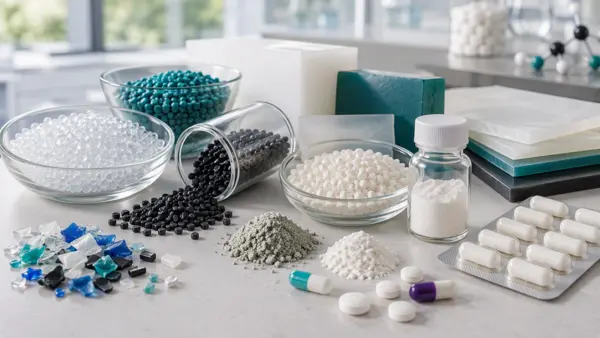
From plastics to active pharmaceutical ingredients, STA offers valuable insight into Thermal StabilityA material is thermally stable if it does not decompose under the influence of temperature. One way to determine the thermal stability of a substance is to use a TGA (thermogravimetric analyzer). thermal stability, melting behavior, Glass Transition TemperatureThe glass transition is one of the most important properties of amorphous and semi-crystalline materials, e.g., inorganic glasses, amorphous metals, polymers, pharmaceuticals and food ingredients, etc., and describes the temperature region where the mechanical properties of the materials change from hard and brittle to more soft, deformable or rubbery.glass transitions, and the effects of additives and fillers. In this session, you will learn how to develop reliable STA methods for polymers, interpret thermal transitions clearly, and - where appropriate - expand the analysis through coupling with FTIR or GC-MS for evolved-gas identification.
A dedicated section addresses pharmaceutical and life-science applications. Discover how Thermal StabilityA material is thermally stable if it does not decompose under the influence of temperature. One way to determine the thermal stability of a substance is to use a TGA (thermogravimetric analyzer). thermal stability, formulation ingredients, and moisture exposure may influence the storage behavior and performance of an API. Practical examples show how STA can support the identification of degradation pathways, the definition of safe processing windows, and the assessment of moisture-related transitions or instabilities.
This webinar is for you if you develop polymer formulations, need to confirm Tg or melting behavior, want to evaluate additive effects, or work with thermally sensitive pharmaceutical compounds where stability and shelf life are essential.