Introduction
Epoxy resins have been widely used in the field of building reinforcement and repair due to their excellent adhesion, mechanical properties and chemical corrosion resistance. In particular, epoxy resin is used for crack grouting and surface repair in the restoration of concrete structures, effectively restoring their integrity and durability. However, pure epoxy resin undergoes a certain degree of length change during the Curing (Crosslinking Reactions)Literally translated, the term “crosslinking“ means “cross networking”. In the chemical context, it is used for reactions in which molecules are linked together by introducing covalent bonds and forming three-dimensional networks.curing process and in heated environments. If its thermal expansion coefficient differs greatly from that of the concrete substrate, internal StressStress is defined as a level of force applied on a sample with a well-defined cross section. (Stress = force/area). Samples having a circular or rectangular cross section can be compressed or stretched. Elastic materials like rubber can be stretched up to 5 to 10 times their original length.stress is likely to be generated at the interface during temperature changes, which will further lead to debonding or secondary cracking, and ultimately affect the repair effect and long-term stability [1].
To improve the dimensional stability of epoxy resins, inorganic fillers are often introduced into the resin matrix to reduce their thermal expansion coefficient. As a hollow, lightweight micron-sized inorganic filler, glass beads feature low thermal expansion coefficient, high specific strength and good fluidity [2]. Not only can they reduce the thermal expansion coefficient of the composite material, but also the self-weight of the repair material to a certain extent, making them both practical and economical.
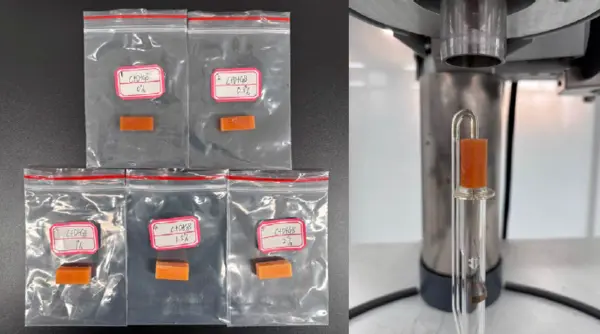
The samples used in this experiment were epoxy resins used for repairing building cracks, with phenolic amide as the Curing (Crosslinking Reactions)Literally translated, the term “crosslinking“ means “cross networking”. In the chemical context, it is used for reactions in which molecules are linked together by introducing covalent bonds and forming three-dimensional networks.curing agent, supplemented by cardanol (C) and diethylenetriamine (D) to form a composite Curing (Crosslinking Reactions)Literally translated, the term “crosslinking“ means “cross networking”. In the chemical context, it is used for reactions in which molecules are linked together by introducing covalent bonds and forming three-dimensional networks.curing accelerator system (Figure 1). By adding glass beads (GB) with different mass fractions (0%, 0.5%, 1%, 1.5%, 2%) to the resin (the addition ratio is calculated as the percentage of the mass of epoxy resin), the influence of its content on the average thermal expansion coefficient of the epoxy resin was studied. The test instrument used in this experiment was a NETZSCH TMA 402 F1 thermomechanical analyzer (equipped with a stainless-steel furnace).
Experimental Conditions
The measurement conditions are detailed in Table 1.
Table 1: Experimental conditions
| Instrument | TMA 402 F1 Hyperion® |
| Sample size | Cuboid, approx. 10 mm x 10 mm x 25 mm |
| Heating rate | 5 K/min |
| Static force | 50 mN |
| Sample holder | Fused silica compression holder |
| Temperature range | -50 - 150°C |
| Atmosphere | Inert gas (70 ml/min) |
Measurement Results and Discussion
Figure 2 shows the second-run dL/L0 curves of the cured epoxy resin samples with different GB contents. Table 2 summarizes the Glass Transition TemperatureThe glass transition is one of the most important properties of amorphous and semi-crystalline materials, e.g., inorganic glasses, amorphous metals, polymers, pharmaceuticals and food ingredients, etc., and describes the temperature region where the mechanical properties of the materials change from hard and brittle to more soft, deformable or rubbery.glass transition temperature (Tg) and the mean coefficient of thermal expansion (mCTE) of each sample in different temperature ranges.
As shown in Table 2, theTg of the epoxy resin slightly decreases with an increasing GB content. The blank sample (1#) exhibits aTg of 60.8°C; at 2.0 % GB, theTg reaches 57.9°C, a reduction of 2.9°C. This marginal decline is attributed to the disruption of the crosslinking network and increased free volume at the interface [3], as well as trace moisture and residual additives that marginally inhibit Curing (Crosslinking Reactions)Literally translated, the term “crosslinking“ means “cross networking”. In the chemical context, it is used for reactions in which molecules are linked together by introducing covalent bonds and forming three-dimensional networks.curing [4].
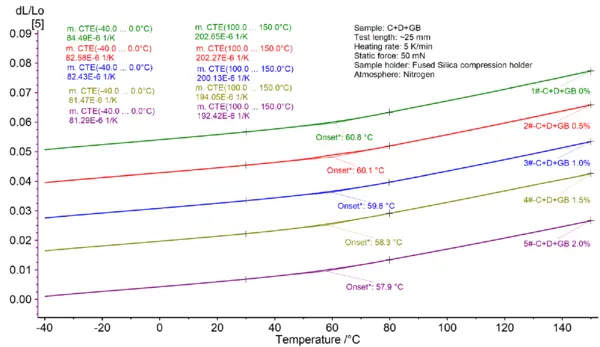
Table 2:Tg and mCTE of epoxy resin samples with different GB contents
| Sample No. | Glass Bead Content (wt-%) | Tg (°C) | mCTE (10-6 1/K) | |
| -40 - 0°C | 100 - 150°C | |||
| 1 | 0 | 60.8 | 84.49 | 202.65 |
| 2 | 0.5 | 60.1 | 82.58 | 202.27 |
| 3 | 1.0 | 59.8 | 82.43 | 200.14 |
| 4 | 1.5 | 58.3 | 81.47 | 194.05 |
| 5 | 2.0 | 57.9 | 81.29 | 192.42 |
In the glassy state (-40°C to 0°C), the mCTE decreases from 84.49 ×10-⁶ K-¹ to 81.29 ×10-⁶ K-¹ as the GB content increases from 0 to 2.0%, corresponding to a reduction of 3.8%. This indicates that rigid GBs constrain thermal expansion even when the matrix is below theTg. In the rubbery state (100°C to 150°C), the neat epoxy shows an mCTE of 202.65×10-⁶ K-¹ (≈ 2.4 times the glassy value). The addition of 2.0 % GB reduces this value to 192.42 ×10-⁶ K-¹ (5.1 % reduction), confirming a more pronounced restriction effect in the rubbery state.
Across the investigated temperature range, the mCTE correlates negatively with the GB content, consistent with literature findings [5].
Conclusion
Based on the sample test results obtained with the TMA 402 F1 , the thermal behavior of the composites can be precisely characterized. The addition of glass beads significantly reduces the thermal expansion coefficient of epoxy resin, enhances thermal matching with concrete substrates, and lowers the risk of debonding and cracking induced by temperature changes, providing an experimental basis for formulation optimization of concrete repair materials.