28.07.2026
Beyond Heat and Smoke: Why Gas Analysis Matters in Modern Fire Testing
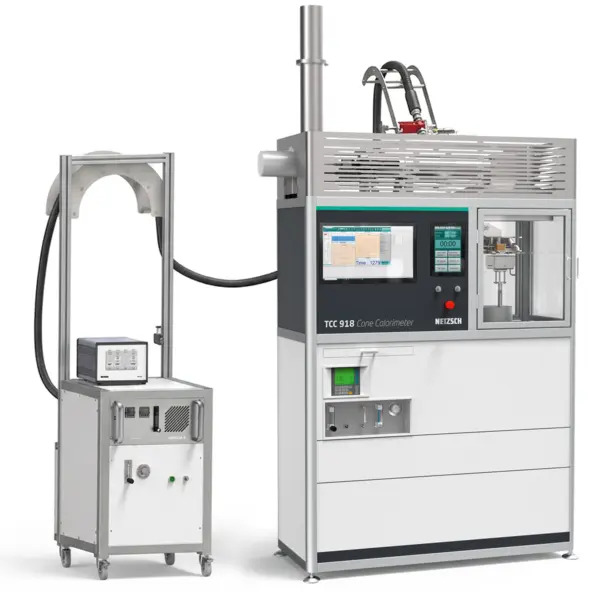
Heat release and smoke production are among the first parameters engineers look at when evaluating how materials respond to fire exposure and behave once they ignite. These parameters are essential for understanding fire growth, burning behavior, and potential hazards. But they do not tell the whole story. In real fire scenarios, one question can be just as critical: Which gases are released—and what are people exposed to? This is where gas analysis adds a powerful chemical perspective to modern fire testing.In our upcoming expert talk, we will show how the NETZSCH TCC 918 Cone Calorimeter can be combined with the Bruker OMEGA 5 FT-IR gas analyzer to deliver deeper insight into combustion behavior, toxic gas formation, and material performance. The result is a synchronized view of heat, smoke, mass loss, and gas composition—helping users move beyond classic fire testing data toward a more complete understanding of fire safety.
Why Fire Testing Needs More Than Heat Release and Smoke Data
Cone calorimetry is a proven method for simulating realistic fire conditions. A sample is exposed to a defined heat flux, and key reaction-to-fire parameters are measured, including heat release rate, smoke production, mass loss, time to ignition, and flame-out behavior. These values help describe how a material contributes to fire growth and development.
However, calorimetric data alone cannot Identify the chemical composition of gases released during combustion. Two materials may show similar heat release or smoke behavior while producing very different gas profiles. Understanding these differences is highly relevant for fire toxicity assessment, tenability studies, material comparison, flame-retardant development, compliance-related testing, and model validation
A Synchronized View: TCC 918 Cone Calorimeter and OMEGA 5 FT-IR Gas Analyzer
By coupling the OMEGA 5 with the TCC 918, users gain access to time-resolved FT-IR gas analysis directly linked to physical fire behavior. Calorimetric data and gas concentrations are displayed on a single time axis, making it easier to correlate ignition, heat release, smoke events, and critical gas peaks.
The setup includes a sampling and transfer concept designed for cone calorimeter conditions, while FT-IR data is integrated into the TCC software via MODBUS. This creates a unified environment for data access, evaluation, and interpretation—supporting faster, better-informed decisions in fire safety engineering and material development.
From Thermal Analysis Expertise to Advanced Fire Testing
The solution builds on decades of collaboration between NETZSCH and Bruker. Since 1993, the companies have combined NETZSCH thermal analysis systems with Bruker FT-IR spectrometers to correlate mass-loss events with evolved gases. This established analytical concept has now been extended to fire testing, where larger fire loads, flaming combustion, faster reactions, and more complex gas release patterns create demanding measurement conditions.
The OMEGA 5 is designed for continuous online FT-IR gas analysis under challenging and changing conditions. With a 5-meter optical path length, it supports low-concentration detection in the parts-per-million range and real-time quantitative analysis. Typical fire-relevant target gases include CO, CO₂, HCN, HCl, HF, formaldehyde, and NH₃—compounds that are important for evaluating toxicity, corrosivity, material performance, and fire scenarios.
What You Will Learn in the Expert Talk
This tech talk will explain how combining cone calorimetry with FT-IR gas analysis expands the scope of modern fire testing. You will learn how synchronized physical and chemical fire data can help Identify critical gas release patterns, compare materials and formulations more reliably, validate fire models, support troubleshooting, and strengthen compliance-related assessments.
Join the Talk and See Fire Testing from a New Perspective
If you want to understand not only how much heat and smoke a material generates, but also which gases are released, when they appear, and why they matter, this expert talk is for you. Join us to discover how the TCC 918 and OMEGA 5 integration brings greater transparency to combustion gas analysis—and helps turn complex fire data into actionable insight.