TG 209 F3 Tarsus®
The easy-to-use and cost-effective thermo-microbalance
The thermo-microbalance, TG 209 F3 Tarsus® , represents a cost-effective overall concept, tailored not only to the quality assurance of polymers, but also to routine applications in the fields of organic, chemistry, pharmaceuticals, cosmetics and food.
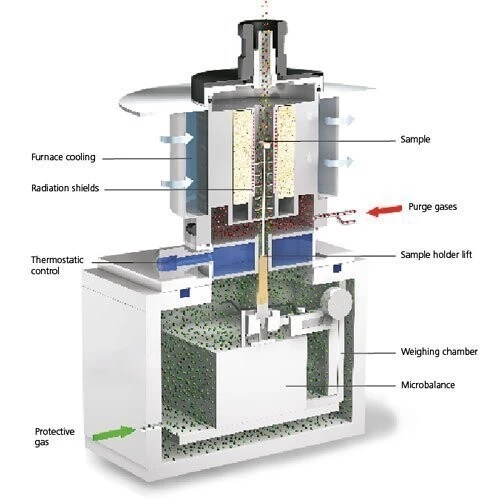
This basic instrument for thermogravimetric measurements offers already a resolution of 0.1 µg. The TG 209 F3 Tarsus® operates between room temperature and 1000°C with freely selectable heating rates from 0.001 K/min up to 200 K/min. The accurate sample temperature is detected by a thermocouple in direct contact with the sample crucible. Through the reliable vertical construction with sample carrier lift, the thermo-balance as a top-loader, is easy and safe to use, with no hang-down wires or exposed fragile parts.
The calculated DTA-signal c-DTA® (option) not only is ideal for temperature calibration. During sample measurements it yields important information regarding endothermal processes (e.g. VaporizationThe Vaporization of an element or compound is a phase transition from the liquid phase to vapor. There exists two types of vaporization: evaporation and boiling.vaporization with mass loss or melting without mass loss) as well as ExothermicA sample transition or a reaction is exothermic if heat is generated.exothermal reactions.
For the TG 209 F3 Tarsus® we offer an automatic sample changer (ASC) for up to 20 samples also in different crucible types.

Technical Data
Wide measuring range:
2000 mg
Resolution:
0.1 µg
Atmospheres:
inert, oxidizing, static, dynamic
Mass flow controller (MFC, optional)
Tightly adjusted gas flow via built-in frits
Gas-tight construction with capability of evacuation
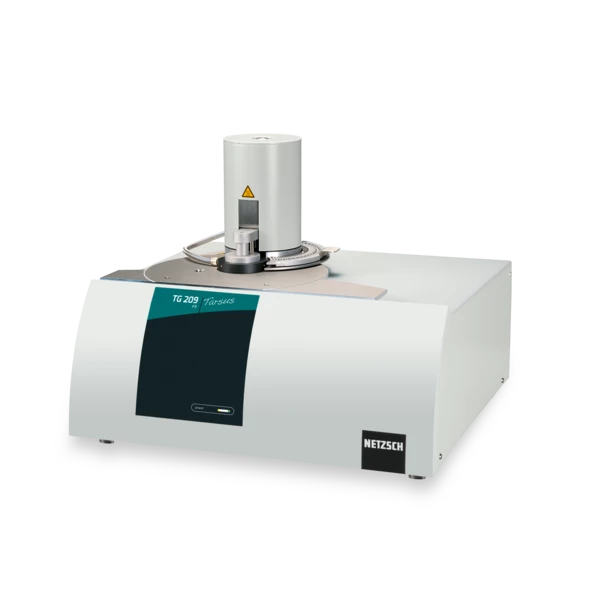
The TG 209 F3 Tarsus® runs under Proteus® Software on Windows®. The Proteus® Software includes everything you need to carry out a measurement and evaluate the resulting data. Through the combination of easy-to-understand menus and automated routines, a tool has been created that is extremely user-friendly and, at the same time, allows sophisticated analysis. The Proteus® software is licensed with the instrument and can of course be installed on other computer systems.
TGA features:
- Mass changes in % or mg
- Automatic evaluation of mass changing steps
- Determination of mass / temperature pair of variates
- Determination of the residual mass
- Extrapolated onset and endset
- Peak temperatures of the1st and2nd derivate of the mass changing curve
- Switch on/off function of buoyancy-correction
- c-DTA®for the calculated DTA signal with evaluation of characteristic temperatures and peak area (option)
- Super-Res for automatic rate controlled mass change and high resolution temperature programs (option)
You can use the following software with this product
To protect the weighing system against the hot furnace and to minimize any system drift during long-term measurements, the standard TG 209 F3 Tarsus® is equipped with a thermostat. To achieve a lower starting temperature the connection of a cooling thermostat is highly recommended.
Linked to the optimal configuration using mass flow controllers (MFC), a membrane pump can also be connected, enabling evacuation of the thermo-microbalance. Thus, measurements in pure inert gas atmosphere (PyrolysisPyrolysis is the thermal decomposition of organic compounds in an inert atmosphere.pyrolysis) are guaranteed.
There is a wide variety of different crucibles (pans) of aluminum oxide, platinum, aluminum, graphite and fused silica available in different sizes.
The automatic sample changer, ASC, for up to 20 different crucible (pan) types, handles your routine measurements in quality control. Day and night it works for you to free your time for other tasks, allowing you to make optimal use of the TG 209 F3 Tarsus® , even over the weekend. Of course, each sample can be assigned a different measurement and evaluation program. Easy-to-understand input fields lead you through the programming of a series of measurements. Unplanned analyses can also be inserted into a pre-programmed series of measurements already in progress.

Crucibles (Pans) for General Applications – TG 209 F3 Tarsus®
| Material (Purity) | Temperature Range | Consisting of | Dimension/ Volume | Remarks | Order Number |
| Al2O3 (99.7) | Max. 1700°C | Crucible | ø 6.8 mm / 85 μl | GB399972 | |
| Al2O3 (99.7) | Max. 1700°C | Lid | For GB399972 | GB399973 | |
| Quartz | Max. 1000°C | Crucible | ø 6.7 mm / 85 μl | GB399974 | |
| Quartz | Max. 1000°C | Lid | For GB399974 | GB399975 | |
| Pt/Rh (80/20) | Max. 1700°C | Crucible | ø 6.8 mm / 85 μl | GB399205 | |
| Pt/Rh (80/20) | Max. 1700°C | Lid | For GB399205 and NGB801556 | GB399860 | |
| Pt/Rh (80/20) | Max. 1700°C | Crucible | ø 6.8 mm / 190 μl | NGB801556 | |
| Al (99.5) | Max. 610°C | Crucible | ø 6.7 mm / 85 μl | Set of 100 pieces | NGB810405 |
| Al (99.5) | Max. 610°C | Lid | For NGB810405 | NGB810406 | |
| Gold (99.9) | Max. 900°C | Crucible + lid | ø 6.7 mm / 85 μl | 6.225.6-93.3.00 | |
| Silver | Max. 750°C | Crucible + lid | ø 6.7 mm / 85 μl | 6.225.6-93.4.00 | |
| ZrO2 | Max. 2000°C | Crucible | 85 μl | CaO-stabilized | GB397053 |
| ZrO2 | Max. 2000°C | Lid | For GB397053 | GB397052 | |
| Graphite | Max. 2200°C | Crucible | 85 μl | GB399956 | |
| Graphite | Max. 2200°C | Lid | For GB399956 | GB399957 | |
| Al2O3 (99.8) | Max. 1700°C | Crucible | ø 9 mm, height 7 mm, volume 350 μl | Sample holder for large samples required | NGB800453 |
| Al2O3 (99.8) | Max. 1700°C | Lid | NGB800454 | ||
| Al2O3 (99.7) | Max. 1700°C | Crucible | ø 8 mm, height 8 mm, volume 300 μl | Sample holder for large samples required, ASC-compatible | NGB803698 |
| Al2O3 (99.7) | Max. 1700°C | Lid | For crucible NGB803698 | NGB808209 |