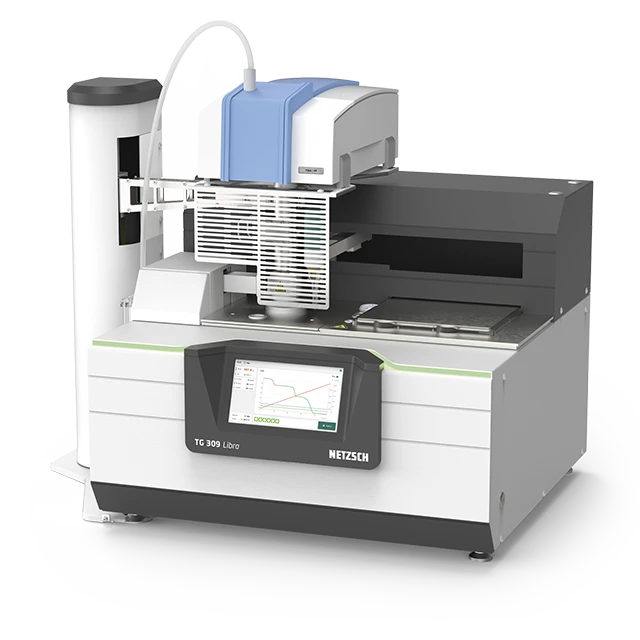
PERSEUS® TG 309 Libra® with Direct Coupling
The Perfect TGA-FT-IR Coupling Solution
Highlights
Thermal Analysis Plus FT-IR - More Than Just the Sum of Its Parts
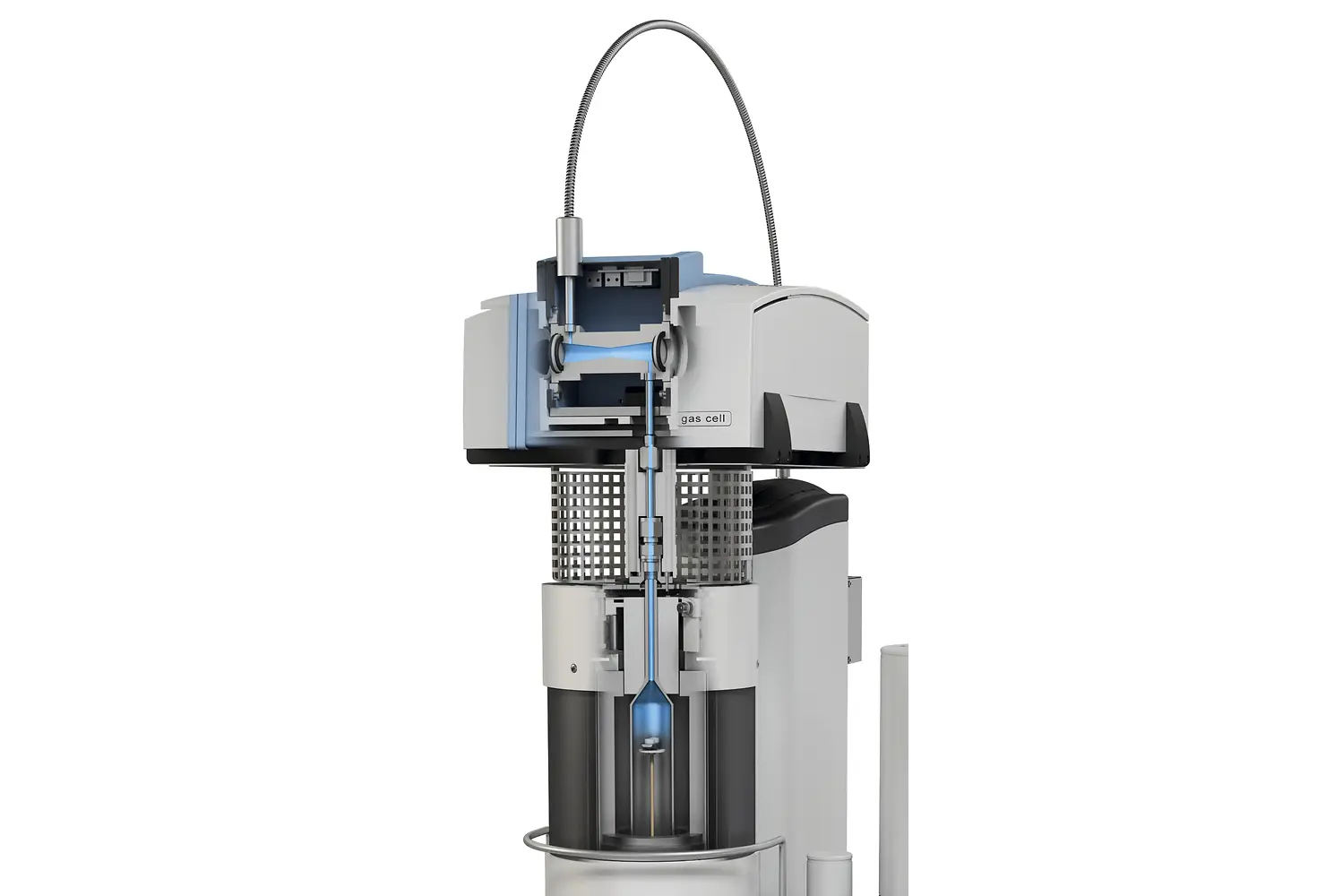
PERSEUS® is the name given to the unique alliance between a NETZSCH thermobalance (TGA or STA system) and a tiny but efficient FT-IR spectrometer by Bruker Optics. Its revolutionary layout sets a benchmark for state-of-the-art hyphenation. The PERSEUS® coupling interface excels in both design and ease of handling. No separate transfer line is necessary. The built-in heated gas cell is directly connected to the gas outlet of the furnace via a heated tube. The low volume of the short gas path guarantees fast response and is quite advantageous in cases where condensable evolved gases are present. Additionally, the PERSEUS® features an extremely small footprint.
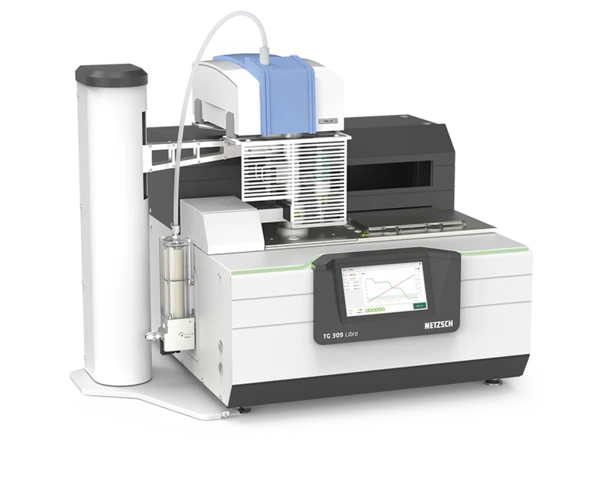
The PERSEUS® TGA 309 Libra® is robust and stands out by virtue of its high performance and compactness. This instrument integrates the small but powerful FT-IR with the TGA and has the potential to fit into any laboratory – be it in universities or industry, quality assurance or development.
Any existing NETZSCH TG 309 Libra®Supreme and the TG 309 Libra®Select system can be upgraded with the PERSEUS® coupling.
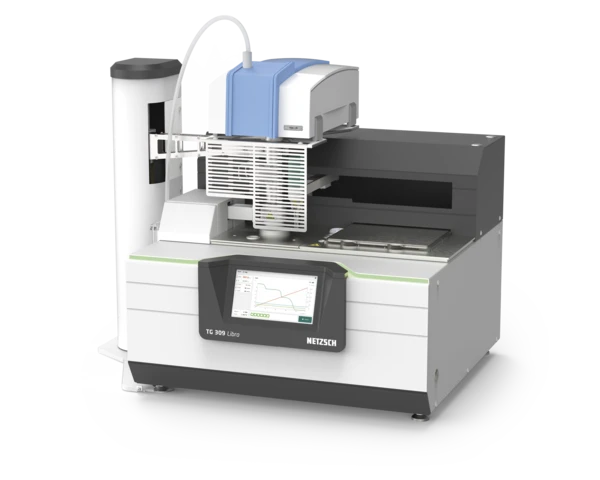
The PERSEUS® coupling interface is distinguished by its exceptional design and user-friendly operation, even with automatic sample changer.
It eliminates the need for a separate transfer line by integrating a heated gas cell directly connected to the furnace's gas outlet through a heated tube. The short gas path's low volume ensures rapid response, which is particularly beneficial when dealing with condensable evolved gases. Moreover, the PERSEUS® is notable for its exceptionally small footprint.
The video shows the fast and straight forward disassembling of the Bruker Alpha II to enable ATR measurements with the same instrument within a few minutes.
Method
Fourier Transform Infrared (FT-IR) Spectrometers Coupled to Thermal Analysis
Thermal analysis offers excellent tools for the characterization of various organic and inorganic solids and liquids. Thermal transitions, Thermal StabilityA material is thermally stable if it does not decompose under the influence of temperature. One way to determine the thermal stability of a substance is to use a TGA (thermogravimetric analyzer). thermal stability, Decomposition reactionA decomposition reaction is a thermally induced reaction of a chemical compound forming solid and/or gaseous products. decomposition, and chemical reactions can be accurately detected and quantified across a wide temperature range.
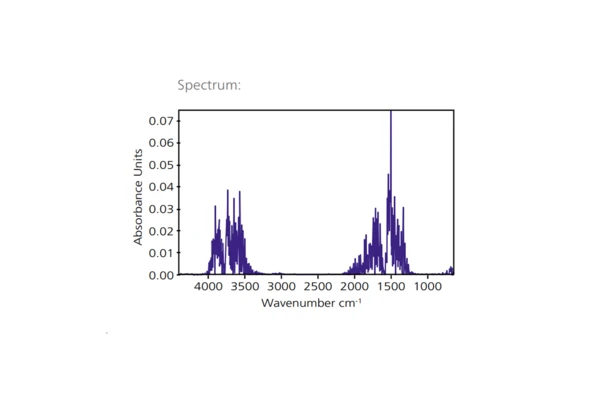
In some cases, however, information about the type of evolved gases is needed to gain a clearer understanding of the chemistry behind the processes. Coupling thermal analysis with powerful infrared spectroscopy for gas analysis bridges this gap. It allows for a deeper insight into the material’s behavior and provides a spectral fingerprint of the gases evolved from the sample when heated.
The Proteus® software for thermal analysis and the OPUS software for FT-IR measurements are seamlessly integrated to enable efficient Thermal Analysis-to-FT-IR coupling. The temperature and time correlations of all experimental data are carefully preserved throughout the process.
Infrared spectroscopy
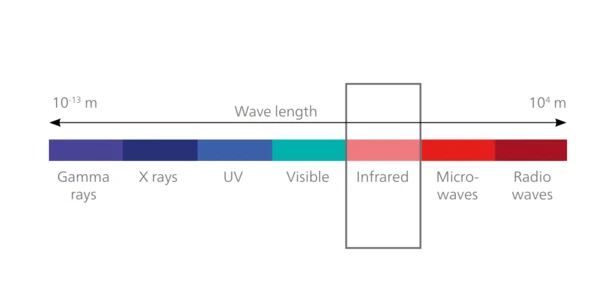
Infrared spectroscopy is a classical technique based on the absorption of infrared radiation by molecular bond vibrations. This absorption occurs when bonds vibrate in specific ways. However, only those vibrations that cause a change in dipole moment can interact with IR light. This is why most substances produce a characteristic spectrum, while homonuclear molecules — such as O₂ and N₂ — or noble gases do not show fundamental IR absorption bands, due to the absence of dipole moment changes during vibrations.
Working principle of a FT-IR spectrometer
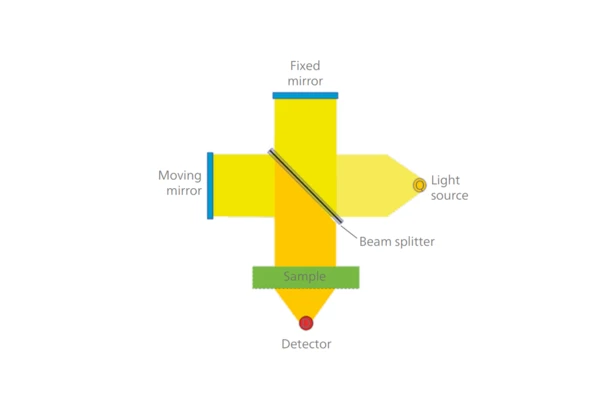
An infrared light beam, depicted in the diagram as coming from the source on the right, is split into two paths by a beam splitter. One path is directed toward a fixed mirror and reflected, while the other is reflected by a moving mirror.
After reflection, the two beams are recombined and interfere with each other. The resulting interference pattern depends on the distance between the two mirrors — which changes as the moving mirror shifts position — and the frequencies present in the beam.
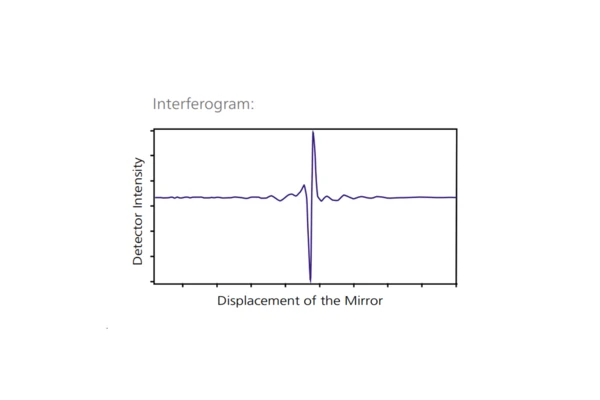
This process generates an interferogram, a signal typically characterized by a central burst and flat wings. The central burst occurs when both mirrors are equidistant from the beam splitter, allowing all frequencies to interfere constructively.
Finally, the interferogram is mathematically transformed into a spectrum using a Fourier Transform, revealing the sample’s infrared absorption characteristics.

Lorem ipsum dolor sit amet, consetetur sadipscing elitr, sed diam nonumy eirmod tempor invidunt ut labore et dolore magna aliquyam erat, sed diam voluptua. At vero eos et accusam et justo duo dolores et ea rebum. Stet clita kasd gubergren, no sea takimata sanctus est Lorem ipsum dolor sit amet. Lorem ipsum dolor sit amet, consetetur sadipscing elitr, sed diam nonumy eirmod tempor invidunt ut labore et dolore magna aliquyam erat, sed diam voluptua. At vero eos et accusam et justo duo dolores et ea rebum. Stet clita kasd gubergren, no sea takimata sanctus est Lorem ipsum dolor sit amet.
Over 30 Years of Successful Cooperation
For over 30 years, NETZSCH and Bruker have collaborated to provide integrated solutions for thermal analysis and gas analysis. This longstanding partnership combines NETZSCH's expertise in thermal analysis with Bruker's leadership in FT-IR technology, offering customers reliable, high-quality systems tailored to their needs. Together, we deliver innovative, user-friendly solutions from a single source, ensuring seamless operation and exceptional support.
Advantages of our Cooperation at a Glance:
- Seamless integration: Optimized coupling of NETZSCH thermal analyzers with Bruker FT-IR spectrometers for reliable and efficient evolved gas analysis.
- Proven expertise: Decades of joint experience ensure high-quality, innovative solutions tailored to customer needs.
- Single-source convenience: Fully compatible systems with comprehensive support from both partners.
- Enhanced performance: Precise coordination of instruments delivers accurate and reproducible results.
- Continuous innovation: Collaboration fosters the development of cutting-edge technologies and features for advanced analysis.
- Effortless Compatibility with Bruker's OPUS Software: At NETZSCH, we offer seamless compatibility with Bruker’s OPUS software, allowing for a smooth workflow between both systems. This ensures an integrated and efficient experience, making the most out of both instruments.
Specifications
Heating of transfer tube
Heating of gas cell
software-controlled
Detector
Affordable Gas Analysis
The unrivaled instrument alliance serves as an innovative coupling technique, even for a narrow budget. It has what it takes to become an integral part of any laboratory and may well become indispensable for future needs.
No Liquid Nitrogen required
The DLaTGS (deuterated L-alanine doped triglycine sulfate) detector operates without the need for liquid nitrogen. This system is thus particularly well-suited for test runs with an autosampler (ASC) or long-term measurements.
Gas cell length/volume:
70 mm / 5.8 ml (no mirror inside, beam conforming design)
Spectral range of FT-IR data:
350 cm-1 to 8000 cm-1 KBr windows
Gas cell:
KBr windows, sealingViton©
To view the technical data of the TG 309 Libra®, please click HERE.



Proven Excellence in Service
At NETZSCH Analyzing & Testing, we offer a comprehensive range of services globally to ensure the optimal performance and longevity of your thermoanalytical equipment. With a track record of proven excellence, our services are designed to maximize the effectiveness of your devices, extend their lifespan, and minimize downtime.
Unlock the full potential of your equipment with our tailored solutions, backed by years of industry expertise and innovation.
Software
Bruker OPUS and NETZSCH Proteus® – Unrivaled Combination for Maximum Ease of Use


The alliance between the NETZSCH Proteus® software and the OPUS FT-IR software is based on synchronized data exchange, enabling coordinated operation of the coupled systems. Measurements are started via the NETZSCH Proteus® software, which simultaneously triggers data acquisition in OPUS. Users only need to input the command for measurement start and data acquisition once; both OPUS and Proteus® will then operate with the predefined parameters. Online data collection is fully synchronized, ensuring precise time and temperature correlation between all signals from the two coupled instruments during evaluation. The two software packages can be operated from a single computer, giving users access to the full range of data evaluation and results display options in either environment at any time.
Find out even more about the software:
- Full software integration – online data exchange between the two instrument software packages during the running experiment
- Seamless instrument control, measurement definition for TGA and FT-IR entirely controlled by Proteus® software
- Segmental activation or deactivation of the FT-IR coupling with one mouse click
- Automatic saving of data sets for both measurements (TGA and FT-IR) with identical file names (but different extensions) in the same directories
- Measurements with automatic sample changer allow for individual FT-IR measurement parameter for each position
- Conjoint presentation of the Gram-Schmidt plot plus up to 30 pre-selected traces together with thermal analysis curves in Proteus® software during the experiment
- Online evaluation (SNAP SHOT) of TGA/STA/DSC measurements already including FT-IR data during the measurement
- Trace calculations with evaluation of characteristic temperatures and peak areas together with TGA and DSC curves
- Combined analysis graphics of thermal analysis and FT-IR signals
- Multi-component search in OPUS
- Identification by various gas phase librarys, e.g. TGA-FT-IR library of polymers by NETZSCH
Related Devices
Consultancy & Sales
Do you have further questions about the instrument or the method and would like to speak to a sales representative?
Service & Support
Do you already have an instrument and need technical support or spare parts?