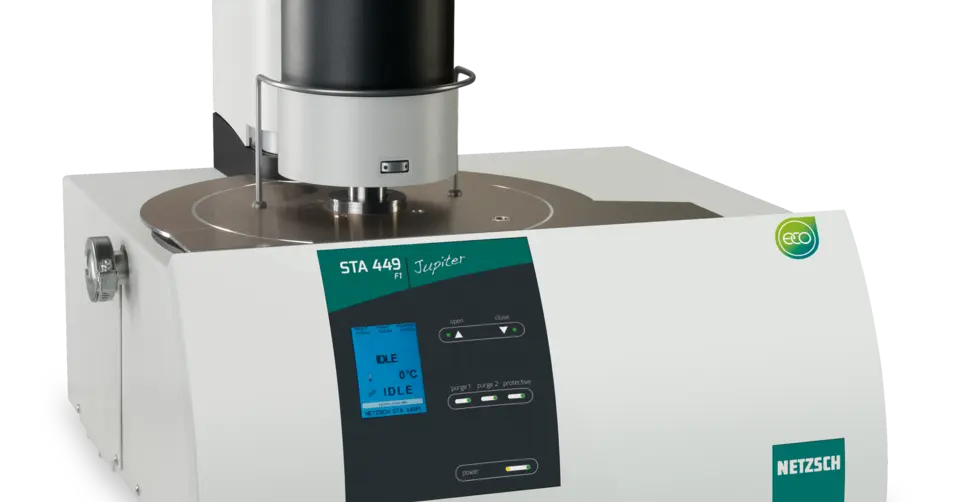
STA 449 F3 Jupiter®
Fascinating Flexibility in Thermal Analysis
The simultaneous thermal analyzer NETZSCH STA 449 F3 Jupiter® allows the measurement of mass changes and thermal effects between -150°C and 2400°C.
The high flexibility caused by the various sensors, the great variety of sample crucibles and the wide TGA-measuring range make the system applicable for analysis of all kinds of materials including also inhomogenous substances. Easily interchangeable sample holders allow the optimal system adaption to the diverse application areas (TGA, TGA-DTA and TGA-DSC measurements). Various furnaces, easy interchangeable by the user, cover the complete temperature range (please see accessories).
Through to the vacuum tight design measurements at defined atmospheres (e.g. inert) are possible. The system is controlled by a newly developed integrated digital electronic device. The analysis of measuring data runs under a standard PC and the well-provenWindows® software.

Technical Data

Heating and cooling rates:
0.001 K/min to 50 K/min
(dependent on furnace)
Weighing range:
35000 mg
TG resolution:
0,1 µg (over entire weighing range)
DSC resolution (depending on sensor type):
e.g. < 1 µW for DSC sensor type S and 0.5 µW for DSC sensor type E
Atmospheres:
inert, oxidizing, reducing, static, dynamic
Switch valve:
for 2 purge gases and 1 protective gas
Vacuum-tight assembly:
up to 10-4 mbar
Coupling:
FT-IR, MS via Capillary or SKIMMER coupling

| Type | Temperature range | Cooling system |
|---|---|---|
| Silver furnace | -120°C to 675°C | liquid nitrogen |
| Copper furnace | -150°C to 500°C | liquid nitrogen |
| Steel furnace | -150°C to 1000°C | liquid nitrogen |
| Platinum furnace | RT to 1500°C | forced air |
| Silicon carbide furnace | RT to 1600°C | forced air |
| Rhodium furnace | RT to 1650°C | forced air |
| Graphite furnace | RT to 2000°C | tap or chilled water |
| Water vapor furnace | RT to 1250°C | forced air |
| High-speed furnace | RT to 1250°C | forced air |
| Tungsten furnace | RT to 2400°C | tap or chilled water |

The STA 449 F3 Jupiter® runs under Proteus® Software on Windows® 7, Windows® 8.1 and Windows® 10. The Proteus® Software includes everything you need to carry out a measurement and evaluate the resulting data. Through the combination of easy-to-understand menus and automated routines, a tool has been created that is extremely user-friendly and, at the same time, allows sophisticated analysis. The Proteus®® software is licensed with the instrument and can of course be installed on other computer systems.
TGA features:
- Mass changes in wt% or mg
- Automatic evaluation of mass-change steps
- Determination of residual mass
- Extrapolated onset and end temperatures
- Peak temperatures of the1st and2nd derivative of the mass-change curve
- Automatic baseline and buoyancy correction
- c-DTA®® for calculated DTA signal with evaluation of characteristic temperatures and the peak area (optional for TGA measurements)
DSC features:
- Determination of onset, peak, inflection and end temperatures
- Automatic peak search
- Transformation enthalpies:
Analysis of peak areas (enthalpies) with selectable baseline and partial peak area analysis
Enthalpy determination allowing for mass changes
Complex peak analysis with all characteristic temperatures, area, peak height and half-width - Comprehensive analysis of Glass Transition TemperatureThe glass transition is one of the most important properties of amorphous and semi-crystalline materials, e.g., inorganic glasses, amorphous metals, polymers, pharmaceuticals and food ingredients, etc., and describes the temperature region where the mechanical properties of the materials change from hard and brittle to more soft, deformable or rubbery.glass transitions
- Automatic baseline correction
- Degree of Crystallinity / Degree of CrystallinityCrystallinity refers to the degree of structural order of a solid. In a crystal, the arrangement of atoms or molecules is consistent and repetitive. Many materials such as glass ceramics and some polymers can be prepared in such a way as to produce a mixture of crystalline and amorphous regions.crystallinity
- Oxidative-Induction Time (OIT) and Oxidative-Onset Temperature (OOT)Oxidative Induction Time (isothermal OIT) is a relative measure of the resistance of a (stabilized) material to oxidative decomposition. Oxidative-Induction Temperature (dynamic OIT) or Oxidative-Onset Temperature (OOT) is a relative measure of the resistance of a (stabilized) material to oxidative decomposition.OIT (oxidative induction time) evaluation
- Specific heat determination (optional)
- BeFlat® for automatic DSC baseline correction (optional)
- Tau-R® Mode: takes into account the time constant and thermal resistance of the instrument and reveals thus sharper DSC effects from the sample (optional available for the use with DSC sample carrier)
- DSC correction: Evaluation of exo- and endothermal effects under consideration of system time constants and thermal resistance values (optional)
- TM-DSC module software extension for temperature-modulated DSC tests (optional)
You can use the following software with this product
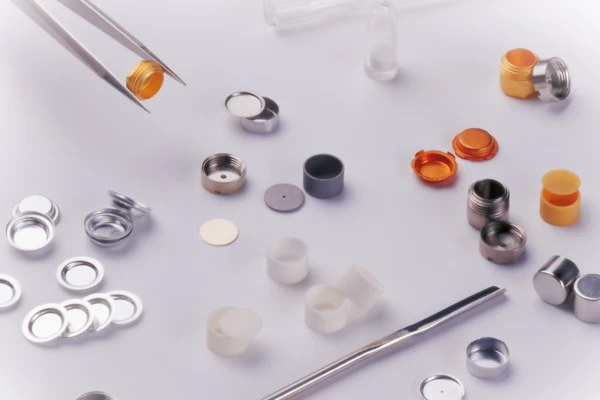
A variety of sample crucibles (pans) made of alumina, platinum, aluminum, graphite, fused silica, etc. is available in different sizes.
The water vapor furnace with perfectly balanced accessories for steam generation, gas mixing and flow control offers the unique opportunity to study the mass and energy changes in samples up to 1250°C under defined absolute humidity.
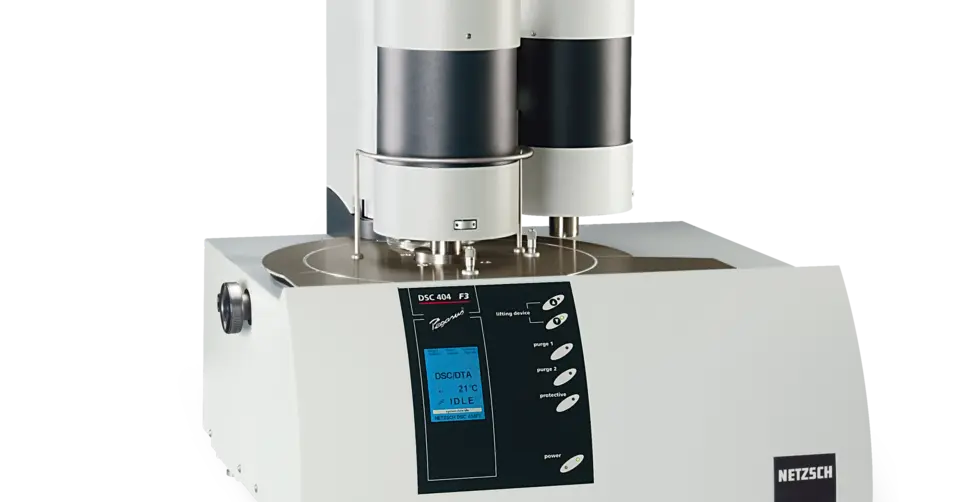
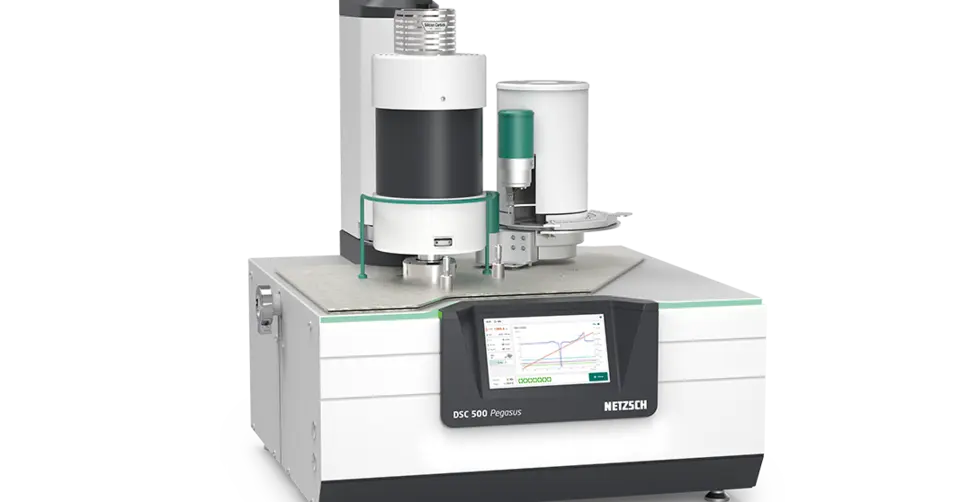
The high-speed furnace does not require a stand-alone instrument but extends the well-established instrument series STA-Jupiter® by another furnace type. The concept allows for equipping a measuring instrument with a double-furnace hoisting device for two furnaces. The high-speed furnace can therefore be mounted on the double hoisting device combined with other furnaces. Instead of a second furnace, an automatic sample changer (ASC) can optionally be used for the high-speed furnace. Modular flexibility and particularly the combinability of the high-speed furnace with the ASC saves a great amount of time and thus directly results in an increased sample throughput.


Optionally available, the OTS® system allows for reducing effectively the oxygen partial pressure at the sample vicinity.
The automatic sample changer is designed for routine measurements. It works day and night, giving you time for other tasks, and provides for optimal use of the STA 449 F3 Jupiter® (e.g. calibrations on the weekend).
A carousel is available for up to 20 sample and reference crucibles (pans) which can be automatically run in any order. The controlled generation of the required gas atmosphere in the sample chamber and cooling are automatic.
Of course, each sample can be assigned an individual measurement and evaluation macro. Easy-to-understand input masks lead you through the programming of the measurement series. And it is always possible to insert unplanned analyses into a preprogrammed series of measurements that is already in progress.
PulseTA®
With the PulseTA® technique an exactly defined quantity of gas is injected to the purge gas of the thermobalance (TGA) or the simultaneous thermal analysis instrument (STA).
This clearly increases the measuring possibilities:
- Defined/incremental chemical reactions or adsorption of the injection gas with the sample
- Quantification of gases evolved from the sample.

Crucibles (Pans) Made of Aluminum for the STA 449 F1 /F3 Jupiter®
| Material (Purity) | Temperature Range | Consisting of | Dimension/ Volume | Remarks | Order Number |
|---|---|---|---|---|---|
| Al (99.5%) | Max. 600°C | Crucible + lid | ø 6 mm / 25/40 μl | Set of 100, cold weldable* | 6.239.2-64.5.00 |
| Al (99.5%) | Max. 600°C | Crucible + lid | ø 6 mm / 25/40 μl | Set of 500, cold weldable* | 6.239.2-64.51.00 |
| Al (99.5%) | Max. 600°C | Crucible + punched lid (0.05mm) | ø 6 mm / 40 μl | Set of 100, cold weldable* | 6.239.2-64.8.00 |
| Al (99.5%) | Max. 600°C | Crucible + punched lid (0.05mm) | ø 6 mm / 40 μl | Set of 500, cold weldable* | 6.239.2-64.81.00 |
| Al (99.5%) | Max. 600°C | Crucible | ø 6.7 mm / 85 μl | Set of 100 pieces, non-weldable | NGB810405 |
| Al (99.5%) | Max. 600°C | Lid | Set of 100 pieces, for NGB810405 | NGB810406 |
* Please note: One and the same sealing press is capable of sealing all the Al crucibles (pan + lid), order no. 6.240.10-80.0.00A

This instrument is LabV®️-primed
LabV® takes the data from your analytical instrument: It automatically imports all measurement data into a central and secure database solution, the LabV® software. This allows you to visualize the data in LabV®️ and to make them searchable. Your data will now be accessible from anywhere. Moreover you have the possibility to generate reports.
Application Literature

Our latest blog articles
- 03.12.2024
Using STA Instruments to Convert Solid Waste into Energy Materials

- 16.07.2024
Optimizing the Safety of High-Rise Buildings with NETZSCH Thermal Analysis Instruments and Kinetics Neo Software

- 04.06.2024
Green Hydrogen Infrastructure: Recycling End-of-Life Fuel and Electrolysis Cells

- 06.05.2024
NETZSCH Tech Talk – Spring Edition:Unveiling Thermal Innovations in Just 30 Minutes

- 22.04.2024
NETZSCH Stands for Sustainability

- 15.04.2024
H2Secure Concept: NETZSCH Now Analyzes Under Hydrogen Atmosphere