Introduction
Polymethyl methacrylate (PMMA), commonly referred to as acrylic glass or by trade names such as Plexiglas® or Perspex®, is a transparent thermoplastic known for its optical transparency, stiffness, rigidity, shatter resistance, durability, and low DensityThe mass density is defined as the ratio between mass and volume. density. These characteristics make it an ideal material, frequently used as a glass alternative, for a wide range of applications in optics, electronics, automotive, marine, aerospace, and construction industries. Given its extensive use in various industries, understanding PMMA’s thermal behavior is essential for ensuring safety, optimizing thermal management, and improving design, performance, and manufacturing processes.
Experimental
Two PMMA samples were tested using the TCT 716 Lambda Guarded Heat Flow Meter (GHFM) following the method described in ASTM E1530. This steadystate method involves placing a sample of known thickness between two plates maintained at different temperatures, allowing heat to flow through the sample.
The heat flow through the sample’s thickness is then measured, and Thermal ConductivityThermal conductivity (λ with the unit W/(m•K)) describes the transport of energy – in the form of heat – through a body of mass as the result of a temperature gradient (see fig. 1). According to the second law of thermodynamics, heat always flows in the direction of the lower temperature.thermal conductivity is calculated. The two specimens were tested across a temperature range of -10°C to 70°C in 10°C intervals. Each test specimen had a diameter of approximately 51 mm, a thickness of 3 mm, and a DensityThe mass density is defined as the ratio between mass and volume. density of 1.18 g/cm³. Calibration was performed using Vespel® SP-1. The samples were tested under a load of 175 kPa, and a thin layer of thermal paste was applied to reduce Contact ResistanceAccording to the second law of thermodynamics, heat transfer between two systems always moves in the direction from higher to lower temperatures. The amount of thermal energy transferred by heat conduction, e.g., through a wall of a building, is influenced by the thermal resistances of the concrete wall and the insulation layer.contact resistance.
Results and Discussion
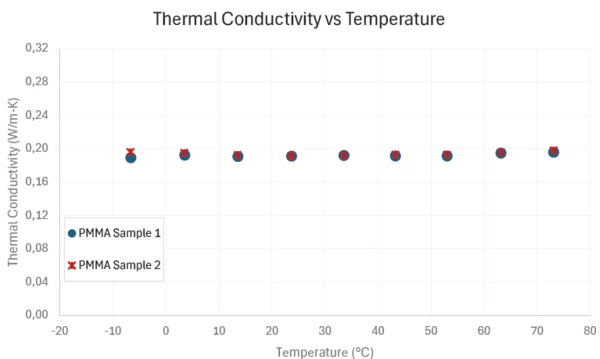
The Thermal ConductivityThermal conductivity (λ with the unit W/(m•K)) describes the transport of energy – in the form of heat – through a body of mass as the result of a temperature gradient (see fig. 1). According to the second law of thermodynamics, heat always flows in the direction of the lower temperature.thermal conductivity of PMMA over the measured temperature range of -10°C to 70°C was approximately 0.19 W/(m·K), increasing slightly to 0.20 W/(m·K) within this range. Both PMMA samples were tested three times across this range, demonstrating good repeatability between measurements; an average relative standard deviation of 1% throughout the entire temperature range was observed.
The data presented in Chart 1 represents the average of these triplicate measurements. It is evident that the Thermal ConductivityThermal conductivity (λ with the unit W/(m•K)) describes the transport of energy – in the form of heat – through a body of mass as the result of a temperature gradient (see fig. 1). According to the second law of thermodynamics, heat always flows in the direction of the lower temperature.thermal conductivity exhibits a nearly linear trend over this temperature range, and the agreement between the two separate test samples is excellent.
Thermal conductivity values for PMMA are available in various literature sources. Typically, literature values report the Thermal ConductivityThermal conductivity (λ with the unit W/(m•K)) describes the transport of energy – in the form of heat – through a body of mass as the result of a temperature gradient (see fig. 1). According to the second law of thermodynamics, heat always flows in the direction of the lower temperature.thermal conductivity of PMMA at room temperature to be around 0.19 W/(m·K). Antoniadis et al. have compiled numerous literature sources and developed a recommended dataset for PMMA over the temperature range of -178°C to 90°C [1]. The thermal conductivity results from this study (average of PMMA Samples 1 and 2) are plotted in Chart 2, together with the reference values from Antoniadis et al. It is clear that the data presented here aligns extremely well with the reference values.

Summary
The thermal conductivity of PMMA was measured between -10°C and 70°C using the TCT 716 Lambda Guarded Heat Flow Meter. The conductivity ranged from 0.19 W/(m·K) to 0.20 W/(m·K), showing a slight increase with temperature. The measured values closely matched the reference data from literature [1], confirming that the TCT 716 Lambda provides accurate and reliable measurements of PMMA’s thermal conductivity, an essential property in understanding the material’s thermal characteristics.