Introduction
Determining the Thermal ConductivityThermal conductivity (λ with the unit W/(m•K)) describes the transport of energy – in the form of heat – through a body of mass as the result of a temperature gradient (see fig. 1). According to the second law of thermodynamics, heat always flows in the direction of the lower temperature.thermal conductivity of highly transparent materials, such as glasses, presents a challenge for some measurement methods. The Laser Flash Analysis (LFA) is one of the most widely used methods for determining Thermal DiffusivityThermal diffusivity (a with the unit mm2/s) is a material-specific property for characterizing unsteady heat conduction. This value describes how quickly a material reacts to a change in temperature.thermal diffusivity and Thermal ConductivityThermal conductivity (λ with the unit W/(m•K)) describes the transport of energy – in the form of heat – through a body of mass as the result of a temperature gradient (see fig. 1). According to the second law of thermodynamics, heat always flows in the direction of the lower temperature.thermal conductivity. To perform an LFA measurement, the material must be opaque, or made so. This can necessitate special coating techniques for highly transparent samples.
The Guarded Heat Flow Meter (GHFM) measurement method (ASTM E 1530) with the TCT 716 Lambda instrument allows for the measurement of such samples without special pretreatment. The TCT 716 Lambda can measure solid and rigid samples with low and medium Thermal ConductivityThermal conductivity (λ with the unit W/(m•K)) describes the transport of energy – in the form of heat – through a body of mass as the result of a temperature gradient (see fig. 1). According to the second law of thermodynamics, heat always flows in the direction of the lower temperature.thermal conductivity between -10 and 300°C.
The low Thermal ConductivityThermal conductivity (λ with the unit W/(m•K)) describes the transport of energy – in the form of heat – through a body of mass as the result of a temperature gradient (see fig. 1). According to the second law of thermodynamics, heat always flows in the direction of the lower temperature.thermal conductivity and the ability to withstand extreme temperature fluctuations make borosilicate glass, also known by the brand name Pyrex®, an indispensable material in many fields that require high thermal performance. Examples include laboratory equipment such as flasks or test tubes, sterilization containers in medical technology, or kitchen utensils such as baking dishes and measuring cups.
Measurement Conditions
Two samples of borosilicate glass from different manufacturers (Aachner Quarzglas Technologie Heinrich GmbH & Co. KG and Corning Inc.) were examined using the TCT 716 Lambda. The samples had a diameter of approximately 51 mm and a thickness of 25.4 mm and 12.7 mm, respectively, and were examined with two different TCT 716 Lambda measuring devices at different locations (NETZSCH-Gerätebau GmbH, Selb, and NETZSCH Instruments North America, LLC).
As with every measurement, thermal paste was applied to the samples before the test to reduce Contact ResistanceAccording to the second law of thermodynamics, heat transfer between two systems always moves in the direction from higher to lower temperatures. The amount of thermal energy transferred by heat conduction, e.g., through a wall of a building, is influenced by the thermal resistances of the concrete wall and the insulation layer.contact resistance between the sample and the plates and to align with the calibration. The samples were then measured from -10°C to 300°C, and from 25°C to 150°C, respectively.
Measurement Results
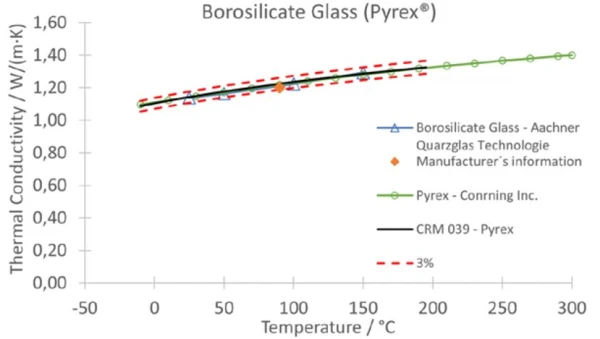
Figure 1 summarizes the measurement results. The blue triangles and green circles represent the results of the TCT measurements and show good agreement. Pyrex® is also an internationally known reference material for Thermal ConductivityThermal conductivity (λ with the unit W/(m•K)) describes the transport of energy – in the form of heat – through a body of mass as the result of a temperature gradient (see fig. 1). According to the second law of thermodynamics, heat always flows in the direction of the lower temperature.thermal conductivity [1]. These values are represented by the black line in Figure 1. All measurement results are within ± 3% of the literature value.
Summary
The measurement of highly transparent materials is easily performed using the TCT 716 Lambda without special pretreatment of the samples and shows good agreement with literature values.