Introduction
Polyether ether ketone (PEEK) is a high-performance thermoplastic widely used in demanding engineering applications due to its excellent Thermal StabilityA material is thermally stable if it does not decompose under the influence of temperature. One way to determine the thermal stability of a substance is to use a TGA (thermogravimetric analyzer). thermal stability, mechanical strength, and chemical resistance. Commercial grades such as TECAPEEK® natural and the glass fiber reinforced TECAPEEK® GF30 natural (Figure 1), manufactured by Ensinger, are commonly employed to tailor material performance for specific applications.
TECAPEEK® natural is an unfilled PEEK grade with a DensityThe mass density is defined as the ratio between mass and volume. density of ~1.31 g/cm³, while TECAPEEK® GF30 natural contains 30% glass fiber and has a DensityThe mass density is defined as the ratio between mass and volume. density of ~1.53 g/cm³. Both materials support long-term service temperatures of ~250 to 260°C, and their reported thermal conductivities are ~0.29 W/(m·K) (TECAPEEK® natural) and ~0.30 W/(m·K) (TECAPEEK® GF30 natural) [2, 3].
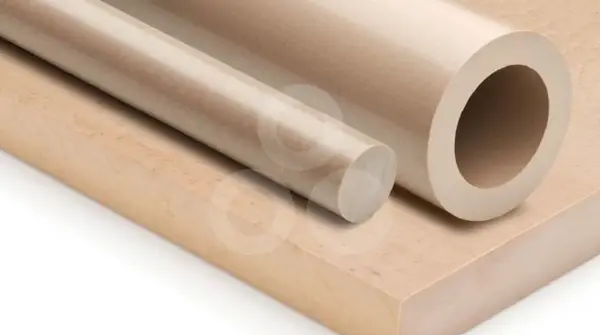
In this Application Note, the Thermal ConductivityThermal conductivity (λ with the unit W/(m•K)) describes the transport of energy – in the form of heat – through a body of mass as the result of a temperature gradient (see fig. 1). According to the second law of thermodynamics, heat always flows in the direction of the lower temperature.thermal conductivity of TECAPEEK® natural and TECAPEEK® GF30 natural is evaluated over the temperature range of -10°C to 250°C using a NETZSCH TCT 716 Lambda guarded heat flow meter (GHFM) and a NETZSCH LFA 717 HyperFlash® laser flash analyzer (LFA). The materials tested were supplied by Ensinger as commercial stock, ensuring direct relevance to real-world applications. This temperature range reflects typical service conditions across industries such as aerospace, automotive, electrical engineering, and chemical processing, where thermal transport properties influence heat dissipation and component reliability. The experimental data presented in this application note provides engineers with independent data on commercially available materials to support design decisions when such data is unavailable.
Experimental
The GHFM method provides direct, steady-state measurement of Thermal ConductivityThermal conductivity (λ with the unit W/(m•K)) describes the transport of energy – in the form of heat – through a body of mass as the result of a temperature gradient (see fig. 1). According to the second law of thermodynamics, heat always flows in the direction of the lower temperature.thermal conductivity, offering a straightforward evaluation of heat transport under equilibrium conditions. In contrast, LFA is a transient technique that measures Thermal DiffusivityThermal diffusivity (a with the unit mm2/s) is a material-specific property for characterizing unsteady heat conduction. This value describes how quickly a material reacts to a change in temperature.thermal diffusivity (α), which reflects the rate at which heat propagates through a material. To determine Thermal ConductivityThermal conductivity (λ with the unit W/(m•K)) describes the transport of energy – in the form of heat – through a body of mass as the result of a temperature gradient (see fig. 1). According to the second law of thermodynamics, heat always flows in the direction of the lower temperature.thermal conductivity (λ) using this technique, the measured diffusivity is combined with independently determined Specific Heat Capacity (cp)Heat capacity is a material-specific physical quantity, determined by the amount of heat supplied to specimen, divided by the resulting temperature increase. The specific heat capacity is related to a unit mass of the specimen.specific heat capacity (cp) and DensityThe mass density is defined as the ratio between mass and volume. density (ρ). This relationship is expressed as:
λ = α · cp · p
This combined approach enables cross-validation between direct and calculated Thermal ConductivityThermal conductivity (λ with the unit W/(m•K)) describes the transport of energy – in the form of heat – through a body of mass as the result of a temperature gradient (see fig. 1). According to the second law of thermodynamics, heat always flows in the direction of the lower temperature.thermal conductivity values, enhancing confidence in the measured results.
The Specific Heat Capacity (cp)Heat capacity is a material-specific physical quantity, determined by the amount of heat supplied to specimen, divided by the resulting temperature increase. The specific heat capacity is related to a unit mass of the specimen.specific heat capacity was determined using a NETZSCH DSC 300 Caliris® differential scanning calorimeter (DSC), while temperature-dependent DensityThe mass density is defined as the ratio between mass and volume. density was obtained from thermal expansion measurements via a NETZSCH 402 Expedis® dilatometer (DIL).
Measurements were conducted over the temperature range of -10°C to 250°C to capture behavior across typical service conditions, including the Glass Transition TemperatureThe glass transition is one of the most important properties of amorphous and semi-crystalline materials, e.g., inorganic glasses, amorphous metals, polymers, pharmaceuticals and food ingredients, etc., and describes the temperature region where the mechanical properties of the materials change from hard and brittle to more soft, deformable or rubbery.glass transition region.
Results and Discussion
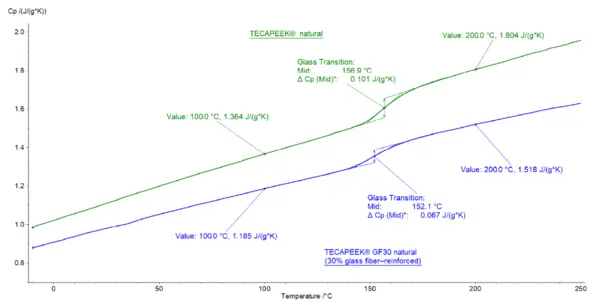
The temperature-dependent Specific Heat Capacity (cp)Heat capacity is a material-specific physical quantity, determined by the amount of heat supplied to specimen, divided by the resulting temperature increase. The specific heat capacity is related to a unit mass of the specimen.specific heat capacity (cp) of TECAPEEK® natural and TECAPEEK® GF30 natural was measured for use in the LFA-based Thermal ConductivityThermal conductivity (λ with the unit W/(m•K)) describes the transport of energy – in the form of heat – through a body of mass as the result of a temperature gradient (see fig. 1). According to the second law of thermodynamics, heat always flows in the direction of the lower temperature.thermal conductivity calculations (Figure 2). Across the full temperature range, the unfilled material exhibits higher Cp values than the glass fiber–reinforced material due to the lower heat capacity contribution from the inorganic fibers. Both materials show a distinct Glass Transition TemperatureThe glass transition is one of the most important properties of amorphous and semi-crystalline materials, e.g., inorganic glasses, amorphous metals, polymers, pharmaceuticals and food ingredients, etc., and describes the temperature region where the mechanical properties of the materials change from hard and brittle to more soft, deformable or rubbery.glass transition, with TECAPEEK® natural exhibiting a midpoint around 157°C, while TECAPEEK® GF30 natural shows a slightly lower midpoint at 152°C. The Glass Transition TemperatureThe glass transition is one of the most important properties of amorphous and semi-crystalline materials, e.g., inorganic glasses, amorphous metals, polymers, pharmaceuticals and food ingredients, etc., and describes the temperature region where the mechanical properties of the materials change from hard and brittle to more soft, deformable or rubbery.glass transition behavior of PEEK can also be monitored by using temperature-modulated DSC [4].
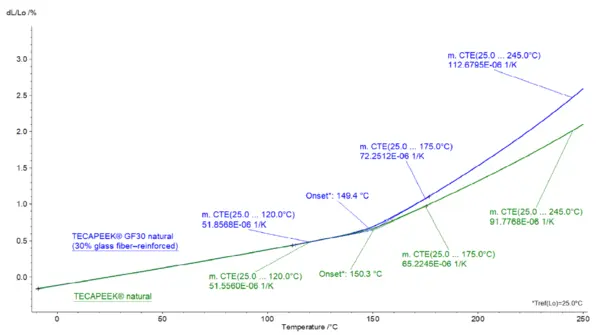
The temperature-dependent thermal expansion of TECAPEEK® natural and TECAPEEK® GF30 natural was measured to correct sample thickness in diffusivity calculations and DensityThe mass density is defined as the ratio between mass and volume. density in thermal conductivity determinations (Figure 3); however, further analysis of these data also provides valuable insight into material behavior. A pronounced increase in expansion is observed near the Glass Transition TemperatureThe glass transition is one of the most important properties of amorphous and semi-crystalline materials, e.g., inorganic glasses, amorphous metals, polymers, pharmaceuticals and food ingredients, etc., and describes the temperature region where the mechanical properties of the materials change from hard and brittle to more soft, deformable or rubbery.glass transition temperature (Tg), where increased chain mobility leads to a higher coefficient of thermal expansion. In the glass fiber-reinforced material, expansion is strongly influenced by anisotropy arising from fiber orientation, microstructure, and processing history, resulting in fiber direction-dependent behavior [5].
Thermal conductivity measurements obtained from GHFM and LFA show strong agreement across the full temperature range, with both materials exhibiting increasing conductivity with temperature (Figure 4). TECAPEEK® GF30 natural consistently demonstrates higher thermal conductivity than TECAPEEK® natural, which is attributed to improved heat-transfer pathways provided by the glass fibers.
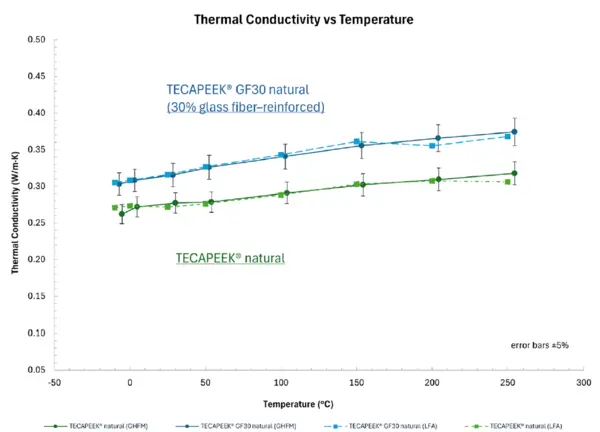
The thermal conductivity results obtained in this study also agree well with those reported in NETZSCH Application Note 327 [5], particularly in both the absolute values and the temperature-dependent trends. In Application Note 327, thermal conductivity determined via direct GHFM measurement and indirect LFA calculations demonstrate close correlation when proper cp and DensityThe mass density is defined as the ratio between mass and volume. density inputs are used. Similarly, the present work shows excellent consistency between GHFM and LFA results across the full temperature range, with deviations remaining within typical experimental uncertainty. Overall, the close alignment between this study and previous work confirms the reliability of the GHFM and LFA methods and validates the applicability of these methods to both unfilled and glass fiber–reinforced PEEK systems.
Summary
The thermal conductivity of TECAPEEK® natural and TECAPEEK® GF30 natural was evaluated over the temperature range of -10°C to 250°C using a guarded heat flow meter (GHFM) and laser flash analysis (LFA). The results show that thermal conductivity increases with temperature for both materials, with TECAPEEK® GF30 natural exhibiting higher conductivity due to enhanced heat transfer through glass fiber reinforcement. The strong agreement between GHFM and LFA results, combined with consistency with previous NETZSCH studies, demonstrates the reliability of these methods for thermal characterization.