
28.04.2026 by Aileen Sammler
From DSC Data to Industry Intelligence: How Your DSC Data Can Power Scalable Polymer Recycling
Help improve AI-based polymer analysis. Share standardized DSC data and get more accurate, reliable results for recyclates with Proteus® Now Quantify.
Why Recyclate Analysis is Still so Difficult
If you work with polymers, recyclates, or complex compounds, you face the same fundamental question: What is really inside your material?
Recyclates are not defined materials. They are dynamic mixtures of different polymers, additives, unknown contaminants, and degradation products. No batch is identical.
The result:
- unstable processing behavior
- inconsistent material properties
- increasing risk in product quality
And yet, most decisions are still based on indirect, qualitative indicators like MFI or FT-IR.
Are they fast? Yes. But are they reliable for composition? No. This is where NETZSCH comes into play.
From Guesswork to Data-Driven Insight
This is exactly the gap NETZSCH’s Proteus® Now Quantify is designed to bridge.
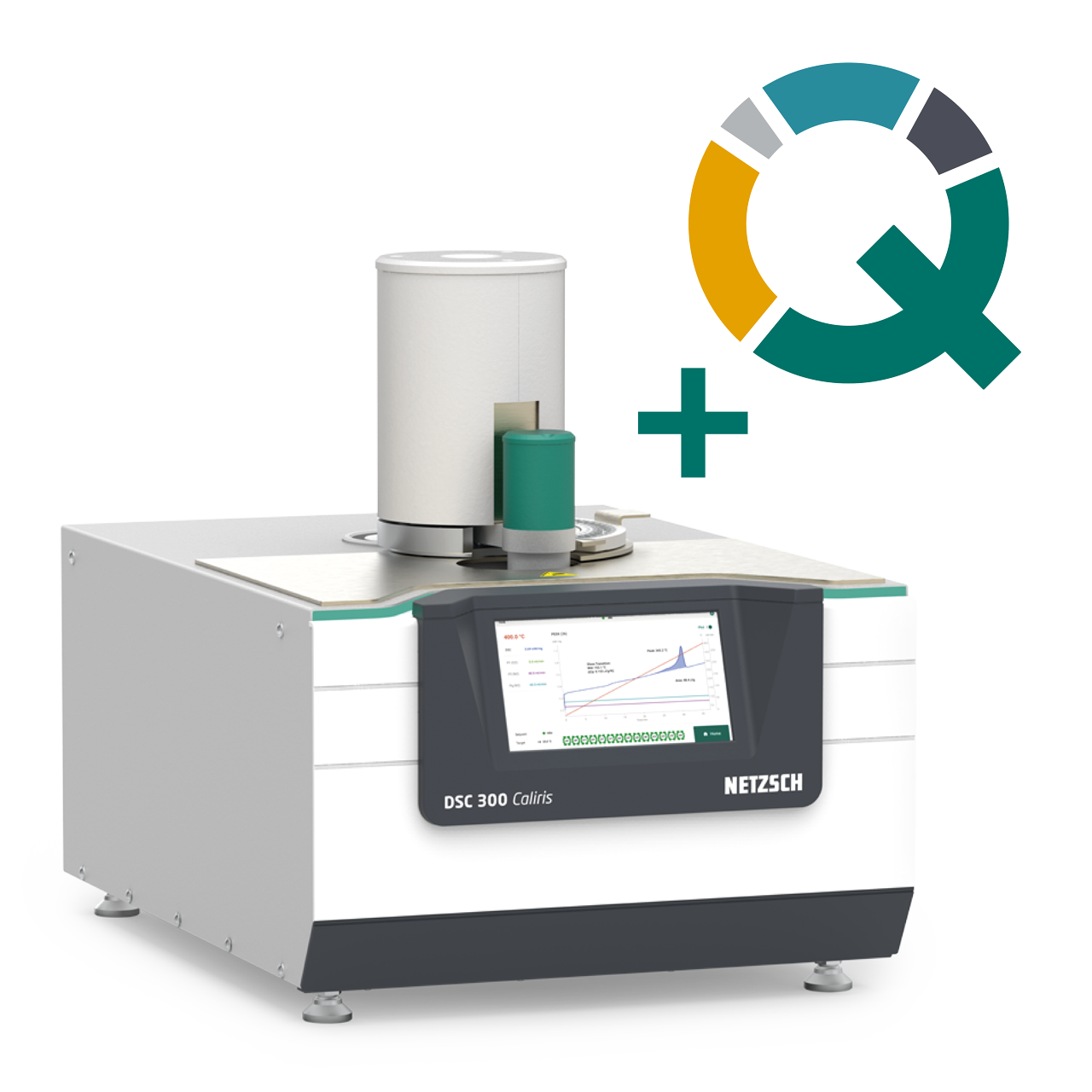
Proteus® Now Quantify turns DSC data into automated composition insights.
Using supervised machine learning, the software maps DSC thermograms to polymer composition. Advanced data processing pipelines calibrate and preprocess the signal, extracting features such as transition temperatures, peak shape, and enthalpy before translating them into quantitative results — even for complex, multi-component systems.
In this article we will demonstrate:
- how Proteus® NowQuantify works
- why standardized measurement conditions matter
- and how your data can directly help improve accuracy – of your materials and those across the entire community
From Measurement to Result in Three Steps
The workflow is straightforward:
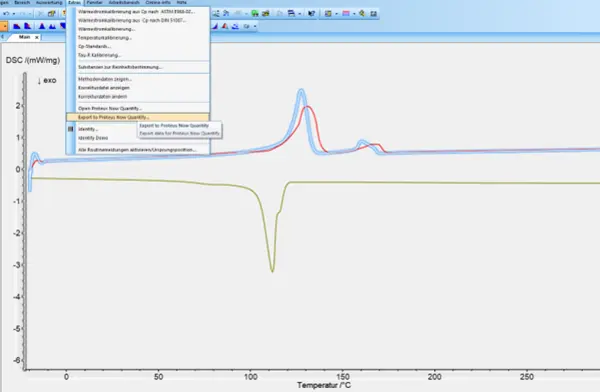
- Run your DSC measurement
- Upload the data into Quantify
- Receive results within seconds
What You Get from Proteus® Now Quantify
Clear answers instead of assumptions:
- Quantitative determination of recyclate composition
- Detection of deviations from the specified target composition and identification of contamination
- Confidence score for every result
Get your free Trial!
Discover the full power of Proteus®Now Quantify with our FREE Full Access Trial:
The Model Is Only as Good as the Data — And That Is Where You Come In
No AI model can outperform the data it is trained on. Recyclates are inherently complex and diverse.
No single dataset can fully represent:
- different industries,
- different waste streams,
- different formulations,
- different contamination scenarios.
- And no model can generalize what it has never encountered.
This means accuracy is not just a function of the algorithm. It is also a function of the data behind it.
Why your Data is Really Essential
To further improve Proteus® Now Quantify, we are continuously expanding the training dataset.
This is where your contribution becomes essential. We are looking for high-quality reference data, including:
- real industrial compounds
- realistic contamination scenarios
- standardized DSC measurements
These datasets enable the model to learn meaningful relationships between thermal signals and composition – especially in complex, multi-component systems.
Standardization Is the Key to Making Data Useful
For this system to work, data must be comparable. Even small changes in DSC parameters can impact peak shape, enthalpy and CrystallizationCrystallization is the physical process of hardening during the formation and growth of crystals. During this process, heat of crystallization is released.crystallization behavior. Without standardization, the model cannot distinguish between material differences and measurement noise.
That’s why Quantify requires defined conditions:
- Sample mass: 10 ± 1 mg
- Heating/cooling rate: 10 K/min
- Atmosphere: Nitrogen
- Defined crucible and calibration
Who Should Contribute?
You are a perfect fit if you work in recycling & compounding, quality control, R&D or material purchasing.
Especially relevant are:
- polyolefin systems (PP, PE blends)
- PET-based systems
- PA-based systems
- engineering plastics
- automotive materials
What Data Is Needed?
We are looking for:
- Compounded materials (no dry blends)
- Realistic industrial compositions
- Standardized DSC measurements
Of course, your data can be anonymized. Only material classes and compositions are required.
How to Participate
Getting started is simple:
- Follow the Quantify measurement guidelines on our website
- Prepare your DSC data
- Share your dataset with us
- Our team will contact you directly
Please visit our website to see the details:

Start Using Quantify – and Help Shape It
Proteus® Now Quantify already delivers fast, reliable polymer analysis. But its real strength grows with every dataset. If you are working with variable or unknown materials, you will directly benefit from improving the model.
This is more than just data sharing. It’s about creating a shared material intelligence layer for the industry.
Your next Steps:

Composites World Article
Read the latest article published in Composites World magazine in April 2026.
Watch also:
AI-Powered Polymer Quantification with Proteus® Now Quantify and DSC 300 Caliris® - Explained in 5 minutes
Share this article