General Properties
Short Name: EVA
Name: Ethylene Vinyl Acetate
Chemical Formula: (C2H4)n(C4H6O2)m
The properties and applications of polyethylene vinyl acetate (EVA) vary with the percentage of copolymerized vinyl acetate (VA). The VA amount of the present sample amounts to approx. 19 to 20%.
Structural Formula

Properties
NETZSCH Measurement
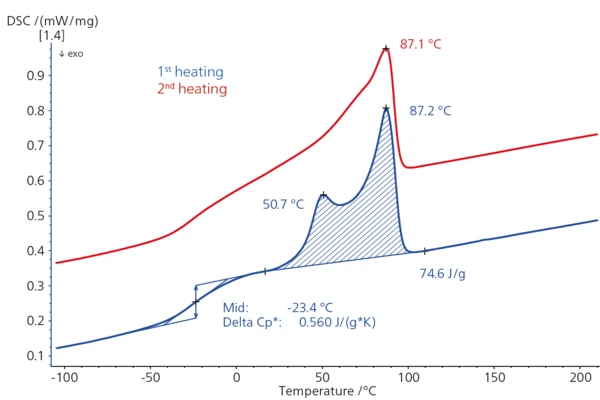
| Sample Mass | 10.65 mg |
| Heating Rates | 10 K/min |
| Crucible | Al, pierced lid |
| Atmosphere | N2 (50 ml/min) |
Evaluation
In the above graphics, only the 1st heating (blue) was evaluated since the effects in the 2nd heating − after controlled cooling – are no longer resolved. In the 1st heating (blue curve), the Glass Transition TemperatureThe glass transition is one of the most important properties of amorphous and semi-crystalline materials, e.g., inorganic glasses, amorphous metals, polymers, pharmaceuticals and food ingredients, etc., and describes the temperature region where the mechanical properties of the materials change from hard and brittle to more soft, deformable or rubbery.glass transition occurs at -23°C (midpoint, with a change in specific heat of 0.56 J/(g·K)). It is followed by two overlapping, endothermal melting effects at 51°C and 87°C (peak temperatures). The entire heat of fusion of the combined peaks amounts to approx. 75 J/g.