General Properties
Short Name: SAN
Name: Styrene-Acrylonitrile Copolymer
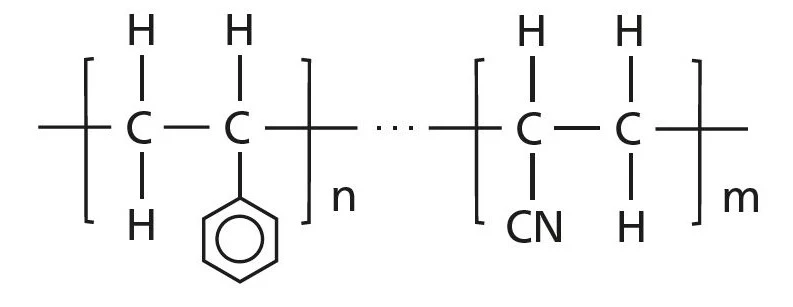
Styrene acrylonitrile (SAN) belongs to the family of styrene copolymers. A typical composition is approx. 70% styrene and 30% acrylonitrile. However, other compositions are also possible and have an impact on the material properties such as Glass Transition TemperatureThe glass transition is one of the most important properties of amorphous and semi-crystalline materials, e.g., inorganic glasses, amorphous metals, polymers, pharmaceuticals and food ingredients, etc., and describes the temperature region where the mechanical properties of the materials change from hard and brittle to more soft, deformable or rubbery.glass transition temperature, stiff ness and toughness. It is worth mentioning that the elasticity modulus of SAN, at almost 4.000 MPa, is very high for an unfi lled, amorphous polymer.
Structural Formula
Properties
NETZSCH Measurement
| Sample Mass | 11.79 mg |
| Heating Rates | 10 K/min |
| Crucible | Al, pierced lid |
| Atmosphere | N2 (50 ml/min) |
Evaluation
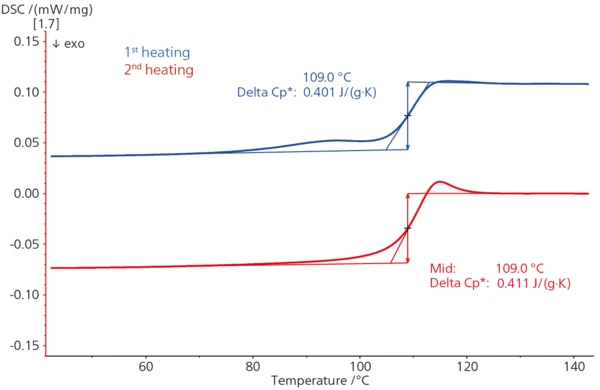
As an entirely amorphous thermoplastic, SAN has a Glass Transition TemperatureThe glass transition is one of the most important properties of amorphous and semi-crystalline materials, e.g., inorganic glasses, amorphous metals, polymers, pharmaceuticals and food ingredients, etc., and describes the temperature region where the mechanical properties of the materials change from hard and brittle to more soft, deformable or rubbery.glass transition in this case at 109°C (both heatings, midpoint each) with a step height (Δcp) of 0.40 J/(g.K) and 0.41 J/(g.K), respectively. In the 2nd heating (red), the Glass Transition TemperatureThe glass transition is one of the most important properties of amorphous and semi-crystalline materials, e.g., inorganic glasses, amorphous metals, polymers, pharmaceuticals and food ingredients, etc., and describes the temperature region where the mechanical properties of the materials change from hard and brittle to more soft, deformable or rubbery.glass transition step shows a RelaxationWhen a constant strain is applied to a rubber compound, the force necessary to maintain that strain is not constant but decreases with time; this behavior is known as stress relaxation. The process responsible for stress relaxation can be physical or chemical, and under normal conditions, both will occur at the same time. relaxation peak, indicating that short-range orders have formed in the polymer during the controlled cooling at 10 K/min. The thermomechanical history of the sample can be noticed in the DSC curve of the 1st heating (blue) by means of some slight waves.