EPDM: Ethylene-propylene-diene rubber

EM

Elastomers

General Properties

Short Name: EPDM

Name: Ethylene-propylene-diene rubber


EPDM is a terpolymer with a diene component, such as cyclopentadiene. E stands for ethylene, P for propylene, D for diene and M for the class of saturated carbon molecules in the main macro-molecule-chain (classification in accordance with ISO 1629 or ASTM D1418). Commercial EPDM rubbers have an ethylene content of approx. 45–75 weight%. Polymers with a low ethylene content (45–55 weight%) are amorphous and very flexible at low temperatures. With an increasing ethylene content, the degree of Crystallinity / Degree of CrystallinityCrystallinity refers to the degree of structural order of a solid. In a crystal, the arrangement of atoms or molecules is consistent and repetitive. Many materials such as glass ceramics and some polymers can be prepared in such a way as to produce a mixture of crystalline and amorphous regions.crystallinity rises. EPDM with a mean ethylene content of approx. 55–65 weight% is semi-crystalline. With ethylene contents >65 weight%, EPDM features larger crystalline regions and behaves as a thermoplastic elastomer.

Structural Formula

Analyzing and testing icons with a sleek design, ideal for digital product development and user experience optimization.

Properties

Glass Transition TemperatureThe glass transition is one of the most important properties of amorphous and semi-crystalline materials, e.g., inorganic glasses, amorphous metals, polymers, pharmaceuticals and food ingredients, etc., and describes the temperature region where the mechanical properties of the materials change from hard and brittle to more soft, deformable or rubbery.Glass Transition Temperature-55 to -30°C
Melting Temperatures and EnthalpiesThe enthalpy of fusion of a substance, also known as latent heat, is a measure of the energy input, typically heat, which is necessary to convert a substance from solid to liquid state. The melting point of a substance is the temperature at which it changes state from solid (crystalline) to liquid (isotropic melt).Melting Temperature-20 to 60°C
Melting Temperatures and EnthalpiesThe enthalpy of fusion of a substance, also known as latent heat, is a measure of the energy input, typically heat, which is necessary to convert a substance from solid to liquid state. The melting point of a substance is the temperature at which it changes state from solid (crystalline) to liquid (isotropic melt).Melting Enthalpy5 to 20 J/g
Decomposition reactionA decomposition reaction is a thermally induced reaction of a chemical compound forming solid and/or gaseous products. Decomposition Temperature470 to 487°C
Young's Modulus2 to 10 MPa
Coefficient of Linear Thermal Expansion (CLTE/CTE)The coefficient of linear thermal expansion (CLTE) describes the length change of a material as a function of the temperature.Coefficient of Linear Thermal Expansion180 *10-6/K
Specific Heat Capacity1.80 to 2.00 J/(g*K)
Thermal ConductivityThermal conductivity (λ with the unit W/(m•K)) describes the transport of energy – in the form of heat – through a body of mass as the result of a temperature gradient (see fig. 1). According to the second law of thermodynamics, heat always flows in the direction of the lower temperature.Thermal Conductivity0.26 W/(m*K)
DensityThe mass density is defined as the ratio between mass and volume. Density0.86 g/cm³
MorphologyRubber, sometimes with soft and hard segments
General propertiesVery good electrical insulating properties. Very good ozone and sunlight resistance. Good aging resistance. Good resistance to heat, chemicals, hot water and water vapor
ProcessingCross-linking by means of sulfur (with accelerators) or peroxides
ApplicationsSeals and profiles. Cable sheathings and insulations. Cool water hoses. Components of household appliance. Construction sealing strips. Blend partners in PP-EPDM blends (TPV) to improve the impact strength of PP (application in the automobile industry as underbody or bumper material)

NETZSCH Measurement

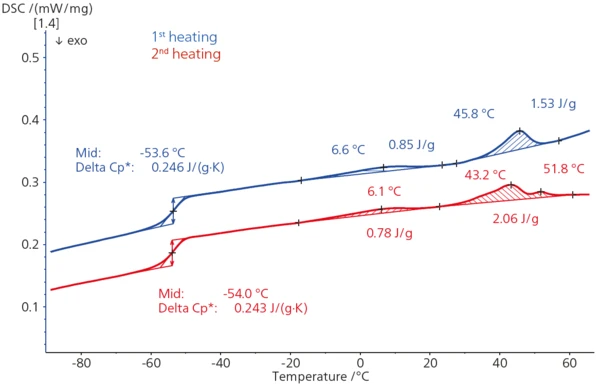
Differential Scanning Calorimetry (DSC) graph showing heating curves for two cycles, highlighting temperature transitions and heat flow.
Sample Mass13.83 mg
Heating Rates10 K/min
CrucibleAl, pierced lid
AtmosphereN2 (40 ml/min)

Evaluation

This EPDM sample is not purely amorphous since it exhibits a small melting transition at 6°C (peak temperature, 2nd heating, red) with an enthalpy of 0.8 J/g, indicating a small amount of crystalline content. The Glass Transition TemperatureThe glass transition is one of the most important properties of amorphous and semi-crystalline materials, e.g., inorganic glasses, amorphous metals, polymers, pharmaceuticals and food ingredients, etc., and describes the temperature region where the mechanical properties of the materials change from hard and brittle to more soft, deformable or rubbery.glass transition at -54°C (midpoint, both heatings) is from the amorphous content. The endothermal effect with peak temperatures of 43°C and 52°C (2nd heating, red) is probably due to the melting of additives. This appears as a single peak in the 1st heating (blue).

AI Overview
An error occurred. Please try again.