HNBR: Hydrogenated acrylonitrile-butadiene rubber

EM

Elastomers

General Properties

Short Name: HNBR

Name: Hydrogenated acrylonitrile-butadiene rubber


Hydrogenated acrylonitrile butadiene rubber (HNBR) is a saturated (or only slightly unsaturated) copolymer of acrylonitrile and butadiene and is obtained by selective hydrogenation of the butadiene groups of NBR. Due to fewer double bonds, it is considerably more inert than NBR.

Structural Formula

Abstract geometric shapes in black on a white background, ideal for modern design and analysis contexts.

Properties

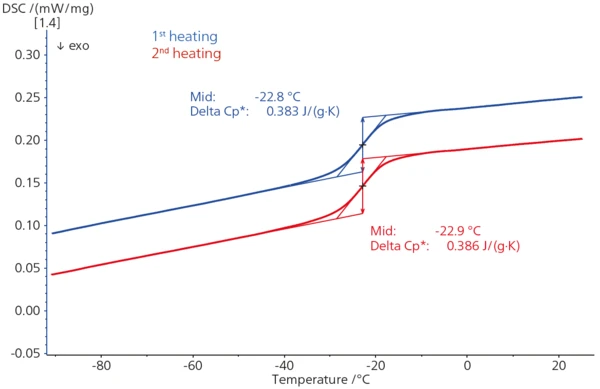
Glass Transition TemperatureThe glass transition is one of the most important properties of amorphous and semi-crystalline materials, e.g., inorganic glasses, amorphous metals, polymers, pharmaceuticals and food ingredients, etc., and describes the temperature region where the mechanical properties of the materials change from hard and brittle to more soft, deformable or rubbery.Glass Transition Temperature-30 to -10°C
Melting Temperatures and EnthalpiesThe enthalpy of fusion of a substance, also known as latent heat, is a measure of the energy input, typically heat, which is necessary to convert a substance from solid to liquid state. The melting point of a substance is the temperature at which it changes state from solid (crystalline) to liquid (isotropic melt).Melting Temperature-
Melting Temperatures and EnthalpiesThe enthalpy of fusion of a substance, also known as latent heat, is a measure of the energy input, typically heat, which is necessary to convert a substance from solid to liquid state. The melting point of a substance is the temperature at which it changes state from solid (crystalline) to liquid (isotropic melt).Melting Enthalpy-
Decomposition reactionA decomposition reaction is a thermally induced reaction of a chemical compound forming solid and/or gaseous products. Decomposition Temperature465 to 480°C
Young's Modulus15 to 25 MPa
Coefficient of Linear Thermal Expansion (CLTE/CTE)The coefficient of linear thermal expansion (CLTE) describes the length change of a material as a function of the temperature.Coefficient of Linear Thermal Expansion225 to 260 *10-6/K
Specific Heat Capacity-
Thermal ConductivityThermal conductivity (λ with the unit W/(m•K)) describes the transport of energy – in the form of heat – through a body of mass as the result of a temperature gradient (see fig. 1). According to the second law of thermodynamics, heat always flows in the direction of the lower temperature.Thermal Conductivity-
DensityThe mass density is defined as the ratio between mass and volume. Density0.92 to 1.00 g/cm³
MorphologyAmorphous rubber
General propertiesVery good oil and gas resistance (like for NBR). High ozone resistance. Good abrasion resistance. Higher temperature, aging and weather resistance than NBR
ProcessingCross-linking by means of sulfur, peroxides or by radiation
ApplicationsFriction linings. Seals. Cables. Profiles

NETZSCH Measurement

DSC analysis graph showing temperature vs. heat flow for first (blue) and second (red) heating cycles, with midpoints and Delta Cp values.
Sample Mass12.40 mg
Heating Rates10 K/min
CrucibleAl, pierced lid
AtmosphereN2 (40 ml/min)
AI Overview
An error occurred. Please try again.