General Properties
Short Name: Q
Name: Silicone rubber
Hydrogenated acrylonitrile butadiene rubber (HNBR) is a saturated (or only slightly unsaturated) copolymer of acrylonitrile and butadiene and is obtained by selective hydrogenation of the butadiene groups of NBR. Due to fewer double bonds, it is considerably more inert than NBR.
Structural Formula

Properties
NETZSCH Measurement
| Sample Mass | 12.81 mg |
| Heating Rates | 10 K/min |
| Crucible | Al, pierced lid |
| Atmosphere | N2 (40 ml/min) |
Evaluation
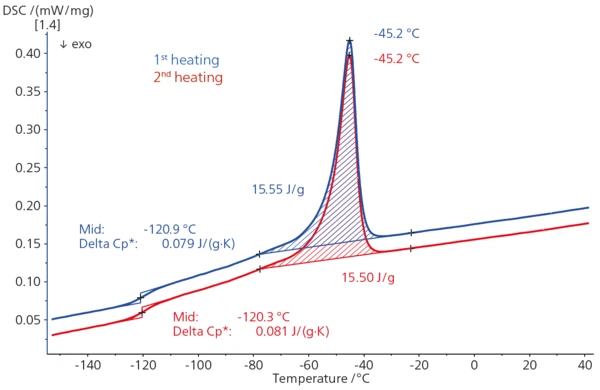
The amorphous portion of silicone rubber (Q) exhibits a very low Glass Transition TemperatureThe glass transition is one of the most important properties of amorphous and semi-crystalline materials, e.g., inorganic glasses, amorphous metals, polymers, pharmaceuticals and food ingredients, etc., and describes the temperature region where the mechanical properties of the materials change from hard and brittle to more soft, deformable or rubbery.glass transition temperature of -120°C (midpoint, 2nd heating, red). The crystalline portion exhibits a sharp melting transition with a peak temperature of -45°C (both heatings). The detected Glass Transition TemperatureThe glass transition is one of the most important properties of amorphous and semi-crystalline materials, e.g., inorganic glasses, amorphous metals, polymers, pharmaceuticals and food ingredients, etc., and describes the temperature region where the mechanical properties of the materials change from hard and brittle to more soft, deformable or rubbery.glass transition with step heights (Δcp) of 0.08 J/(g*K), even in the 2nd heating after a controlled cooling at 10 K/min, indicates a relatively high amorphous content. Highly crystalline silicone rubbers often must be quenched (cooled very quickly) in order to make the Glass Transition TemperatureThe glass transition is one of the most important properties of amorphous and semi-crystalline materials, e.g., inorganic glasses, amorphous metals, polymers, pharmaceuticals and food ingredients, etc., and describes the temperature region where the mechanical properties of the materials change from hard and brittle to more soft, deformable or rubbery.glass transition step visible. Due to the very low Glass Transition TemperatureThe glass transition is one of the most important properties of amorphous and semi-crystalline materials, e.g., inorganic glasses, amorphous metals, polymers, pharmaceuticals and food ingredients, etc., and describes the temperature region where the mechanical properties of the materials change from hard and brittle to more soft, deformable or rubbery.glass transition (-120°C), it is recommended to select a start temperature that is approx. 45°C to 50°C below the Glass Transition TemperatureThe glass transition is one of the most important properties of amorphous and semi-crystalline materials, e.g., inorganic glasses, amorphous metals, polymers, pharmaceuticals and food ingredients, etc., and describes the temperature region where the mechanical properties of the materials change from hard and brittle to more soft, deformable or rubbery.glass transition temperature, i.e., in this case at -165°C.