PVDF: Polyvinylidene fluoride

HTRTP

High-Temperature Resistant Thermoplastics

General Properties

Short Name: PVDF

Name: Polyvinylidene fluoride


Polyvinylidene fluoride (PVDF), like PTFE, belongs to the semi-crystalline, thermoplastic fluoroplastics.

Structural Formula

Detailed diagram of an evacuation system, showcasing components like purge connections and gas flow management.

Properties

Glass Transition TemperatureThe glass transition is one of the most important properties of amorphous and semi-crystalline materials, e.g., inorganic glasses, amorphous metals, polymers, pharmaceuticals and food ingredients, etc., and describes the temperature region where the mechanical properties of the materials change from hard and brittle to more soft, deformable or rubbery.Glass Transition Temperature-40°C
Melting Temperatures and EnthalpiesThe enthalpy of fusion of a substance, also known as latent heat, is a measure of the energy input, typically heat, which is necessary to convert a substance from solid to liquid state. The melting point of a substance is the temperature at which it changes state from solid (crystalline) to liquid (isotropic melt).Melting Temperature170 to 175°C
Melting Temperatures and EnthalpiesThe enthalpy of fusion of a substance, also known as latent heat, is a measure of the energy input, typically heat, which is necessary to convert a substance from solid to liquid state. The melting point of a substance is the temperature at which it changes state from solid (crystalline) to liquid (isotropic melt).Melting Enthalpy105 J/g
Decomposition reactionA decomposition reaction is a thermally induced reaction of a chemical compound forming solid and/or gaseous products. Decomposition Temperature440 to 480°C
Young's Modulus2000 to 2900 MPa
Coefficient of Linear Thermal Expansion (CLTE/CTE)The coefficient of linear thermal expansion (CLTE) describes the length change of a material as a function of the temperature.Coefficient of Linear Thermal Expansion110 to 130 *10-6/K
Specific Heat Capacity0.96 to 1.40 J/(g*K)
Thermal ConductivityThermal conductivity (λ with the unit W/(m•K)) describes the transport of energy – in the form of heat – through a body of mass as the result of a temperature gradient (see fig. 1). According to the second law of thermodynamics, heat always flows in the direction of the lower temperature.Thermal Conductivity0.19 W/(m*K)
DensityThe mass density is defined as the ratio between mass and volume. Density1.76 to 1.78 g/cm³
MorphologySemi-crystalline polymer
General propertiesRigid and tough. Very good chemical resistance. High UV resistance. Good abrasion resistance. Very low water absorption
ProcessingExtrusion, injection molding
ApplicationsChemical industry, construction of chemical plants. Food industry. Semiconductor industry

NETZSCH Measurement

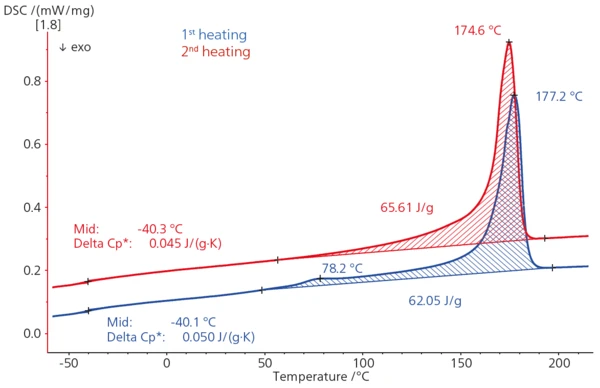
Differential Scanning Calorimetry (DSC) graph showing exothermic peaks and specific heat capacities for two heating cycles.
Sample Mass18.64 mg
Heating Rates10 K/min
CrucibleAl, pierced lid
AtmosphereN2 (70 ml/min)

Evaluation

PVDF is a semi-crystalline polymer and shows, along with a Glass Transition TemperatureThe glass transition is one of the most important properties of amorphous and semi-crystalline materials, e.g., inorganic glasses, amorphous metals, polymers, pharmaceuticals and food ingredients, etc., and describes the temperature region where the mechanical properties of the materials change from hard and brittle to more soft, deformable or rubbery.glass transition at -40°C (midpoint, visible in both heatings), a broad melting range from approx. 50°C/60°C to approx. 200°C. Nevertheless, the molecular weight distribution of the polymer chains is narrow, as indicated by the narrow full width at half maximum of the main peak with a peak temperature of 175°C (2nd heating, red). The melting enthalpy was approx. 66 J/g in the 2nd heating (red) indicating a degree of Crystallinity / Degree of CrystallinityCrystallinity refers to the degree of structural order of a solid. In a crystal, the arrangement of atoms or molecules is consistent and repetitive. Many materials such as glass ceramics and some polymers can be prepared in such a way as to produce a mixture of crystalline and amorphous regions.crystallinity of approx. 63%, based on an enthalpy value of 105 J/g for the 100% crystalline material.

Degree of Crystallinity / Degree of CrystallinityCrystallinity refers to the degree of structural order of a solid. In a crystal, the arrangement of atoms or molecules is consistent and repetitive. Many materials such as glass ceramics and some polymers can be prepared in such a way as to produce a mixture of crystalline and amorphous regions.crystallinity (in %):

Formula for calculating melting enthalpy percentage for crystalline materials, highlighting experimental versus theoretical values.
AI Overview
An error occurred. Please try again.