Introduction
Fire tests play a crucial role in ensuring personal safety, meeting legal requirements and minimizing potential property damage, by evaluating how materials and systems behave under fire conditions. Controlled tests verify whether products can withstand heat, limit the spread of fire and guarantee the reliable operation of critical building systems, such as fire alarms and suppression systems, in an emergency.
Fire tests also confirm compliance with national and international fire safety standards, which are essential prerequisites for building permits and product certifications. At the same time, the actual performance of materials and protection systems is evaluated to ensure they provide sufficient time for safe evacuation and limit the impact of a fire.
TCC Method
A polymer-based reference material was examined. As part of a development project, several variants with targeted material modifications were produced to systematically analyze their influence on key fire performance parameters.
The focus was on determining the extent to which firerelated parameters change compared to the reference material, and identifying correlations between these parameters.
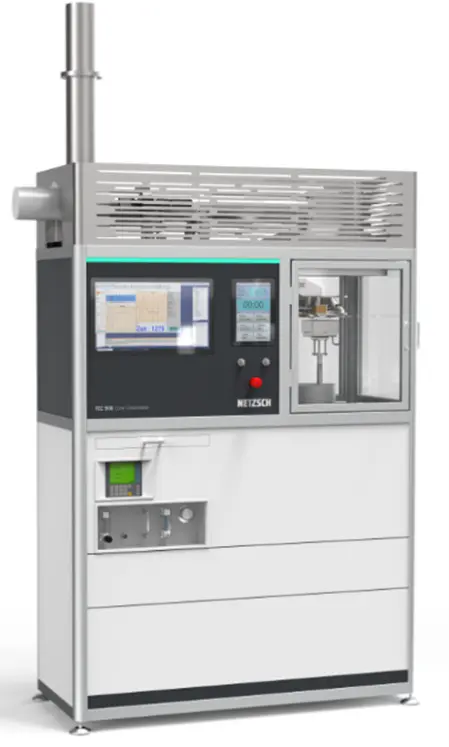
The TCC 918 (figure 1) was used for the experimental investigation. This method enables simultaneous determination of several fire-relevant parameters, including:
- Time to ignition (TOI)
- Maximum heat release rate (HHRmax)
- Total smoke release (TSR)
- Mass loss during combustion
Cone calorimetry thus allows for the comprehensive characterization of the fire behavior of polymer-based materials under defined and reproducible fire conditions.
Determination of the heat release rate is based on the oxygen consumption principle, where the heat released is calculated from the measured oxygen consumption of the combustion gases.
Measurement Conditions
The measurements were carried out with the NETZSCH TCC 918 Cone Calorimeter in accordance with ISO 5660-1. The measurement parameters are listed in Table 1.
Table 1: Measurement conditions
| Sample holder | Horizontal |
| Heat flow | 50kW/m2 |
| Nominal heat flow rate | 24.0 l/s |
| Distance to the cone heater | 25 mm |
The samples were positioned horizontally in the sample holder and subjected to a constant heat flow DensityThe mass density is defined as the ratio between mass and volume. density of 50 kW/m². This thermal load corresponds to a typical fire scenario, enabling realistic assessment of fire behavior.
During the measurement, the heat release rate, smoke production and mass loss were continuously recorded.
The test series included the following materials:
- Standard material
- Development variants A, B, C and D
All samples were polymer-based materials with the following geometric properties:
- Area: 100 x 100 mm
- Thickness: 3.3 - 3.9 mm
- Mass: 53 - 62 g
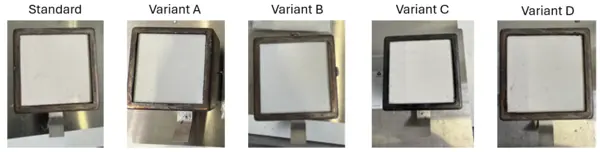
While the material base is comparable in all cases, the variants have been specifically modified. Figure 2 shows the samples in the sample holder prior to measurement.
Measurement Results
Ignition Behavior – Delay as a Development Goal
The measured times to ignition (TOI1) ranged from 69 s to 86 s.
With 86 s, variant A showed the longest time to ignition, while the standard material was in the middle range of the tested materials.
The results demonstrate that targeted modifications can enhance ignition resistance. A longer ignition time means that the material transitions to self-sustaining combustion at a later stage under identical thermal loading.
1TOI(Time to Ignition): Time span from the start of the heat release until the sample ignites.
Heat Release – Standard Remains the Benchmark
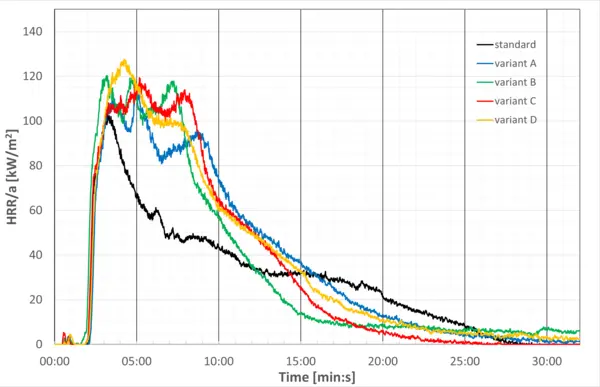
The maximum heat release rates (HRRmax2) were between 102 and 128kW/m2 (see figure 3).
The standard material exhibited the lowest maximum heat release rate, while development variants A through D showed comparable or slightly higherHRRmax values.
No additional reduction in the maximum heat release rate compared to the reference material was observed. Regarding the maximum heat release, the standard material therefore remains the benchmark.
While only moderate differences were observed in terms of ignition behaviour and maximum heat release, more pronounced differences occurred between the materials regarding smoke development.
2HRRmax: Maximum heat release rate; highest measured value of HRR during the test and parameter for the maximum fire intensity.
Smoke Production – Clear Differentiation
As shown in figure 4, the greatest differences between the materials are evident in smoke development.
The standard material exhibits the lowest total smoke release (TSR3). Variant C shows the highest smoke production, while variants A, B and D are in the middle range.
3TSR(Total Smoke Release): Total amount of smoke released during the test; integrale parameter for the quantitative assessment of smoke production over the entire duration of the fire.

These results demonstrate that improving individual parameters, such as ignition time, does not necessarily reduce smoke release. Therefore, the fire behavior of polymeric materials represents a multidimensional optimization problem, where changes in material composition can differently affect the ignition behavior, heat release and smoke development.
Mass Loss – Comparable Degradation Mechanisms
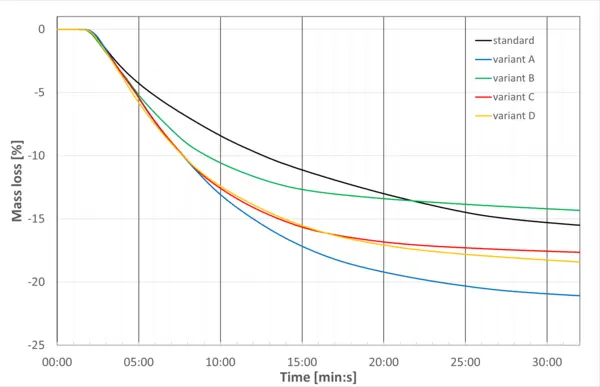
The relative mass loss during the measurement ranged from 14% to 21% (see figure 5). Expression of the results as relative mass loss enables direct comparison of the degradation profiles, despite minor differences in sample mass. There are only minor differences in the timely course of material degradation among the examined variants. The similar curve profiles suggest that all materials undergo thermal Decomposition reactionA decomposition reaction is a thermally induced reaction of a chemical compound forming solid and/or gaseous products. decomposition and combustion in a comparable manner. The standard material exhibits slightly lower mass loss at the start of combustion, and the curves converge as the process continues.
State the Sample after the Measurement
Upon completion of the measurements, significant residue formation was observed for all materials (figure 6). The differences in the structure, integrity and surface characteristics of the residues correlate with the variations observed in the combustion profile.

Summary
Cone calorimetry using the NETZSCH TCC 918 allows for the simultaneous measurement of the heat release, smoke production, and mass loss, providing a comprehensive experimental basis for evaluating and optimizing polymeric materials with regard to their fire behavior.
Investigating variants of a polymer-based reference material reveals significant differences in individual fire-related parameters.
Among the materials tested, variant A achieves the longest ignition time at 86 s, thus exhibiting the highest ignition resistance.
However, the standard material remains the benchmark regarding the maximum heat release rate, as it shows the lowestHRRmax.
The standard material also exhibits the most favorable smoke development properties, with the lowest total smoke release; while variant C reveals the highest smoke production.
The relative mass loss for all materials lies within a similar range between 14 to 11%, indicating comparable thermal Decomposition reactionA decomposition reaction is a thermally induced reaction of a chemical compound forming solid and/or gaseous products. decomposition mechanisms.
The results demonstrate that simultaneous optimization of all fire-related parameters is not readily achievable. Improvement of individual parameters may be accompanied by changes in other fire performance characteristics.
Cone Calorimetry allows for sensitive differentiation even between closely related material formulations.