Introduction
Polypropylene (PP) is a thermoplastic that is both economically significant and easy to process, offering a wide range of applications. However, due to its relatively high flammability, its use in applications requiring increased fire safety is limited.
A well-established strategy for improving fire behavior is to use high proportions of mineral fillers. In the event of a fire, these can act as a thermal barrier, reducing heat release and slowing down the Decomposition reactionA decomposition reaction is a thermally induced reaction of a chemical compound forming solid and/or gaseous products. decomposition process while contributing to the formation of stable residual structures.
This application note examines four highly filled PP materials with a filler content of 60%. One material serves as a reference, while materials 1, 2 and 3 represent modified variants with adjusted compositions.
The study aims to systematically quantify differences in the fire and smoke behavior of these PP systems and evaluate the influence of the material modifications on ignition behavior, heat release, smoke generation and mass loss.
Measurement Conditions
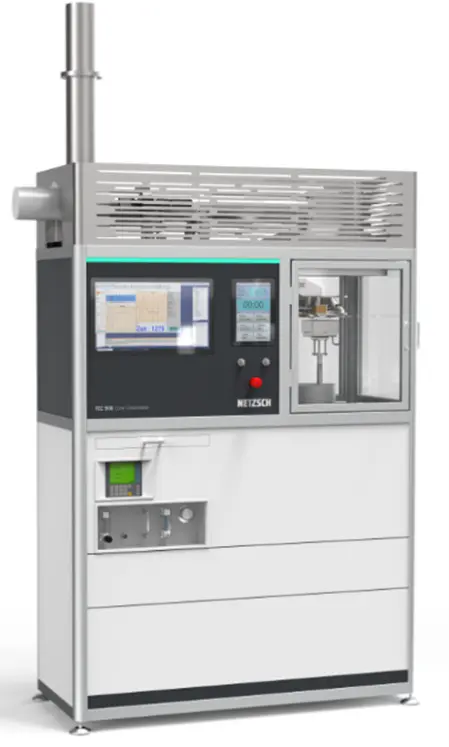
The investigation were carried out with the TCC 918 Cone Calorimeter (figure 1) in accorrdance with ISO 5660-1.
The samples were positioned horizontally and exposed to a constant heat flow DensityThe mass density is defined as the ratio between mass and volume. density of 50 kW/m². The following parameters were recorded during the measurement:
- Time to ignition (TOI)
- Maximum heat release rate (HRRmax)
- Total smoke release (TSR)
- Time-dependent mass loss
The main testing parameter are summarized in table 1.
Table 1: Measurement conditions
| Sample holder | Horizontal |
| Heat flow | 50kW/m2 |
| Nominal flow rate | 24.0 l/s |
| Distance to the cone heater | 25 mm |
| Sample masses | Standard: 48.8 g Material 1: 38.3 g Material 2: 41.9 g Material 3: 42.3 g |
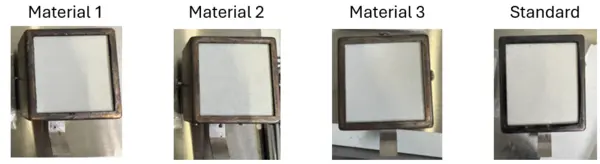
Figure 2 shows the samples in the sample holder prior to the measurement.
Measurement Conditions
Ignition Behavior
All tested materials ignited within a narrow time window of approximately 21 to 25 seconds.
These very similar ignition times suggest that the different material modifications have little to no influence on the initial thermal heating and Decomposition reactionA decomposition reaction is a thermally induced reaction of a chemical compound forming solid and/or gaseous products. decomposition behavior of the PP systems under the selected test conditions.
Heat Release
The heat releaserate1 is a key parameter for evaluating the fire intensity of materials. The corresponding HRR curves are shown in figure 3.
1Heatrelease rate (HRR): The rate of energy released per unit of time and area during combustion. It is s considered one of the most important parameters for assessing fire intensity and is determined using a cone calorimeter based on the oxygen consumption principle.
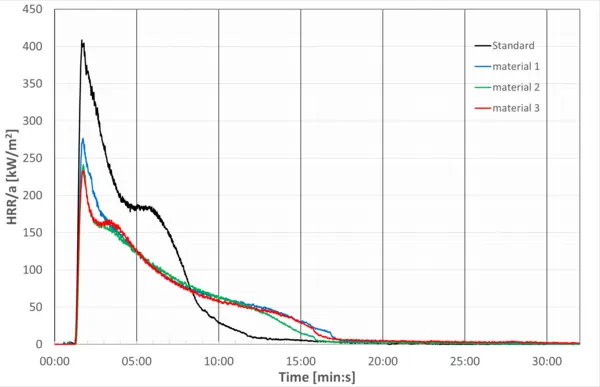
The reference material exhibits a significantly more pronounced peak in the heat release rate. The maximum heat release rate (HRRmax) is approximately twice that of the modified PP variants.
Materials 1, 2 and 3, on the contrary, achieved significantly lowerHRRmax values and exhibited more uniform overall fire growth. This suggests that the modified material composition effectivly limits fire intensity in the early phase of a fire.
After the initial maximum, the heat release curves of the different material converge. This indicates that despite their different formulations, the materials investigated exhibit similar overall combustion behavior.
Smoke Development
The most significant differences between the tested material variants are observed in smoke development, which is a key safety-related parameter in the event of a fire (see Figure 4).
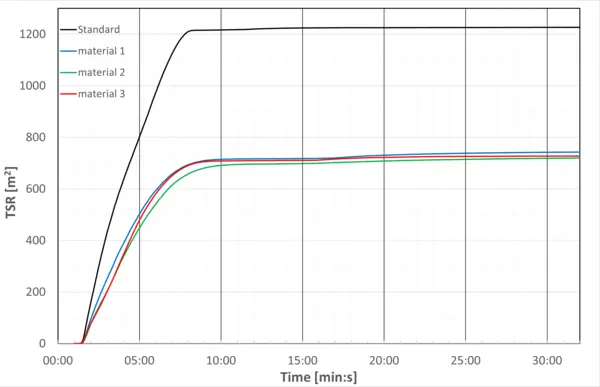
The standard material exhibits the highest total smoke release. In contrast, all three modified PP variants demonstrate significantly reduced total smoke emission throughout the duration of the fire.
The TSR² values of materials 1, 2 and 3 are significantly lower than the reference material’s value. This shows that smoke generation can be reduced by making specific changes to the material’s composition.
The results show that smoke development can be optimized through appropriate modifications to the formulation without significantly affecting the ignition behavior of highly filled PP systems.
2TSR(Total Smoke Release): Total smoke release during the test; an integral parameter for quantitative assessment of smoke production over the entire duration of the fire.
Mass Loss
The relative mass loss is a measure of the thermal degradation of materials during fire exposure, as shown in figure 5. Expressing the data as a percentage compensates for the influence of different initial sample masses and enables direct comparison of the degradation curves.

The three modified polypropylene (PP) materials (materials 1 to 3) exhibit very similar relative mass-loss curves. The maximum mass loss for all three variants is approximately 8 to 9%.
In contrast, the standard material exhibits significantly higher relative mass loss of almost 12%. Therefore, under the selected test conditions, it undergoes greater thermal degradation than the modified PP variants.
The lower relative mass loss of the modified materials is consistent with their high mineral filler content, which reduces the polymer content and can contribute to stable residue formation.
The similar curves for materials 1 to 3 indicate that modifying the material composition leads to comparable thermal Decomposition reactionA decomposition reaction is a thermally induced reaction of a chemical compound forming solid and/or gaseous products. decomposition behavior in these variants.
Condition of the Samples after the Measurement
Upon completion of the measurements, all materials tested exhibit significant residue formation, as typical for highly filled PP systems (see figure 6).
Differences in surface structure and degree of charring correlate with the observed variations in the early stages of the fire.

Summary
The investigation of the highly filled polypropylene (PP) materials show that all systems tested under the selected test conditions have comparable ignition times.
However, the reference material exhibited a significantly higher maximum heat release rate (HRRmax), approximately twice that of the modified PP variants, indicating higher fire intensity.
The differences in smoke generation are particularly pronounced. All of the modified materials demonstrate significantly reduced total smoke release (TSR) compared to the reference system.
The relative mass loss is also lower for the modified PP variants, at around 8 to 9%, than for the standard material, at almost 12%, suggesting reduced thermal degradation of the material.
These results demonstrate that targeted adjustments to the material composition can reduce the maximum fire intensity, smoke development, and material degradation of highly filled PP systems.
Cone calorimetry is considered as one of the most important methods for evaluating the fire behavior of polymer materials. This is because it simultaneously measures key parameters such as heat release, smoke generation and mass loss under defined fire conditions.
The NETZSCH TCC 918 provides a reliable and reproducible means of characterizing such material-related differences.