Introduction
When it comes to sensory play materials, kinetic sand and play putty offer children distinctly different experiences – both fascinating in their own right. Though they may seem similar at first glance, their underlying compositions and physical behaviors reveal a world of difference.
Kinetic sand is a dispersion of sand particles dispersed within a small amount of polymer (PDMS – polydimethylsiloxane), giving it a unique flow-like behavior while still retaining the granular texture of sand. Upon agitation, it behaves almost like a slow-moving liquid, allowing children to mold, slice, and crumble it with ease. Its composition is close to the maximum packing fraction – meaning the sand particles are densely packed, with just enough binder to allow both movement and adhesion without collapsing into a heap.
In contrast, play putty (also based on PDMS) is usually a dispersion of pigment particles in a viscoelastic medium. It stretches, bounces, and can even snap under sudden force. Unlike kinetic sand, play putty has a much lower solid loading with significantly smaller particles, resulting in a more fluid and elastic behavior.
While both kinetic sand and play putty are classified as dispersions, they are formulated quite differently. Rheological testing explains the unique properties of kinetic sand and play putty and their dependence on how they are handled.
Test Results and Discussion
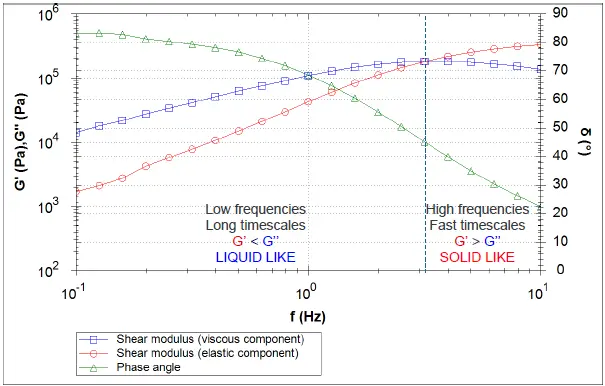
Figure 1 depicts the resulting curves of a frequency sweep performed on play putty.
While G' (elastic shear modulus) describes the solid-like properties of the material, G" (viscous shear modulus), is related to its liquid-like properties. The phase angle, δ, is the lag between applied oscillatory StrainStrain describes a deformation of a material, which is loaded mechanically by an external force or stress. Rubber compounds show creep properties, if a static load is applied.strain and resulting StressStress is defined as a level of force applied on a sample with a well-defined cross section. (Stress = force/area). Samples having a circular or rectangular cross section can be compressed or stretched. Elastic materials like rubber can be stretched up to 5 to 10 times their original length.stress. It is defined as:
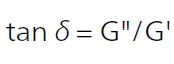
The phase angle varies from 0° for a perfect elastic material up to 90° for perfect viscous ones.
At high frequencies, the elastic shear modulus is greater than the viscous shear modulus. As a result, for rapid oscillations (associated with short timescales or quick movements), the material exhibits solid-like behavior.
A crossover between G' and G" is observed at 3 Hz, corresponding to a phase angle of 45°. At lower frequencies, indicative of slower movements, play putty exhibits flow behavior.
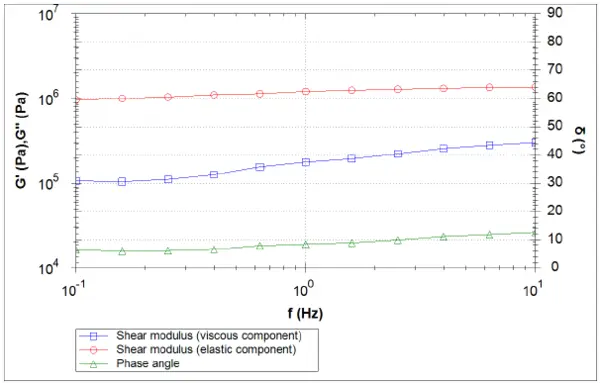
Figure 2 illustrates the frequency-dependent behavior of the elastic shear modulus (G'), viscous shear modulus (G"), and phase angle (δ) for kinetic sand. Across the entire measured frequency range, the material exhibits predominantly solid-like characteristics. This is evidenced by the consistently lower phase angle values (below 45°) and the dominance of G' over G" throughout the measurement.
Conclusion
Frequency sweeps are used to predict how a material behaves over both short or long timescales. The curves obtained from testing play putty and kinetic sand can be associated with the sensory experiences of the individuals using them. Kinetic sand allows for the construction of shapes or structures, which maintain their form. Play putty gradually flows and takes on the shape of its container after use.