Introduction
The NETZSCH Kinexus Prime series of rheometers can characterize a broad range of complex fluids and semisolids due to its sensitivity, low volume requirement, modular geometries, and advanced software capabilities. Particularly, these rheometers possess an ultra-low friction air bearing which provides unmatched sensitivity across very low (0.001 1/s) to very high (10,000 1/s) shear rates. This is important for understanding and being able to measure material behavior under real world conditions such as shear through an eyedropper or physiological shear over the eye during blinking. Ophthalmic- focused therapeutic companies can use the data generated by the Kinexus Prime series of rheometers to influence formulation development.
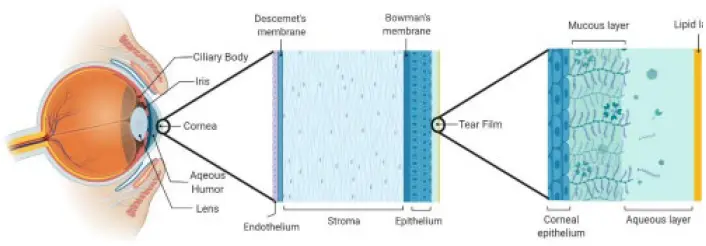
Topical eyedrops are the frontline treatment modality for ocular conditions, such as dry eye, glaucoma, and seasonal allergies. However, it is well understood that topical eyedrops are largely ineffective with less than 5% of the drug in an applied dose reaching the target tissues [1]. This phenomenon is primarily caused by natural effect of the eye to clear away foreign objects. The front of the eye, as shown in Figure 1, consists of numerous barriers such as the complex tear film and the hydrophobic and hydrophilic nature of the cornea. Additionally, nasolacrimal drainage and blinking play a major role in quickly eliminating applied eyedrops. Blinking is a unique case in which shear rate goes from zero while the eye is open, to very high shear as the lids quickly close and reopen.
To improve the residence time of active components, different dosage forms can be used, such as ointments, gels and emulsions. NETZSCH recently worked with the R&D group of an eyecare pharmaceutical and device company to develop a unique testing methodology, in the programmable rSpace software, to help guide formulation development of ointment and lubricant eyedrop formulations.
Measurement Conditions
Kinexus rheometers utilize rSpace software which allows users to program a custom test sequence. Users can also access and modify the over 200 pre-built programs that come with the software and cover 6 languages.
For testing the provided samples, a custom sequence was produced capable of measuring a single sample across a range of shear rates, at different temperatures, with intermittent pauses for heating. This method simulates both the application of the topical formulation as it is applied from the primary packaging (shear flow) at room temperature, and the effect of blinking at near physiological temperature. The test parameters are outlined in Table 1.
Table 1: Test parameters for measuring topical ophthalmic materials
| Geometry | 1° cone, 40 mm |
|---|---|
| Sample volume | 0.8 ml |
| Gap (H) | 1.5 mm |
| Normal force | 5 N |
| Temperature tested | 25°C and 37°C |
| Isotherm shear range | 1 -5000 1/s |
Comparing Topical Formulations
Viscosity as a function of shear rate and temperature for three commercial topical products are shown in Figures 2a, b and c. Figure 2a shows an ocular ointment made of petrolatum, mineral oil, and lanolin, which is used for providing overnight relief of dry eye symptoms. Figure 2b is also an ointment used to treat overnight symptoms of dry eye but includes Vitamin A along with petrolatum, mineral oil, and lanolin. Finally, Figure 2c, is an ocular lubricant with high molecular weight sodium hyaluronate and glycerin.
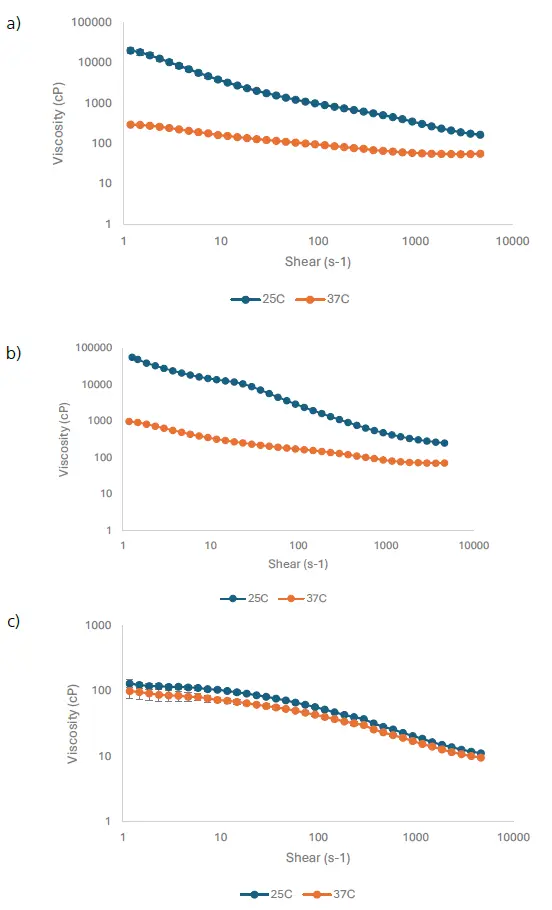
Although all three samples are designed to provide eye comfort for dry eye patients. The ocular ointment formulations shown in Figure 2a and 2b are orders of magnitude more viscous compared to the lubricant shown in Figure 2c. Additionally, the ointments have a clear temperature dependency in which heating the samples from ambient to physiological temperature significantly decreases their viscosity. In contrast, the lubricant shows only a slight reduction in viscosity as temperature increases, that doesn’t change its overall response profile. These are informative results from a design standpoint: the ointments ‘melt’ against the heat of the eye but remain viscous enough to enhance retention time. These ointments are often used for eye comfort in patients with severe dry eye and corneal diseases. The ocular lubricant on the other hand shows a distinct Shear ThinningThe most common type of non-Newtonian behavior is shear thinning or pseudoplastic flow, where the fluid viscosity decreases with increasing shear.shear thinning effect suggesting that the formulation will shear thin as a function of blinking and won’t be quickly removed or impede vision.
Finally, despite both being ocular lubricants with similar formulations, there is a distinct difference in the response profiles shown in Figure 2a and 2b. At room temperature, Figure 2b shows a biphasic response to shear rather than the gradual response shown by Figure 2a. Additionally, at physiological temperatures, sample 2b is significantly more viscous compared to 2a. This result illustrates the sensitivity of the Kinexus units and their ability to differentiate between products, even when they have similar compositions.
Summary
The NETZSCH Kinexus Prime series of rheometers offers users versatility and a high degree of customization when it comes to the characterization of complex fluids and semi-solids. For pharmaceutical and life science applications, the high sensitivity across a large shear rate range and low sample volume are both key attributes for testing. Herein, we demonstrated how a custom test method was generated for the Kinexus to produce data on commercial eyecare products to support formulation development. The broad shear rate range allows users to simulate blinking shear rates to guide formulation experts on ocular residence time, patient comfort and blur.