Introduction
Swallowing disorders due to a disease, recovery after an operation affecting throat or esophagus, premature birth and so on – there are plenty of reasons why a patient might not be able to eat on their own, and a liquid nutritional product is provided directly into the gastrointestinal tract, without oral intake.
Tube feeding formulations meet the nutritional needs of the patient and contain essential nutrients such as carbohydrates and proteins. Not only is their composition crucial to ensuring the patient’s comfort and safety, they must also meet expectations in terms of flowability, stability and bioavailability of ingredients. Formulations must easily flow through the tubes. Furthermore, they should be stable at rest to ensure that neither sedimentation nor phase separation take place. Finally, the flow behavior in the stomach is of crucial importance, to reduce the risks of vomiting, aspiration problems and flowing through the larynx to the respiratory system. Digestion in the acidic environment of the stomach involves chemical processes resulting in structural and rheological changes in foods.
In the following, digestion of a commercial tube feeding formulation is simulated ex-situ in the Kinexus rotational rheometer. Following this digestion process, the sample prepared this way is characterized by means of frequency sweeps. This allows the influence of digestion on rheological characteristics to be investigated.
Ex-Situ Digestion on the Kinexus Rotational Rheometer
The digestion simulation setup consists of:
- The Kinexus rotational rheometer equipped with a stainless-steel stirrer with 2 blades, with a diameter of 32 mm (figure 1). The cup was introduced into the cylinder cartridge to ensure accurate temperature control.
- A stainless-steel cup with a diameter of 34 mm.
- A solvent trap filled with water to minimize sample evaporation.
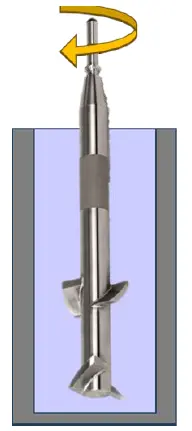
The acidic environment of the stomach was simulated by adding a solution wiht a pH value of 2 (acidic solution) to the tube-feed formulation (solution 3; see also table 1). Digestion was simulated by stirring this mixture at 37°C for three hours at a shear rate of 1 s-1.
A second solution was prepared as described in table 1 to ensure that possible differences between the measurements stem from acid present, and not from preparation.
Table 1: Preparation of the solutions
| Solution No. | Tube-feed formulation | Stirring condition | ||
|---|---|---|---|---|
| Duration | Temperature | Shear rate | ||
| 1 | Pure | - | - | - |
| 2 | Mixed with distilled water in a ratio formulation/water: 100/3 (w/w) | 3 hours | 37°C | 1 s-1 |
| 3 | Mixed with the acidic solution in a ration formulation/acidic solution: 100/3 (w/w) | 3 hours | 37°C | 1 s-1 |
Influence of Digestion on the Rheologial Properties
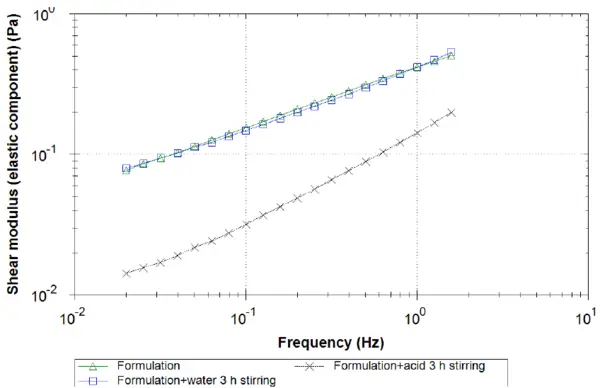
Frequency sweeps were conducted on the three solutions prepared according to table 1. For that, a 60-mm plate geometry was used. Here also, the geometry was equipped with a solvent trap filled with water. This accessory can be adapted to all types of Kinexus geometries. The measurements were performed at 25°C at a deformation of 1%. This deformation was found to be in the linear-viscoelastic region of the materials by means of an amplitude sweep (not presented). Figure 2 displays the curve of the elastic shear modulus measured during the frequency sweep on the three solutions.
The elastic shear modulus curves from the pure tube-feed measurements (green triangles) and from the reference solution (stirred for 3 h after adding 3% water; blue squares) do not exhibit visible differences. Adding an acid solution to the feed formulation and stirring the mixture for 3 h causes a decrease in G´ (black crosses).
Conclusion and Outlook
A setup mimicking digestion was used with the Kinexus rotational rheometer. The solution prepared with the dedicated system was rheologically compared to a reference solution on the basis of frequency sweeps. Stirring in an acidic environment for 3 hours (simulating the stomach) results in a decrease in elastic shear modulus.
Standard geometries and accessories of the Kinexus rotational rheometer can be used for both mimicking digestion and performing subsequent rheological characterization at controlled temperature and without evaporation. Even very weakly structured materials can be accurately tested thanks to the low torque ability of the Kinexus rheometer.
As a possible further development of this approach, the possibility of incorporating digestive enzymes in order to describe the environment in the stomach in even greater detail should be mentioned in particular.