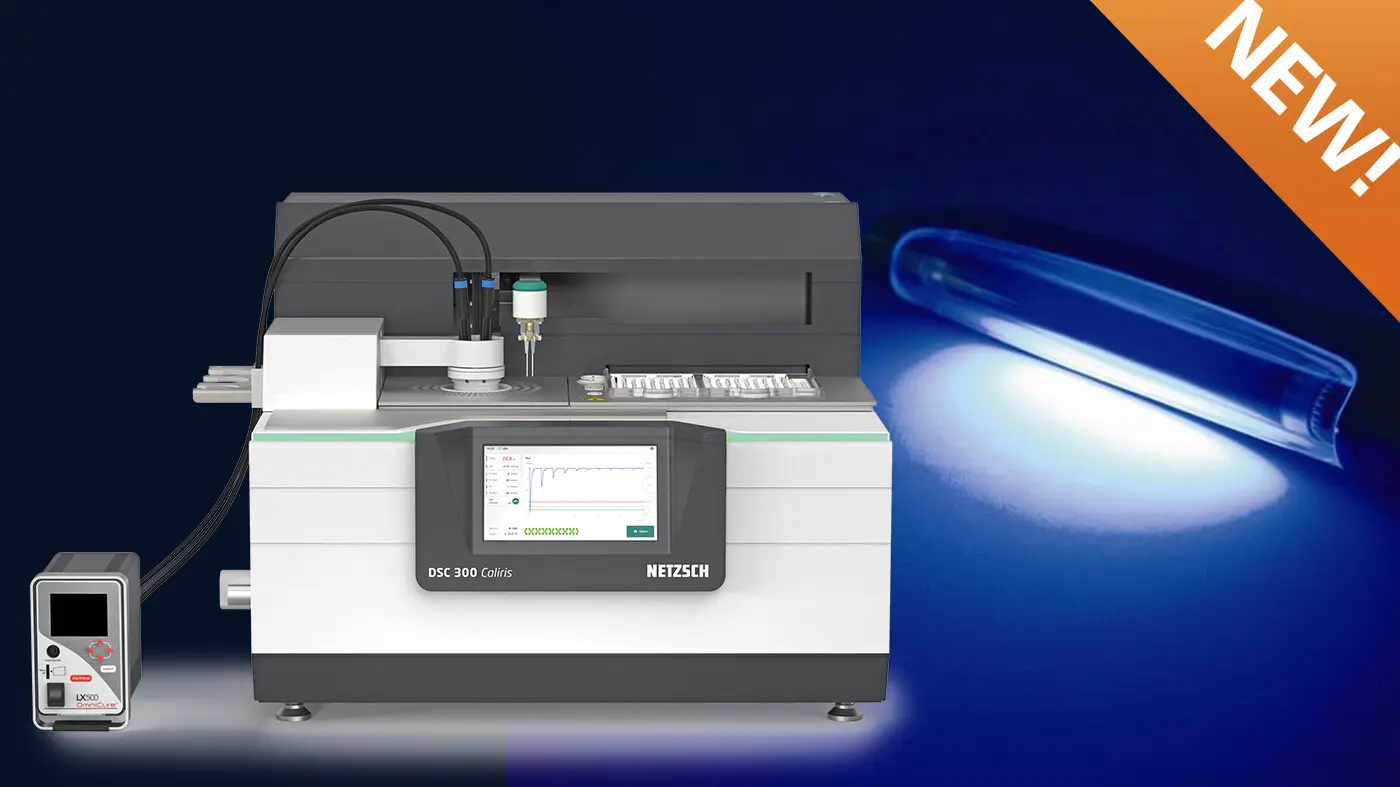
03.11.2025 by Aileen Sammler
Adding New Features to Our Success Story: NETZSCH DSC 300 Caliris®
Differential Scanning Calorimetry: We are taking the DSC 300 Caliris® success story even further – with three innovative new features that will make your analyses more efficient, transparent, and automated than ever before.
New Features for Thermal Analysis by means of DSC
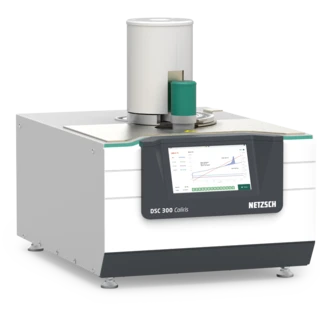
At NETZSCH Analyzing & Testing, we continue to set the benchmark in material characterization. Our DSC 300 Caliris® – the most comprehensive, reliable, and versatile differential scanning calorimeter (DSC) on the market – defines a new standard in thermal analysis.
Whether in research and development, quality control, contract testing, or material specification, the DSC 300 Caliris® delivers fast, reproducible results for melting and CrystallizationCrystallization is the physical process of hardening during the formation and growth of crystals. During this process, heat of crystallization is released.crystallization behavior, Glass Transition TemperatureThe glass transition is one of the most important properties of amorphous and semi-crystalline materials, e.g., inorganic glasses, amorphous metals, polymers, pharmaceuticals and food ingredients, etc., and describes the temperature region where the mechanical properties of the materials change from hard and brittle to more soft, deformable or rubbery.glass transition, Curing (Crosslinking Reactions)Literally translated, the term “crosslinking“ means “cross networking”. In the chemical context, it is used for reactions in which molecules are linked together by introducing covalent bonds and forming three-dimensional networks.curing, oxidative stability, purity, and much more. It is based on the heat-flux method in accordance with ISO 11357 and complies with all relevant standards, including ASTM E793, ASTM E967, ASTM E968, ASTM E794, ASTM E1356, and DIN 51007 – allowing for the highest measurement accuracy and comparability across laboratories worldwide.
Now, we are taking the DSC 300 Caliris® success story even further – with three innovative new features that will make your analyses more efficient, transparent, and automated than ever before.
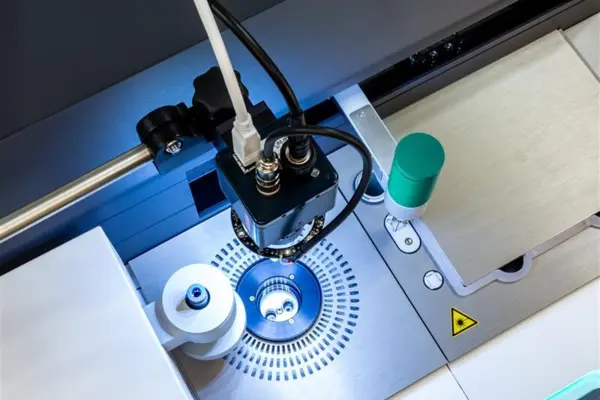
1. New Camera Feature Integration – Real-Time Visual Insights
The new camera feature elevates your analysis experience by providing enhanced data interpretation and real-time visual information directly during the measurement.
- Observe physical changes in your samples. Track transformations as they happen for a deeper understanding of material behavior.
- Instantly confirm sample integrity and behavior during the measurement process.
- Improve your sample preparation: Detect preparation or positioning issues early to ensure consistent, reliable results.
With this capability, you can truly see what your material experiences – merging visual observation and calorimetric data for comprehensive interpretation.
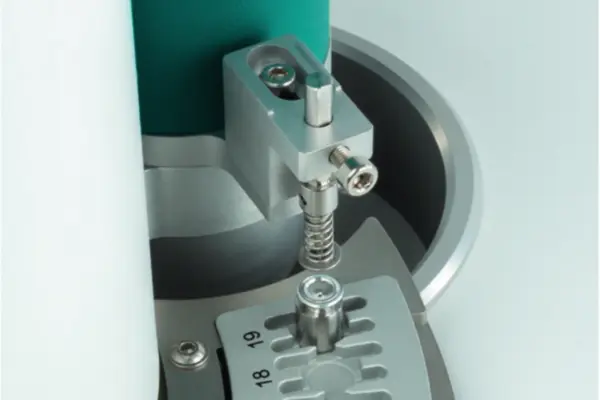
2. New Automatic Piercing Device for the 20-Position Automatic Sample Changer
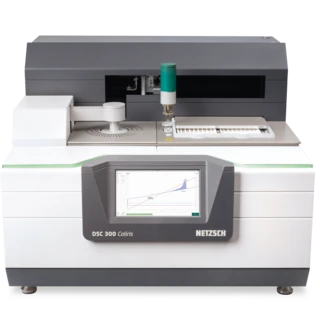
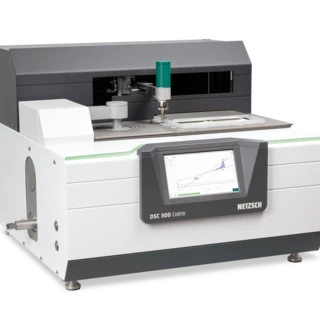
Greater precision and efficiency come with the new automatic piercing device, designed for the 20-position Automatic Sample Changer (ASC).
- Precise Lid Opening: Opens aluminum crucible lids just before the measurement starts.
- Enhanced Efficiency: Automates sample preparation, streamlining your workflow.
This innovation eliminates manual handling, reduces potential errors, and enables seamless automation – ideal for laboratories with high sample throughput or continuous operation.
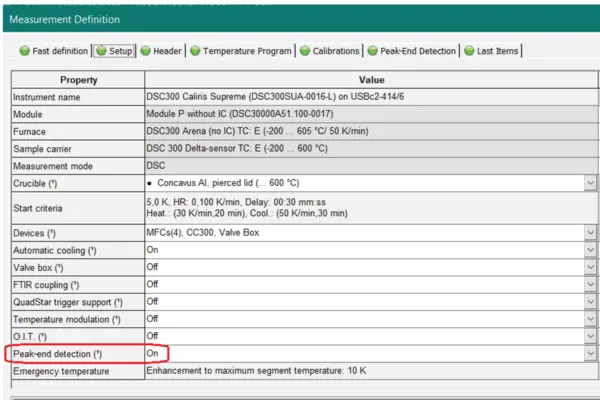
3. Peak-End Detection Software – Smart and Safe Measurement Control
The new Peak-End Detection function takes measurement control to the next level.
- It automatically identifies EndothermicA sample transition or a reaction is endothermic if heat is needed for the conversion.endothermic and ExothermicA sample transition or a reaction is exothermic if heat is generated.exothermic peaks during measurements.
- Smart Measurement Control: Automatically triggers a jump to the next temperature segment or ends the measurement.
- Flexibility: Selectable on a segment-by-segment basis to suit your experimental design.
Save time and enhance safety – protecting your instrument while reducing overall measurement duration.
The DSC 300 Caliris® – Designed for Every Requirement
Available as Classic, Select, and Supreme versions, the NETZSCH DSC 300 Caliris® offers a temperature range from -180°C to 750°C and a modular architecture with interchangeable sensor-furnace units. Your investment remains future-proof – new modules and technologies can be added at any time.
The intuitive Proteus® software enhances productivity through features such as AutoEvaluation, Identify, SmartMode, and AutoCooling, delivering efficient workflows, transparent results, and maximum analytical control – whether in routine work or advanced research.


New Features for our DSC 300 Caliris® - Explained in 5 minutes
NETZSCH: Always One Step Ahead
With intelligent features such as Eco Mode, LED Status Bar, and the Automatic Sample Changer (ASC) – and now the addition of the camera feature, automatic piercing device, and Peak-End Detection – the DSC 300 Caliris® offers everything a modern laboratory demands: top precision, sustainability, maximum efficiency, and full transparency throughout the measurement process.
Would you like to learn more about the new features of the DSC 300 Caliris® or request a quote?
👉 Contact your NETZSCH sales representative – we’ll be happy to advise you personally:
Go to DSC 300 product pages

Local Contact
Share this article: