16.09.2025 by Dr. Chiara Baldini, Aileen Sammler
Thermal, Rheological, and Tribological Insights into Cutting Fluids with NETZSCH Analysis Instruments
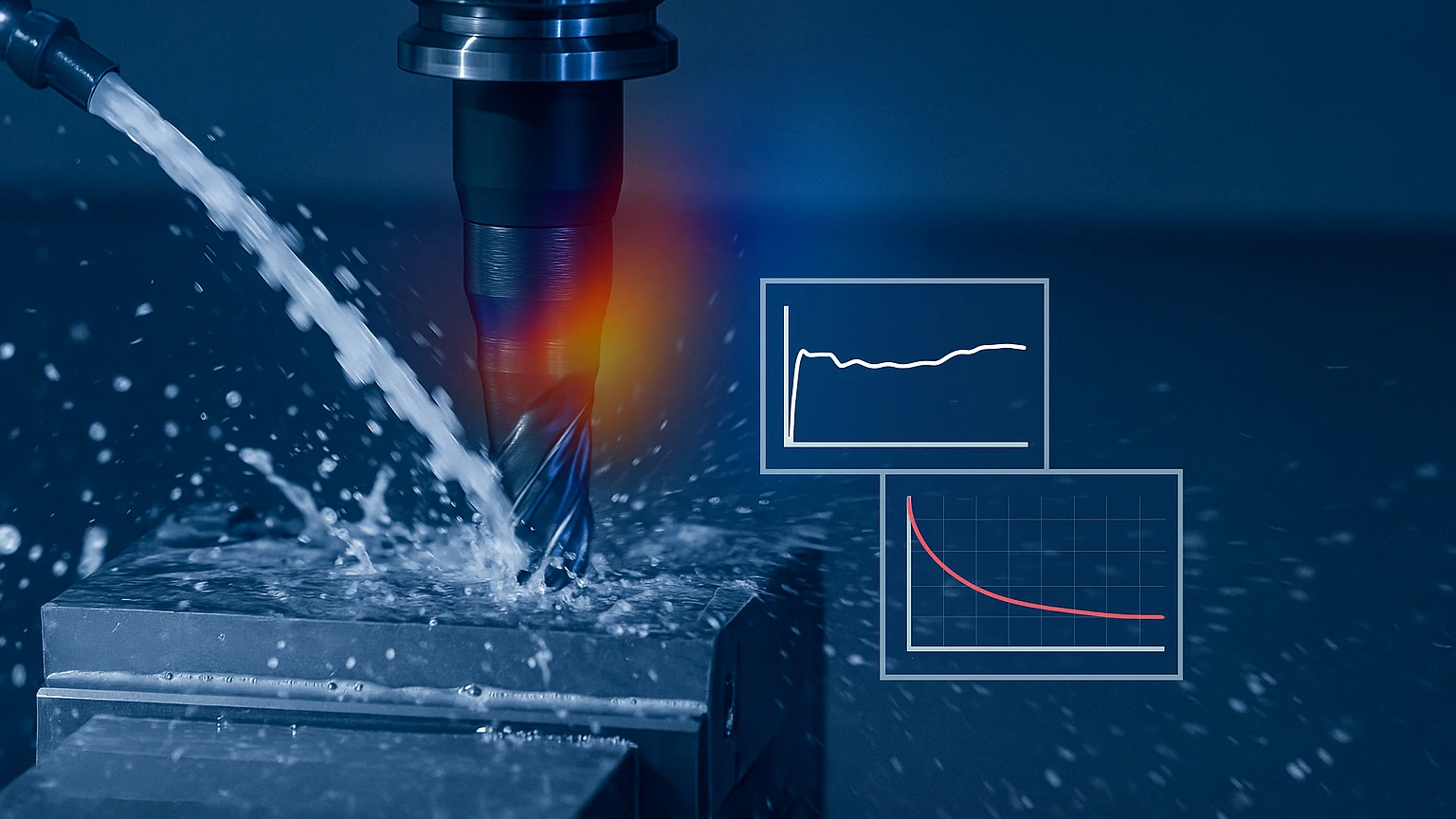
Whether in the automotive industry, aircraft construction, or the manufacture of precision machine parts, cutting fluids have always played a key role in preventing heat-related damage and ensuring the smooth running of complex manufacturing processes. The thermal, rheological, and tribological performance of cutting fluids is essential to optimize process stability and productivity. Learn, how NETZSCH instruments can help here.
Today, metalworking fluids (MWFs) are essential for modern machining operations. They extend tool life, improve surface finish, enhance process efficiency, and facilitate effective thermal management.
As manufacturing processes become more demanding, particularly in high-speed and precision environments, understanding the thermal, rheological, and tribological performance of cutting fluids is essential to optimize process stability and productivity.
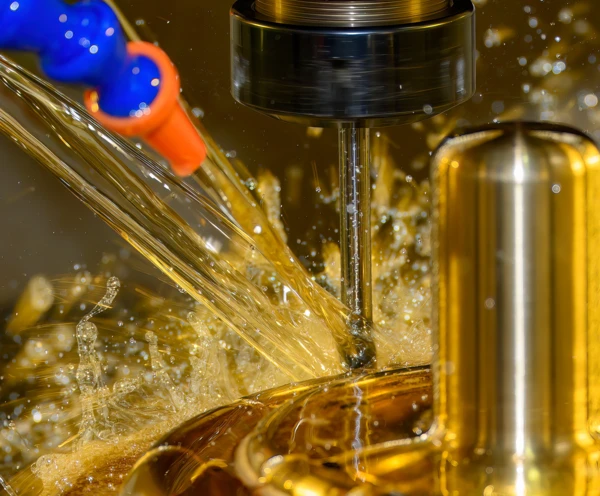
A recent study, published in Lubricants (MDPI) magazine, offers a comparative evaluation of cutting oils and water-based MWFs under simulated machining conditions. The study aimed to provide actionable insights into fluid formulation, lubrication performance, and heat dissipation during metal cutting applications.
Multi-Parameter Characterization with NETZSCH Thermal Analysis and Rheology Solutions
The study involved twelve commercially relevant metalworking fluids, evaluated using high-precision instrumentation by NETZSCH-Gerätebau GmbH.
These tests were designed to accurately simulate the stresses typically experienced in real-world machining operations — such as shear, contact pressure, and thermal loading — thereby enabling a thorough evaluation of each fluid’s characteristics.
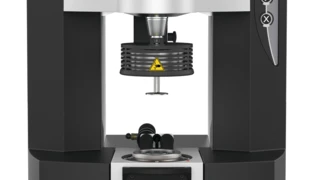
Rheological measurements were conducted with the NETZSCH Kinexus Pro+ rotational rheometer.
The results showed a clear contrast: Water-based cutting fluids exhibited Shear ThinningThe most common type of non-Newtonian behavior is shear thinning or pseudoplastic flow, where the fluid viscosity decreases with increasing shear.shear-thinning behavior; with decreasing viscosity as the shear rate increased. These features make them well-suited for dynamic, high-speed operations where adaptability to changing conditions is required. In contrast, cutting oils maintained a more Newtonian profile, offering stable viscosity under varying shear conditions, which is advantageous in steady-state processes or fine finishing applications.
The tribological performance of the MWFs was evaluated using a tribo-cell mounted on the same Kinexus platform. The findings proved that cutting oils featured enhanced lubrication performance under mixed and full-film conditions, particularly at elevated temperatures. However, water-based fluids demonstrated more stable frictional characteristics across a wider range of speeds and contact pressures, indicating their versatility in variable machining setups.
Measurement of the coefficient of friction (COF) provided further insights: cutting oils showed greater COF reduction under high-temperature, high-load conditions, while water-based coolants maintained a more consistent COF, suggesting reliable performance across diverse machining environments.
The thermal behavior of MWFs was analyzed using multiple NETZSCH instruments.
Using the DSC 204 F1 Phoenix®, researchers identified specific heat capacities and Phase TransitionsThe term phase transition (or phase change) is most commonly used to describe transitions between the solid, liquid and gaseous states.phase transitions, including a distinct solid-to-liquid change around 0°C in water-based fluids.
This is particularly relevant in applications involving low-temperature storage or cryo-machining.
The TG 209 F1 Libra® thermogravimetric analyzer confirmed that cutting oils resist thermal degradation better than water-based formulations, decomposing at higher temperatures — an advantage in long machining cycles or high-heat zones.
Finally, Thermal DiffusivityThermal diffusivity (a with the unit mm2/s) is a material-specific property for characterizing unsteady heat conduction. This value describes how quickly a material reacts to a change in temperature.thermal diffusivity and Thermal ConductivityThermal conductivity (λ with the unit W/(m•K)) describes the transport of energy – in the form of heat – through a body of mass as the result of a temperature gradient (see fig. 1). According to the second law of thermodynamics, heat always flows in the direction of the lower temperature.thermal conductivity were measured with the LFA 467 HyperFlash®, showing that water-based MWFs outperform cutting oils in both metrics. Maintaining process temperature control and avoiding heat-related damage to tools and parts requires this superior heat transfer capability.
Collaboration Across Institutions
The study was the result of a close collaboration between NETZSCH-Gerätebau GmbH and Leibniz University of Hannover.
Co-authors from NETZSCH contributed technical expertise in thermal analysis and rheological characterization, supporting the development of a robust methodology and data interpretation framework. The synergy between academic research and industrial instrumentation facilitated a comprehensive comparison of coolant properties and lubrication strategies for metalworking.
This study offers a valuable data set and methodology reference for professionals involved in fluid selection for machining, coolant development, or simulation of cutting processes.
To explore the complete methods, data, and results, please refer to the full article, which is available via open access:







TECH TALK – Breakthrough Innovations in Materials and Battery Testing
Join our NETZSCH TECH TALK – 30 minutes, packed with insights: thermal analysis made easy with the new DSC features, intelligent software, rheology, fire testing, and reaction calorimetry presented by our four experts.
Michael Müller, our renowned head of the software department at NETZSCH Analyzing & Testing, will moderate the event and set the stage for a dynamic and insightful experience.
- Live online session on Wednesday, December 10, 2025
- Sessions at 9:00 a.m. and 4:00 p.m. (CET - Central European Time)
Tune in to get the latest updates in just half an hour!