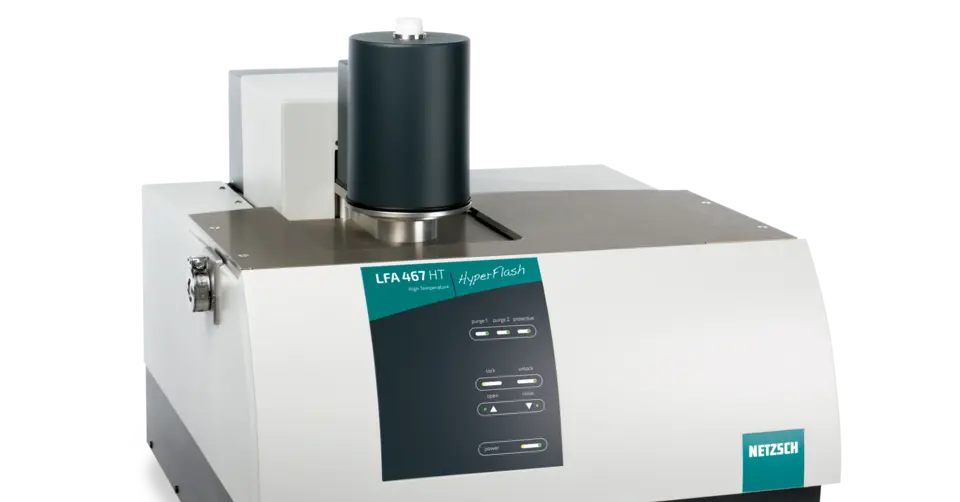
New Dimensions in the Measurement of Thermal DiffusivityThermal diffusivity (a with the unit mm2/s) is a material-specific property for characterizing unsteady heat conduction. This value describes how quickly a material reacts to a change in temperature.Thermal Diffusivity and Conductivity – Fast, Simple, Economical
Broadest temperature range available, from -100°C to 500°C
With a single instrument setup – that is, without having to swap out either the detector or the furnace – the LFA 467 HyperFlash® can carry out measurements from -100°C to 500°C. Coupled with the broadest range of accessories available on the market, the instrument opens the door to completely new dimensions in the determination of thermophysical properties.
Sample throughput up to 4 times higher due to sample holder for 16 samples
One unique advantage of the LFA 467 HyperFlash® is its ability to simultaneously measure up to 16 samples over the entire temperature range. This allows for maximum sample throughput with a minimum input of operational time and effort.
Refill systems are available for automatic refilling of the Dewar on both the detector and the furnace, allowing uninterrupted operation of the LFA system around the clock.

ZoomOptics for more precise measurement results without measurement errors
The patented ZoomOptics system (patent no.: DE 10 2012 106 955 B4 2014.04.03) optimizes the field of view of the detector, thus eliminating any influences caused by aperture stops. The result is a significant increase in the precision of the measurement results.
Ultra-fast recording of measurement data for thin samples (2 MHz)
Thin films and high-conductivity materials require a very high data acquisition rate for the precise recording of rapid temperature increases on a sample’s upper surface. The LFA 467 HyperFlash® offers a sampling rate of 2 MHz – an unprecedented value for LFA systems.

Technical Data

Measuring range Thermal DiffusivityThermal diffusivity (a with the unit mm2/s) is a material-specific property for characterizing unsteady heat conduction. This value describes how quickly a material reacts to a change in temperature.thermal diffusivity:
0.01 mm2/s to 2000 mm2/s
Measuring range Thermal ConductivityThermal conductivity (λ with the unit W/(m•K)) describes the transport of energy – in the form of heat – through a body of mass as the result of a temperature gradient (see fig. 1). According to the second law of thermodynamics, heat always flows in the direction of the lower temperature.thermal conductivity:
< 0.1 W/(m*K) to 4000 W/(m*K)
Sample dimensions:
6 mm to 25.4 mm diameter
0.01 mm to 6 mm thickness
Patented pulse mapping technique
for pulse length correction and improved cp determination
Compliant to and in accordance with:
ASTM E1461, ASTM E2585, DIN EN 821-2, DIN 30905, ISO 22007-4, ISO 18755, ISO 13826; DIN EN 1159-2, etc.

The future is now!
Bring our devices into your laboratory with the click of a button.
Simply scan the QR code and get a 3D model of the instrument directly on your mobile phone or tablet. With the help of the latest AR Technology (Artificial Reality), the 3D model can easily be placed in your laboratory in its original life size. This function is browser-based and requires no app.
Find out and be amazed!


This instrument is LabV®️-primed
LabV®️ takes the data from your analytical instrument: It automatically imports all measurement data into a central and secure database solution, the LabV®️ software. This allows you to visualize the data in LabV®️ and to make them searchable. Your data will now be accessible from anywhere. Moreover you have the possibility to generate reports.
ZoomOptics for more Precise Measurement Results without Measurement Errors
Generally, the area on the sample’s upper surface being scanned by the detector is customized to fit to the maximum sample size up to 25.4 mm. Samples with a smaller diameter are most often covered with a mask or a cap to hide peripheral zones to the greatest extent possible. Since all bodies, however, emit infrared radiation – i.e., even the masking or capping material – the resulting detector signal is inevitably influenced. The extent to which this influence is noticeable depends on the difference in Thermal DiffusivityThermal diffusivity (a with the unit mm2/s) is a material-specific property for characterizing unsteady heat conduction. This value describes how quickly a material reacts to a change in temperature.thermal diffusivity between the sample and the mask/cap material. The result – in the final segment of the main temperature rise – can be either a further continuous increase or a premature leveling of the detector signal. In either case, a shift of the evaluated half time occurs, thus falsifying the calculated Thermal DiffusivityThermal diffusivity (a with the unit mm2/s) is a material-specific property for characterizing unsteady heat conduction. This value describes how quickly a material reacts to a change in temperature.thermal diffusivity.
ZoomOptics (patent no.: DE 10 2012 106 955 B4 2014.04.03) allows the detector’s field of view to be adjusted until the only temperature increase registered is that of the sample and no influences by the surroundings or mask can have any effect. The pre-set focus value – which covers most applications – is 70%; however, this value can also be individually adjusted by the operator to the given sample geometry.
The advantage of ZoomOptics is clearly illustrated by the following example measurement on Pyroceram:

for round and square specimens, liquids, pastes, polymer melts, resins and for measurements on liquid and powdery metallic samples
Application Literature

Our latest blog articles
- 15.06.2026
Understanding Molten Salts for the Next Generation of Nuclear Reactors

- 16.09.2025
Thermal, Rheological, and Tribological Insights into Cutting Fluids with NETZSCH Analysis Instruments
- 28.05.2025
Contract Testing of Thermophysical Properties – Enhanced with the NETZSCH TCT 716 Lambda Guarded Heat Flow Meter

- 07.05.2025
Characterization of NaNO₃–KNO₃ Salt Mixture Using NETZSCH Thermal Analysis Instruments and X-ray Diffraction

- 08.01.2025
Introducing the New NETZSCH LFA 717: Precision Redefined in Thermal Conductivity Measurement
- 21.11.2024
Measuring Thermophysical Properties with Focus on Thermal Conductivity