
11.03.2026 by Aileen Sammler
Thermogravimetry Meets Hydrogen (Part 2): Studying the Reduction of Fe₂O₃ under Different Hydrogen Concentrations
Thermogravimetry meets hydrogen: Learn how the reduction of iron oxide (Fe₂O₃) under different hydrogen concentrations can be analyzed using TGA to evaluate redox behavior and material stability.
Hydrogen and Materials Research: Understanding the Connection
Hydrogen is a key building block for sustainable energy and process concepts, particularly in high-temperature applications and material development. Understanding how materials behave under a hydrogen atmosphere is therefore essential for the development of robust, efficient, and scalable hydrogen technologies.
In the first part of our blog series “Thermogravimetry Meets Hydrogen”, we introduced the fundamentals of hydrogen-compatible thermogravimetric measurements and their relevance for hydrogen-related materials research. In this second part, we take a closer look at iron(III) oxide (Fe₂O₃) as a well-established reference material and demonstrate how different hydrogen concentrations influence reduction behavior, reaction kinetics, and mass transport phenomena.
Investigating Hydrogen Concentration Effects with Thermogravimetric Analysis
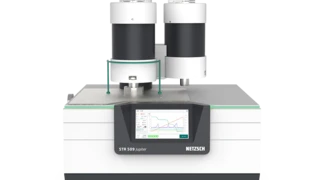
In a new study, NETZSCH demonstrates how thermogravimetric analysis (TGA) can be used to study the reduction of Fe₂O₃ at varying hydrogen concentrations. The experiments were performed using a NETZSCH STA Jupiter® analysis instrument, which allows for precise mass change measurements under defined gas atmospheres and elevated temperatures.
By systematically varying the hydrogen content in the purge gas, the study reveals how hydrogen concentration directly affects the rate of mass loss.
Lower hydrogen concentrations lead to slower reduction rates and longer reaction times, while higher hydrogen contents accelerate the reduction process. These effects are clearly reflected in the thermogravimetric curves and provide quantitative insight into gas-solid interaction mechanisms.
Why Hydrogen Concentration Matters in Real Applications
In practical hydrogen-based processes, materials are rarely exposed to pure hydrogen under idealized conditions. Instead, hydrogen concentration often varies due to process constraints, safety considerations, or gas recycling strategies.
The results presented in this study highlight that hydrogen concentration is not merely a boundary condition, but a critical process parameter that directly influences reaction kinetics and material performance. Thermogravimetric analysis enables researchers and engineers to quantify these effects and to evaluate how materials will behave under realistic operating conditions.

Safe Hydrogen Measurements with H₂Secure
Performing thermogravimetric experiments under hydrogen requires uncompromising safety – especially at elevated temperatures. NETZSCH addresses this challenge with the TÜV-certified H₂Secure concept, which can be fully integrated into the STA Jupiter® instrument series.
H₂Secure allows for safe operation with hydrogen-containing atmospheres through controlled gas switching, automatic inert gas purging, and continuous monitoring. This allows for stable, reproducible measurements while minimizing risks for both users and laboratories.
Want to Explore the Details?
The full experimental setup, measurement parameters, and detailed results can be found in the complete application note:
👉 Read the full Application Note:
What Comes Next?
This second part of “Thermogravimetry Meets Hydrogen” focuses on the influence of hydrogen concentration on the reduction behavior of iron oxide. In the next blog article, we will go one step further and show how cyclic redox experiments can be used to evaluate long-term material stability and reversibility under alternating hydrogen and oxidizing atmospheres.
👉 Stay tuned!






Become an Expert with our Free E-Learning Courses
All NETZSCH E-Learning Basic Courses are free of charge! The content is created by our laboratory method experts, who share their personal experiences with you. Take advantage of flexible online learning, fully adapted to your training needs!