05.05.2026 by Aileen Sammler
Thermogravimetry Meets Hydrogen (Part 3): Investigating Cu and CuO Redox Reactions under Hydrogen Atmospheres
Learn how cyclic redox reactions of CuO/Cu can be analyzed by a NETZSCH TGA to assess reaction mechanisms, reversibility, and long-term material stability.
Thermogravimetry meets Hydrogen
Hydrogen is a key building block for sustainable energy and process concepts, particularly in high-temperature and material development.
In Part 1 of our blog series “Thermogravimetry Meets Hydrogen”, we introduced the fundamentals of hydrogen-compatible thermogravimetric analysis and explained why controlled hydrogen atmospheres are essential for studying hydrogen-related materials.
In Part 2, we focused on the reduction of the Fe2O3 under different H2 concentrations.
In this Part 3, the next step is taken to apply the same methodology to a metal oxide system with well-defined reaction pathways: the CuO/Cu redox couple. This example clearly illustrates how thermogravimetric analysis under hydrogen can be used to evaluate long-term redox stability, reversibility, and degradation effects under application-relevant conditions.
Why CuO/Cu is a Strong Reference?
Redox-active metal oxides have been widely used as model materials in hydrogen research. Our new application note demonstrates the well-established copper oxide system (CuO/Cu) cyclic redox behavior under hydrogen.
The stepwise reduction and OxidationOxidation can describe different processes in the context of thermal analysis.oxidation of copper oxides is extensively described in literature and frequently used as a reference system in studies on chemical looping, energy storage, and thermochemical processes.
Published work highlights how repeated redox cycling can lead to structural changes and altered kinetics under both IsothermalTests at controlled and constant temperature are called isothermal.isothermal and non-IsothermalTests at controlled and constant temperature are called isothermal.isothermal conditions (e.g., Chen et al., 2024; Cerciello et al., 2024) as well as the OxidationOxidation can describe different processes in the context of thermal analysis.oxidation kinetics of copper-based materials (Jahromy et al., 2019).
The NETZSCH Instrumentation Used
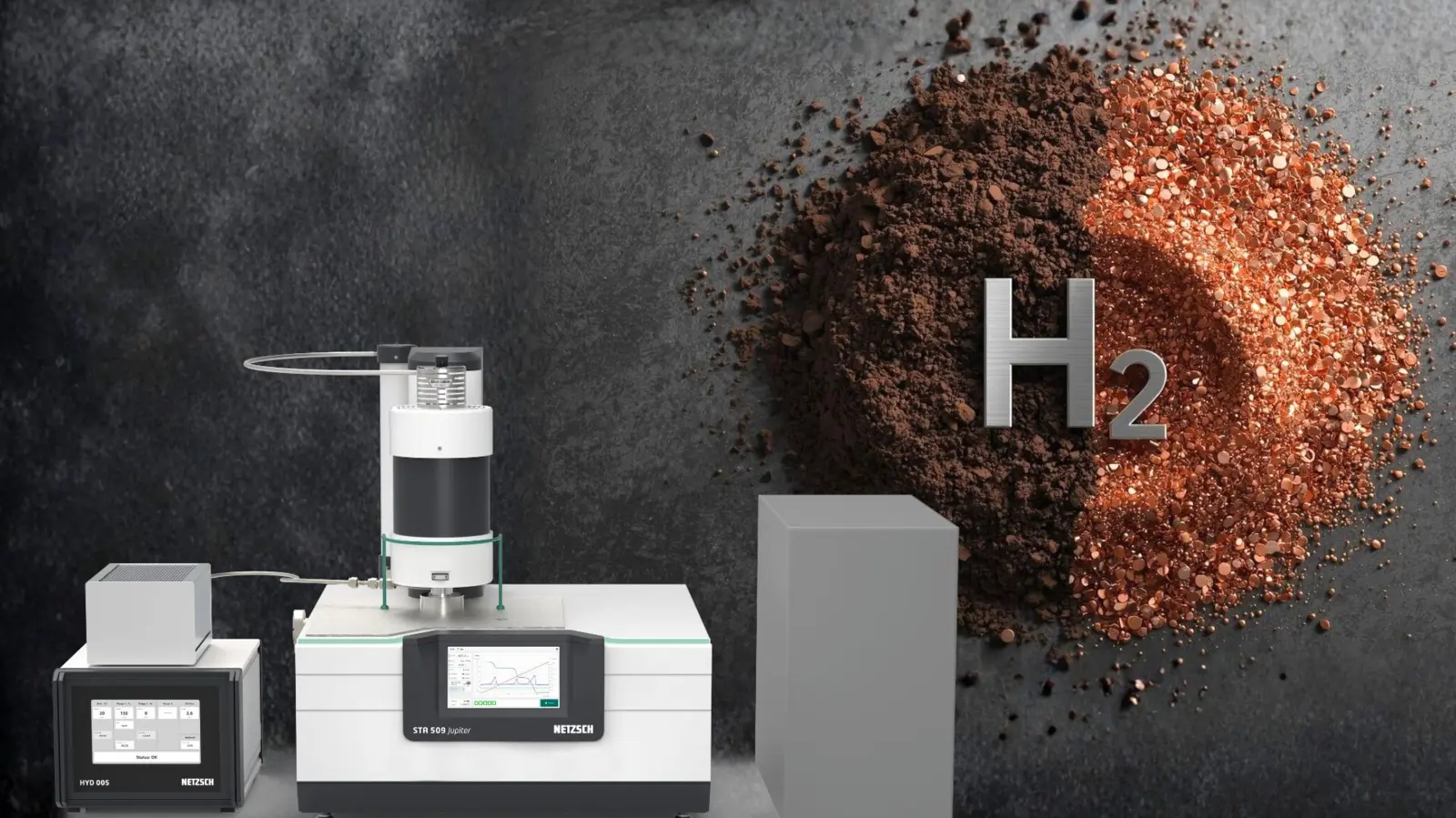
All experiments described in the study were performed using the NETZSCH STA 509 Jupiter® in combination with the H₂Secure safety box.
This configuration allows for safe operation under hydrogen atmospheres while ensuring stable and reproducible experimental conditions during repeated gas switching.
The setup supports:
- Defined gas flow to the sample
- Continuous monitoring of process conditions
- Automated inert gas purging to maintain safe scenarios
- Pressure monitoring to prevent abnormal operating conditions.
This makes the system particularly suitable for long-term redox cycling experiments.

What the Experiment Shows: Stable Reduction, Changing OxidationOxidation can describe different processes in the context of thermal analysis.Oxidation
The presented experiment cycles CuO at 500°C, alternating between:
- 100% hydrogen for reduction and
- synthetic air (21% O₂) for OxidationOxidation can describe different processes in the context of thermal analysis.oxidation.
The thermogravimetric signal reveals two distinct behaviors:
Reduction remained fully reproducible across all cycles.
The mass loss during reduction was approximately 20.1%, which is in excellent agreement with the theoretical value of 20.11% for the complete reduction of CuO to metallic copper. After reduction, the sample stabilized at 79.9% mass, cycle after cycle.
OxidationOxidation can describe different processes in the context of thermal analysis.Oxidation, however, gradually decreased over successive cycles.
The OxidationOxidation can describe different processes in the context of thermal analysis.oxidation-related mass increase dropped from 20.1% in the first cycle to 19.0% and then to 18.2%.
The application note suggests that this behavior can be attributed to surface passivation effects or particle agglomeration, which limit oxygen accessibility and reduce OxidationOxidation can describe different processes in the context of thermal analysis.oxidation completeness over time.
Such subtle changes are critical for real hydrogen applications. They become visible only through cyclic thermogravimetric analysis.
Learn More in the Full Application Note
👉 Detailed experimental conditions, curves, and interpretations are available here:







Become an Expert with our Free E-Learning Courses
All NETZSCH E-Learning Basic Courses are free of charge! The content is created by our laboratory method experts, who share their personal experiences with you. Take advantage of flexible online learning, fully adapted to your training needs!