General Properties
Short Name: PVAL
Name: Polyvinyl Alcohol
Polyvinyl alcohol (PVAL) cannot be produced by means of polymerization, but only by hydrolysis of polyvinyl esters, such as poly- vinyl acetate. The plastic is water-soluble and therefore easily absorbs air humidity. The melting and Glass Transition TemperatureThe glass transition is one of the most important properties of amorphous and semi-crystalline materials, e.g., inorganic glasses, amorphous metals, polymers, pharmaceuticals and food ingredients, etc., and describes the temperature region where the mechanical properties of the materials change from hard and brittle to more soft, deformable or rubbery.glass transition temperatures depend on various parameters such as the degree of hydrolysis, the molar mass, the distribution of the acetyl groups (statistical or in blocks), and the water content.
Structural Formula

Properties
NETZSCH Measurement
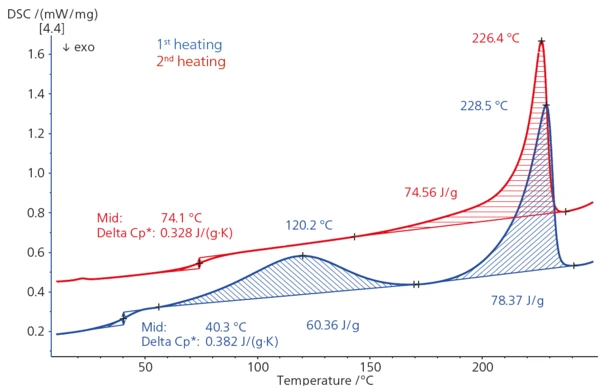
| Sample Mass | 10.26 mg |
| Heating Rates | 10 K/min |
| Crucible | Al, pierced lid |
| Atmosphere | N2 (50 ml/min) |
Evaluation
Water has plasticizing properties. For this reason, the Glass Transition TemperatureThe glass transition is one of the most important properties of amorphous and semi-crystalline materials, e.g., inorganic glasses, amorphous metals, polymers, pharmaceuticals and food ingredients, etc., and describes the temperature region where the mechanical properties of the materials change from hard and brittle to more soft, deformable or rubbery.glass transition is considerably lower in the 1st heating (blue) than in the 2nd heating (red) by 34 K. Directly related to this is the broad endothermal effect between approx. 60°C and 170°C (1st heating). It can be attributed to the evaporation of humidity. By using aluminum crucibles with pierced lids, water was eliminated from the sample during the 1st heating. Above 150°C and 170°C, PVAL exhibited melting transition with peak temperatures of 229°C (1st heating, blue) and 226°C (2nd heating, red). The corresponding melting enthalpies were approx. 78 J/g (1st heating) and 75 J/g (2nd heating), respectively.