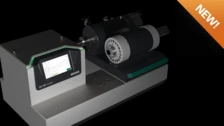
DIL 502 Expedis® Supreme
Ultimate Sophistication for Advanced Research
Highlights
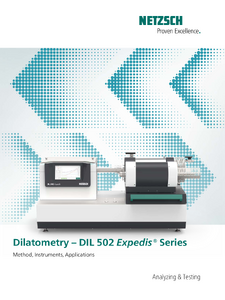
The dilatometer DIL 502 Expedis®Supreme offers state-of-the-art dilatometer technology and is designed for a wide range of sophisticated applications.
Introducing the Expert 502 Expedis® Supreme, the pinnacle of precision, designed for cutting-edge research and high-end industrial applications. This fully equipped, state-of-the-art instrument delivers unmatched performance, offering an extraordinary temperature range of -180°C to 2800°C — all within a single device.
Select the ideal furnace for your specific temperature requirements
In addition to the graphite furnace for ultra-high temperatures up to 2400°C/2800°C, the system supports various interchangeable furnaces, which cover a broad spectrum of temperature ranges and atmospheres.
High Throughput Capability
Optional dual furnace and dual measuring system configurations enable you to test multiple samples simultaneously, accelerating your workflow.
Achieve consistent and reliable results every time: Automatic Specimen Length Detection eliminates manual measurement errors by automatically detecting the specimen’s initial length before testing.
MultiTouch Technology Provides Stable Sample Positioning: Achieve stabilized, repeatable specimen placement with MultiTouch's unique, tail-like motion, which optimizes positioning and enhances measurement reliability.
Adjustable thermocouple positioning: Easily accommodate specimens of various lengths with an adjustable thermocouple guided by a flexible rod. This allows for precise placement without bending or causing damage.
AutoVac enables Inert Atmosphere Testing: The optional AutoVac system facilitates rapid evacuation and gas refill for measurements under pure inert atmospheres, which is ideal for studying OxidationOxidation can describe different processes in the context of thermal analysis.oxidation-sensitive materials.

Our Quality Promise:
NETZSCH’s Unlimited Warranty
At NETZSCH, our commitment to quality goes beyond the instruments themselves. We understand that your investment in advanced technology is a long-term one, and and that’s why we offer something truly unique – our Unlimited Warranty.
Method
The Method for Determination of Dimensional Changes
Pushrod dilatometry is a technique used to measure how the size of a material changes as it is heated or cooled over time. During the test, the sample is placed in a furnace where the temperature is carefully controlled according to a set program. As the temperature changes, the sample either expands or contracts.
A pushrod in contact with the sample moves to follow these changes in size. The movement of the pushrod is measured very precisely to track how much the length of the sample changes.
This allows for the characterization of various fundamental phenomena like:
- Thermal expansion or shrinkage
- SinteringSintering is a production process for forming a mechanically strong body out of a ceramic or metallic powder. Sintering of ceramics or metals
- Glass transition and softening point of polymers
- Phase transitions
This information helps scientists and engineers understand the material's behavior at different temperatures, which is important for designing products that will perform well in real-world conditions.


Discover the revolutionary precision of the NanoEye displacement system
With traditional dilatometry, improving resolution typically requires sacrificing measurement range, and vice versa. However, the revolutionary NanoEye system eliminates this trade-off.
The NanoEye system delivers ultra-high resolution and an exceptionally wide measurement range, setting a new standard in thermal expansion analysis.
At the heart of the DIL 502 Expedis® is the revolutionary optoelectrical NanoEye displacement system. Its cutting-edge technology ensures perfect linearity in every measurement, outperforming conventional dilatometry systems. A linear encoder translates position into a digital signal with consistent accuracy, regardless of temperature or sample length.
DIL Expedis® Supreme Glovebox Version
For investigations with special care
The glovebox version of the NETZSCH DIL Expedis® offers the opportunity to analyze oxygen- or moisture-sensitive materials in a protected atmosphere. The glovebox version is also your first choice for characterizing samples whose properties the user must be protected from.
The stainless steel housing prevents plastic parts from interacting with the samples or the environment.
For measurements up to 1650°C (furnace temperature) in an Argon atmosphere, we offer a rhodium furnace specially designed for this task.


Maximize Lab Efficiency with the Energy-Smart DIL 502 Expedis®
Today, global attention towards saving and efficiently using energy has never been higher. Industries and academia worldwide are actively researching ways to conserve energy and utilize alternative resources.
The DIL 502 Expedis® is at the forefront of optimizing energy use. It eliminates the need for energy-intensive water-cycle thermostats, instead using advanced electronic temperature control to maintain exceptional stability. This allows you to obtain accurate thermal expansion measurements while significantly reducing energy consumption and heat waste in your lab.
Additionally, the instrument features customizable Idle and Eco modes. These modes intelligently manage power when the instrument is idle. This reduces CO₂ emissions, helping to keep your lab green without compromising performance or usability.
Specifications
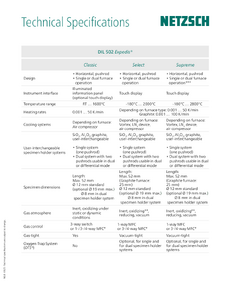
| Temperature range | -180°C to 2800°C |
|---|---|
| Furnaces |
|
| Specimen dimensions | Length: Max. 52 mm
|
| Heating rate |
|
| Gas flow control | 1-way MFC or optional 3-way/4-way MFC |
| Measuring range | ± 25000 μm |
| Force range (load at the sample) | 10 mN … 3 N (compressive and tensile force depending on sample holder) |
| ΔL Resolution | 0.1 nm |
| Force resolution | 0.001 K |
Accessories and more:
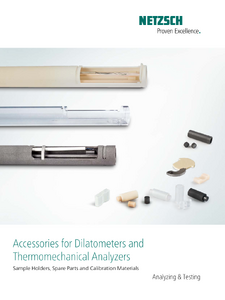
The DIL 502 Expedis® comes with a variety of sample holders and accessories made from different materials. This allows you to optimize your dilatometer’s performance and obtain reliable, accurate data consistently. This flexibility enables you to adapt your setup to different materials and testing conditions, maximizing the precision and efficiency of each measurement.

Protect your samples and equipment with our specially designed containers and protective sleeves. These are key to preserving specimen integrity and ensuring accurate results. Our versatile containers can hold powders, pastes, and materials that transition from solid to liquid, including molten salts. Built-in trays catch leaks to prevent damage. Our protective sleeves provide a barrier against contamination and are available in various materials and for various temperatures.

The DIL 502 Expedis® dilatometers come equipped with a range of advanced cooling options designed to perfectly match your testing requirements. Whether you need to replicate real-world conditions or specific manufacturing processes, our customizable cooling solutions deliver the most accurate and relevant data. Using compressed air cooling, the DIL 502 Expedis® drastically reduces turnaround times between tests, boosting your productivity. Enjoy superior temperature uniformity and rapid response—essential for rate-controlled SinteringSintering is a production process for forming a mechanically strong body out of a ceramic or metallic powder. sintering and analyzing materials exposed to fast temperature changes. Achieve temperatures as low as -180°C/-150°C with liquid nitrogen (LN₂) cooling, or opt for the air intracooling system (AIC 80) to reach -60°C without LN₂. Tailor your thermal testing with precision and efficiency.


Proven Excellence in Service
At NETZSCH Analyzing & Testing, we offer a comprehensive range of services globally to ensure the optimal performance and longevity of your thermoanalytical equipment. With a track record of proven excellence, our services are designed to maximize the effectiveness of your devices, extend their lifespan, and minimize downtime.
Unlock the full potential of your equipment with our tailored solutions, backed by years of industry expertise and innovation.
Software
Proteus® - Best Practice for Measurement and Evaluation
Experience the power of Proteus® dilatometer software, which is fast, reliable and incredibly user-friendly, with an intuitive interface that is easy to learn. With a comprehensive range of functions, it meets all your testing needs and impresses even the most experienced operators with advanced features such as patented c-DTA®®, DensityThe mass density is defined as the ratio between mass and volume. density determination, rate-controlled SinteringSintering is a production process for forming a mechanically strong body out of a ceramic or metallic powder. sintering and the innovative Identify software. Proteus®® is the all-in-one solution that will take your materials analysis to the next level with enhanced efficiency and precision.
Available software features:
This program add-on allows determination of the density change of samples with varying consistency, i.e., solids, viscous materials such as pastes, liquids or melts as well as the volumetric expansion of isotropic materials.
The c-DTA® signal gives the opportunity for simultaneous analysis of length changes and endothermal/ExothermicA sample transition or a reaction is exothermic if heat is generated.exothermal effects. It can also be used for temperature calibration.
AutoEvaluation by NETZSCH is the smart software that transforms thermoanalytical data analysis into a fast, effortless experience. Say goodbye to manual setups: AutoEvaluation independently interprets your measurement curves and delivers accurate results instantly. For polymer testing, it automatically identifies key transitions like Glass Transition TemperatureThe glass transition is one of the most important properties of amorphous and semi-crystalline materials, e.g., inorganic glasses, amorphous metals, polymers, pharmaceuticals and food ingredients, etc., and describes the temperature region where the mechanical properties of the materials change from hard and brittle to more soft, deformable or rubbery.glass transition and softening points with just one click.
NETZSCH's Identify software extension is the most powerful tool on the market for verifying materials. It allows for comparison of a given curve with other individual curves (e.g., groups of curves in quality control) or with literature data from selected libraries. The included extensive libraries contain hundreds of entries from various material categories. Users can also create their own custom libraries and share them across a network.
Take full control of your SinteringSintering is a production process for forming a mechanically strong body out of a ceramic or metallic powder. sintering process with Rate-Controlled Sintering (RCS)The properties of sintered products, such as density or particle size distribution, are determined by the sintering conditions (temperature, atmosphere, etc.) and especially by the sintering rates. RCS technology, which delivers precise, adaptive heating profiles that optimize microstructure and densification. Unlike traditional methods, Rate-Controlled Sintering (RCS)The properties of sintered products, such as density or particle size distribution, are determined by the sintering conditions (temperature, atmosphere, etc.) and especially by the sintering rates. RCS dynamically adjusts the furnace temperature to maintain your target SinteringSintering is a production process for forming a mechanically strong body out of a ceramic or metallic powder. sintering rate. It does so by stopping, starting, or modulating heating based on your material’s behavior. This smart control ensures superior results and provides valuable temperature data to fine-tune and enhance your production process. Experience smarter, faster SinteringSintering is a production process for forming a mechanically strong body out of a ceramic or metallic powder. sintering that’s perfectly tailored to your materials.
This feature is essential for testing materials such as glass and glazes, which soften when heated. It ensures accurate results and protects your equipment from damage. Once a preset shrinkage value is reached, the measurement stops automatically to prevent damage to the pushrod and specimen holder, with the pushrod retracting safely away from the sample.
This instrument is LabV®️-ready.
Turn data into better products with LabV®—a centralized, AI-driven material intelligence platform that integrates data from this instrument and any other data sources. Designed for R&D and QC engineers, LabV® enables data-driven decision-making to drive innovation and ensure consistently high-quality results.
Related Devices
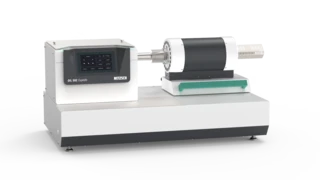
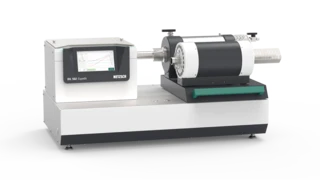

Downloads and Media
Videos
Designed for Precision – Discover the New DIL 502 Expedis® Series by NETZSCH
From -180 °C to 2800 °C, analyze shrinkage, SinteringSintering is a production process for forming a mechanically strong body out of a ceramic or metallic powder. sintering, and Phase TransitionsThe term phase transition (or phase change) is most commonly used to describe transitions between the solid, liquid and gaseous states.phase transitions with NanoEye® accuracy and intelligent software.
Application Literature
Our latest blog articles
- 22.09.2026
NETZSCH Analysis Instruments in Use at South Korean Research Institutes
- 14.01.2026
Learn, Apply, Achieve: NETZSCH Launches Free E-Learning Courses on Thermoanalytical Methods

- 19.12.2025
Frost Under the Christmas Tree: Why Material Testing Below 0°C Is Important

- 16.07.2025
The Brand-New NETZSCH DIL 502 Expedis® Dilatometer: The Future of Low- and High-Temperature Dilatometry