Introduction
Burned red clay is a special relic formed by ancient human fire‑related activities, widely found in residential sites, pottery kilns, sacrificial pits and other remains from the Neolithic Age to historical periods. It serves as a direct physical evidence for studying ancient humans’ fire‑use technology, architectural techniques and subsistence strategies [1]. As a key physico-chemical index of burned red clay, the original firing temperature not only reflects ancient humans’ ability to control fire and the maturity of firing technology, but also provides an important basis for inferring social productivity and resource utilization patterns [2].
Determination of the Firing Temperature
Dilatometry (DIL) has gradually become one of the most widely used techniques for determining the firing temperature of archaeological burned red clay due to its ease of use, minimal sample damage, high measurement accuracy and good repeatability. Burned red clay has undergone dehydration, dehydroxylation, phase transformation and initial SinteringSintering is a production process for forming a mechanically strong body out of a ceramic or metallic powder. sintering during ancient firing, forming a stable microstructure. Therefore, during refiring, when the temperature is below the original firing temperature, the sample only exhibits reversible lattice thermal expansion; once the temperature exceeds the original firing temperature, the residual amorphous phases and unsintered microregions inside the sample undergo further densification, producing a shrinkage effect that suppresses its thermal expansion[3]. This method has been widely applied in temperaturedetermination research of archaeological remains.
The sample used in this study is fresh, unweathered burned red clay from a certain archaeological site, processed into a rectangular cuboid with a regular cross‑section and a length of approximately 25 mm (figure 1). The tests were carried out using a NETZSCH DIL 402 Expedis®Classic dilatometer.
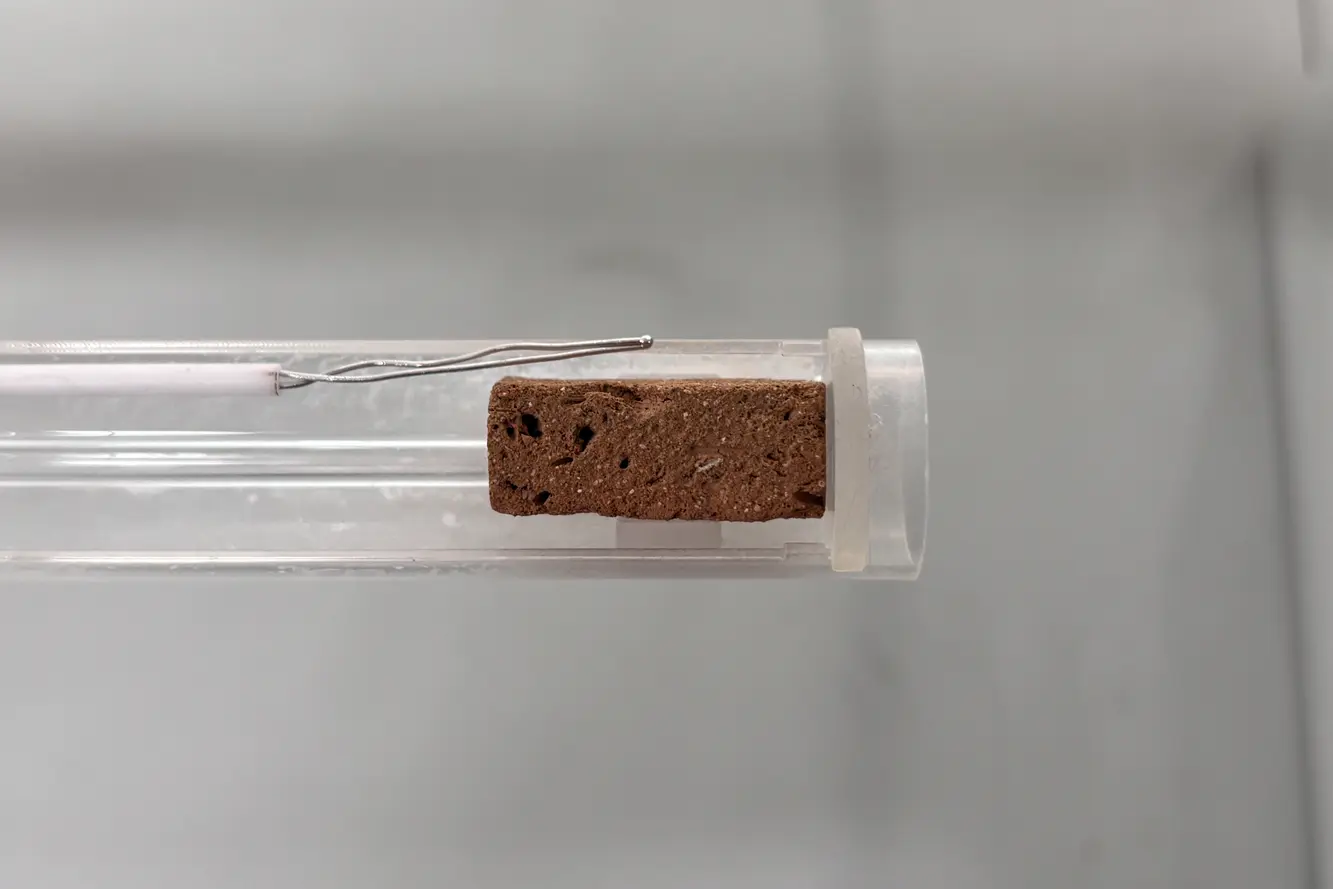
The test parameters are detailed in table 1. Five heating were carried out, two of them with an end temperatur of 400°C and three with an end temperature of 500°C. After each test, the sample was furnace‑cooled to room temperature to ensure a consistent initial state for each heating run and eliminate interference from differing initial states on the test results.
Table 1: Measurement conditions
| Instrument | DIL 402 Expedis®Classic |
|---|---|
| Sample dimensions | Rectangular prism, approx. 10 x 10 x 25 mm |
| Heating rate | 5 K/min |
| Static force | 100 mN |
| Sample holder | Fused silica holder |
| Temperature range | RT - 400°C, RT - 500°C |
| Atmosphere | NItrogen (inert atmosphere) |
Results and Discussion
As mentioned in literature [3], during the original firing process, clay minerals in burned red clay (e.g., illite, montmorillonite) undergo dehydration, dehydroxilation, and structural reorganization at specific temperatures, forming a metastable microstructure. When the refiring temperature is below the original firing threshold, no new phase change occurs inside the sample, and only physical thermal expansion takes place, so the two heating curves overlap. When the refiring temperature exceeds the original firing temperature, additional irreversible reactions occur during the first heating (e.g., removal of residual structural water, healing of lattice defects), resulting in an increased degree of densification. Consequently, during the second heating, the thermal expansion capacity of the sample decreases, which is macroscopically reflected by a reduced slope and an overall downward shift of the dL/L₀ curve. On this basis, the range of the original firing temperature can be determined.
As shown in Figure 2, it can be observed that:
- In the range from RT to 400°C: the first refiring curve (Curve [1]) and the second refiring curve (Curve [2]) almost completely overlap during the entire heating process, with nearly identical slopes (thermal expansion coefficients) in the linear region and no obvious deviation or downward shift.
- In the range from RT to 500°C: the trend of the third refiring curve (Curve [3]) is consistent with Curves [1] and [2] below 400 °C. However, the fourth refiring curve (Curve [4]) shows a significant change during heating, with an overall downward shift and a markedly smaller slope than the previous three curves. To verify the result, a fifth refiring run (Curve [5]) was performed up to 500°C. It can be seen that Curve [5] almost completely overlaps Curve [4], confirming that the sample becomes stable after heating to 500°C.
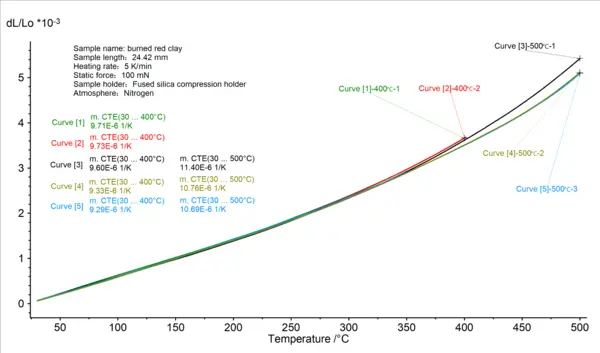
The mean coefficient of thermal expansion (m.Coefficient of Linear Thermal Expansion (CLTE/CTE)The coefficient of linear thermal expansion (CLTE) describes the length change of a material as a function of the temperature.CTE) of each refiring curve are listed in table 2. Based on the test results, it can be inferred that the original firing temperature range of the sample is > 400°C and ≤ 500°C.
Table 2: mCTE of each refiring curve
| Temperature range | Curve [1] | Curve [2] | Curve [3] | Curve [4] | Curve [5] |
| RT - 400°C | 9.71×10⁻⁶K-1 | 9.73×10⁻⁶K-1 | 9.60×10⁻⁶K-1 | 9.33×10⁻⁶K-1 | 9.29×10⁻⁶K-1 |
| RT - 500°C | - | - | 11.40×10⁻⁶K-1 | 10.76×10⁻⁶K-1 | 10.69×10⁻⁶K-1 |
Summary
The use of dilatometry (DIL) to analyze the firing temperatures of burned clays is based on the irreversibility of the thermal behavior of clay minerals. By identifying the slope change of the expansion curve during refiring, it can accurately determine the original firing temperature range of archaeological burned red clay. This method features user-friendly testing, clear criteria, high precision, and minimal sample damage, making it suitable for precious archaeological remains. It is a reliable technique for determining the maximum heating temperature of clay‑based fired relics. cesses, must be excluded.