STA 449 F5 Jupiter®
A Sophisticated Instrument at a Very Attractive Price
Fully Equipped
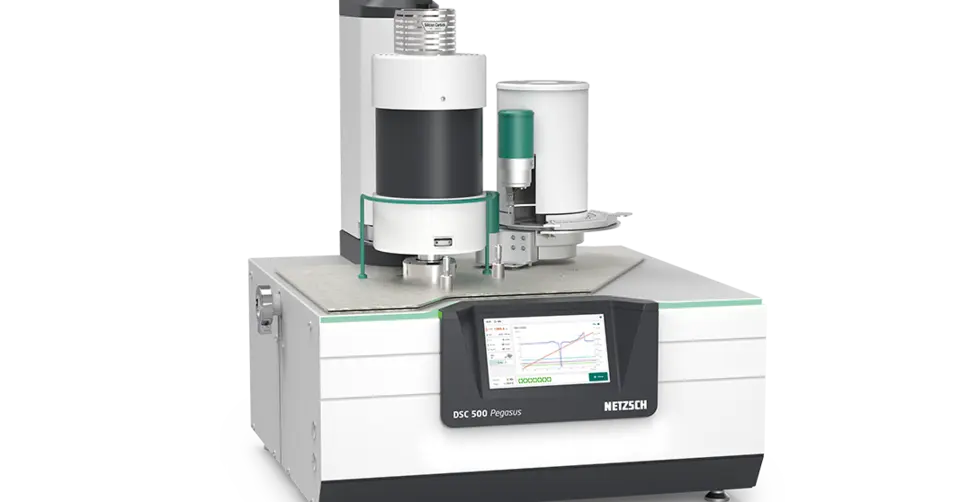
This vacuum-tight STA 449 F5 Jupiter® is hand built specifically for your application. Each instrument comes pre-configured as you need it, with all of the hardware and software features that are required by high-temperature applications in the fields of ceramics, metals, inorganics, building materials, etc.
Best Cost-Performance-Ratio
The STA 449 F5 Jupiter® has high resolution, a high range, low drift balance and sensitive DSC capability that enables it to excel in all typical applications across a broad range of temperatures.
Unique Combination – True TG-DSC and TGA for High-Sample Volumes
True TGA and DSC measurements can be performed with high precision and reproducibility at sample temperatures from ambient to 1600°C. TGA measurements are also possible, even on large or heavy samples.
Top-loading – The Proven Design for Thermobalances
The STA 449 F5 Jupiter® is a top-loading system with a balance design that has been preferred for years in laboratories. The reasons are simple: These systems combine ideal performance with easy handling.

Technical Data
Temperature resolution:
0.001 K
Balance resolution:
0.1 μg (over the entire weighing range)
Balance drift:
< 5 μg/hour
Maximum sample load:
35000 mg (incl. crucible), corresponds to TGA measuring range
Sample volume:
Up to 5 cm3 (for TGA crucibles)
Enthalpy accuracy:
1% (indium)
DSC resolution
(for DSC sensor type S):
1 µW
The STA 449 F5 Jupiter® runs under the versatile Proteus® software on Windows® operating systems. The Proteus® software includes everything you need to carry out a reliable measurement and evaluate the resulting data – or even carry out complicated analyses. The Proteus® software is licensed with the instrument and can also be installed on other computer systems.
General software features:
- Multi-tasking: simultaneous measurement and evaluation
- Multi-moduling: operation of different instruments from one computer
- Combined analysis: comparison and/or evaluation of STA, DSC, TGA, DIL, TMA and DMA measurements in one plot
- Selectable scaling
- Graphic and data export
- Calculation of 1st and 2nd derivative including peak temperatures
- Storage and restoration of analyses
- Context-sensitive help system
- Software produced by iso-certified company
DSC Features:
- Determination of onset, peak, inflection and end temperatures incl. automatic peak search
- Analysis of ExothermicA sample transition or a reaction is exothermic if heat is generated.exothermal and endothermal peak areas (enthalpies) with selectable baseline and partial peak area analysis
- Combined analysis: comparison and/or evaluation of STA, DSC, TGA, DIL, TMA and DMA measurements in one plot
- Comprehensive Glass Transition TemperatureThe glass transition is one of the most important properties of amorphous and semi-crystalline materials, e.g., inorganic glasses, amorphous metals, polymers, pharmaceuticals and food ingredients, etc., and describes the temperature region where the mechanical properties of the materials change from hard and brittle to more soft, deformable or rubbery.glass transition analysis
- Degree of Crystallinity / Degree of CrystallinityCrystallinity refers to the degree of structural order of a solid. In a crystal, the arrangement of atoms or molecules is consistent and repetitive. Many materials such as glass ceramics and some polymers can be prepared in such a way as to produce a mixture of crystalline and amorphous regions.crystallinity
- Oxidative-Induction Time (OIT) and Oxidative-Onset Temperature (OOT)Oxidative Induction Time (isothermal OIT) is a relative measure of the resistance of a (stabilized) material to oxidative decomposition. Oxidative-Induction Temperature (dynamic OIT) or Oxidative-Onset Temperature (OOT) is a relative measure of the resistance of a (stabilized) material to oxidative decomposition.OIT (Oxidative-Induction Time)
TGA Features:
- Mass changes in % or mg
- Automatic evaluation of mass change steps including determination of residual mass
- Extrapolated onset and endset
- Automatic baseline correction
- TGA-BeFlat® for automatic correction of measuring influences
- c-DTA® for the calculated DTA signal with evaluation of characteristic temperatures and peak area-(optional for TGA measurements)
- Super-Res for rate-controlled mass change (optional)
You can use the following software with this product
Accessories
Two Methods – More Effective Together
The system comes equipped with a user exchangeable TGA-DSC sensor. True DSC or simultaneous TGA-DSC measurements can also be performed while using the automatic sample changer (ASC). In addition, sample carriers for TGA and TG-DTA measurements are available.
Atmosphere – Perfectly Controlled by MFC and AutoVac
The three built-in mass flow controllers (MFC) control purge and protective gases to maintain optimum control of the atmosphere around the sample. Evacuation and backfilling of the furnace enables even further control of the atmosphere surrounding the sample, especially when dealing with powders and other “critical-to-evacuate” samples. The AutoVac feature automates and simplifies the evacuation process. For totally software-controlled AutoVac, a vane-type rotary pump system is included.

Variety of Crucibles – Suitable for Your Application
Many crucibles in various materials and dimensions are available. Standard crucibles are made of alumina or platinum, and many additional crucibles types, e.g., gold, zirconia, etc. are available. Crucibles with solid or pierced lids are also available. This large selection allows you to choose the right crucible for your application.
Automatic Sample Changer – Provides Peace of Mind
Efficient and reliable – you’ll be glad you have it. An automatic sample changer (ASC) for up to 20 samples is optionally available. It can be used for TGA or TGA-DSC measurements. The ASC guarantees optimal crucible placements and maximum throughput. Preprogramming allows measurements to be carried out over nights and weekends. By using predefined methods, sample handling becomes even easier.


All Set! – Ready for Coupling to Evolved Gas Analysis
For evolved gas analysis (EGA), the STA system can be coupled directly to a QMS, FT-IR, or GC-MS or to a combination of QMS and FT-IR or a GC-MS and FT-IR – even if equipped with an automatic sample changer.
Application Literature

Our latest blog articles
- 05.05.2026
Thermogravimetry Meets Hydrogen (Part 3): Investigating Cu and CuO Redox Reactions under Hydrogen Atmospheres
- 08.04.2026
Brand-new: The NETZSCH STA 319 Jupiter® – The Cost Effective Solution for Reliable Simultaneous Thermal Analysis to 1100°C
- 11.03.2026
Thermogravimetry Meets Hydrogen (Part 2): Studying the Reduction of Fe₂O₃ under Different Hydrogen Concentrations

- 17.02.2026
Thermogravimetry Meets Hydrogen: Safe Thermal Analysis of Redox Reactions under Hydrogen Atmospheres

- 14.01.2026
Learn, Apply, Achieve: NETZSCH Launches Free E-Learning Courses on Thermoanalytical Methods

- 08.10.2025
NETZSCH Group Publishes First Sustainability Report