03.02.2026 von Aileen Sammler
From Kinetic Model to Real-World Application: How NETZSCH Termica Neo Simulates Thermal Reactions
This blog article is the first of our five-part series “The New Dimension of Thermal Analysis with NETZSCH Termica Neo: Software for the Thermal Simulation of Chemical Reactions on an Industrial Scale.”
Stay tuned and read about the following topics over the next few weeks: From the Kinetic Model to Real-World Applications; Scale-up & Safety; Polymer Curing; Thermoplastic Crystallization (PA12); Ceramic Sintering

Introduction: When Curves Become Reality
Every thermal process tells a story of energy, reactivity, or transformation. Until now, this story has been conveyed through one-dimensional curves: reaction rate vs. time, conversion vs. temperature. But what if you could see how these reactions unfold inside your material in three dimensions?
With NETZSCH Termica Neo, that vision becomes a reality. It bridges the gap between experimental kinetics and real-world applications, turning measured data into dynamic thermal fields you can explore, analyze, and optimize.
Termica Neo is a software program designed for the simulation of the thermal behavior and thermal safety in chemical reactions and crystallization in solids or liquids. It operates in volumes with characteristic size ranging from centimeters to meters. Termica Neo’s primary applications involve materials characterized with elevated thermal potential, in conjunction with reactions such as curing, cross-linking, sintering, decomposition, and polymer crystallization.
Why 1D Analysis Is Not Enough
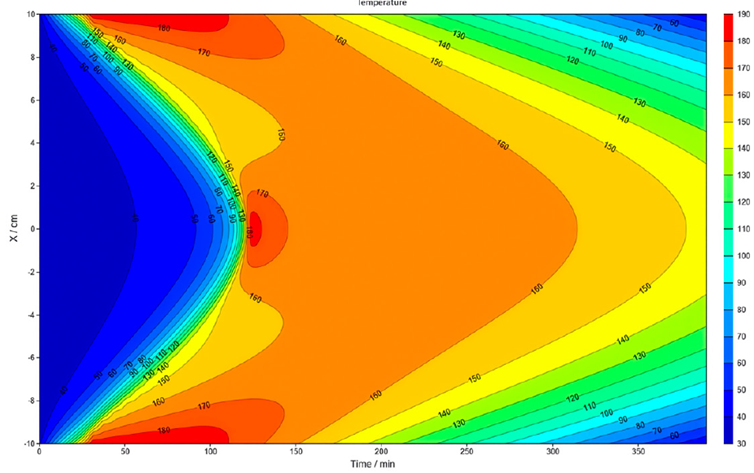
In classic DSC, DIL, Accelerating Rate Calorimetry (ARC)Die Methode, die isotherme und adiabatische Testverfahren beschreibt, wird zur Detektion thermisch induzierter Zersetzungsreaktionen eingesetzt. Das Standardverfahren ist Heat-Wait-Search (HWS.ARC® or TGA measurements, we observe reactions at a given temperature. We see a curve that hides sample size, shape and the local story. However, in real-world applications, temperature, heat production and reaction fronts never behave uniformly:
- Hotspots form at the core, while the surface cools faster.
- Reaction rates vary with geometry, heat transfer, and material properties.
- Diffusion and Tg effects alter the kinetics as curing or decomposition progresses.
These are the effects that determine product quality, safety, and performance; yet until now, they were invisible. That is where the NETZSCH Termica Neo software comes into play.
Introducing Termica Neo: The Simulation Software for Thermal Analysis
Termica Neo extends the power of thermal analysis from data to simulation. It directly imports kinetic models from the NETZSCH Kinetics Neo Software, whether they are model-free or model-based, single-step or multi-step, autocatalytic or diffusion-controlled.
Once the kinetics data has been loaded, you can additionally define:
- Material properties (specific heat capacity, density, thermal conductivity)
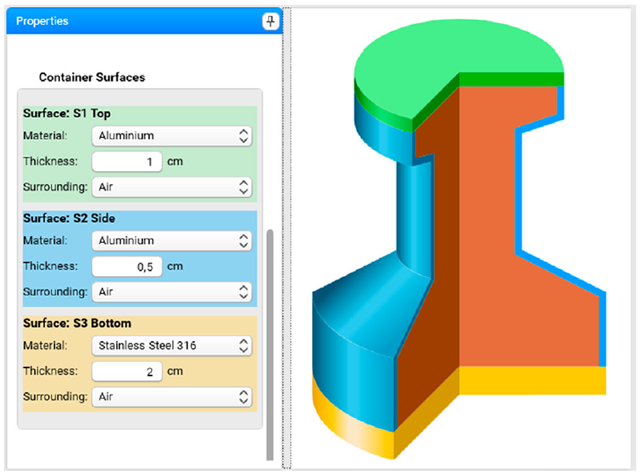
- Container and environment (material, thickness, emissivity, convection)
- Temperature programs: isothermal, dynamic, step-isothermal, modulated, or externally controlled.
The result is a virtual laboratory, where complex reactive behavior can be simulated in 2D or 3D geometries such as plates, cylinders, spheres, or rotational bodies.
From Data to Dynamic Fields
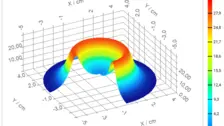
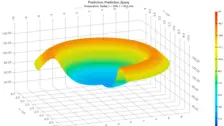
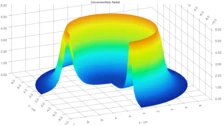
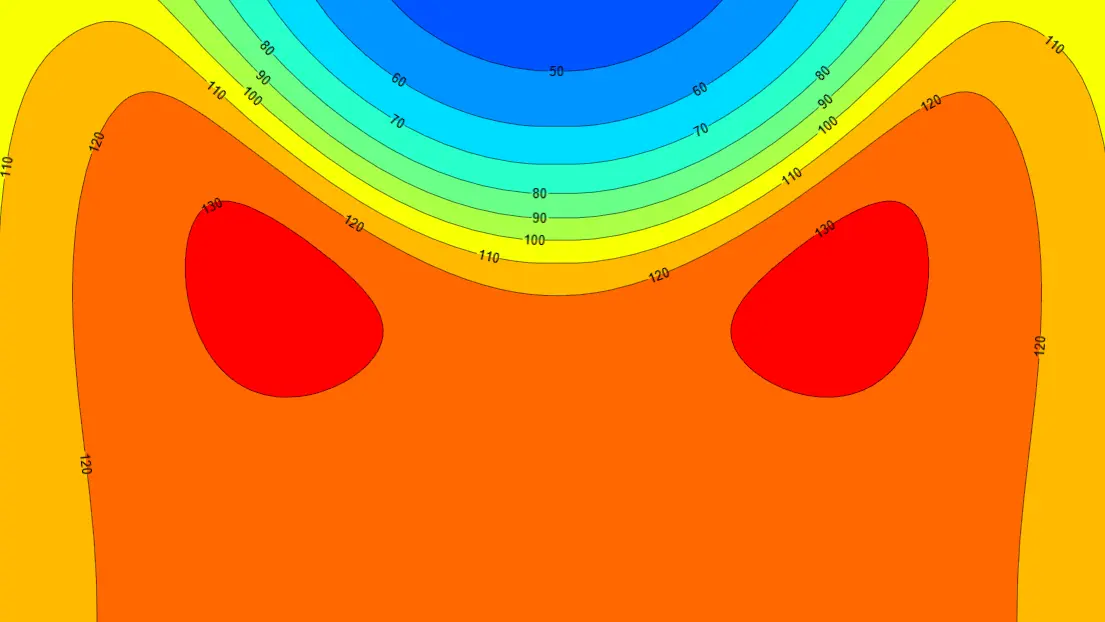
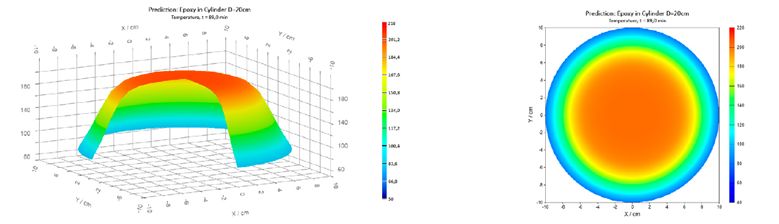
Once launched, Termica Neo computes temperature, conversion, conversion rate, and concentration distributions over the entire volume of your sample, not just over time.
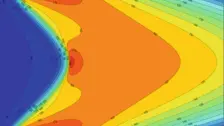
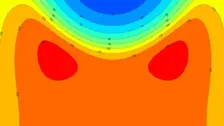
Interactive 2D and 3D views allow you to rotate, slice, and zoom into the process. Hotspots become visible. Reaction fronts move before your eyes. The results can be exported as heat maps, 3D renders, or AVI animations for reporting and communication purposes.
Impact on R&D and Industry
With the NETZSCH Termica Neo software, the measurement curve becomes a predictive simulation tool:
- Predict reaction homogeneity during decomposition, curing, or sintering.
- Anticipate temperature gradients that may cause stress or incomplete reaction.
- Optimize cycle times and safety margins before conducting a single large-scale test.
This approach is faster, safer, and far more insightful than traditional “trial and error.”
Imagine being able to validate your curing, sintering or decomposition behavior at the press of a button. That’s what the NETZSCH Termica Neo software delivers.
Download the new brochure to find out more:
What You can Do with Termica Neo
- Simulate your materials’ behavior at each point inside the container
- Find out where and when the maximum temperature or maximum conversion rate of the reactant inside the container are
- Determine the temperature, conversion, and concentrations for a given time and position of the reactant inside the container
- Predict your degree of curing, decomposition and crystallization
- Determine thermal safety conditions for production and storage
About This Blog Series
This article is the first article in our five-part blog series: “The New Dimension of Thermal Analysis with NETZSCH Termica Neo: Software for the Thermal Simulation of Chemical Reactions on an Industrial Scale.”
In the upcoming posts, we’ll dive deeper into:
- Scale-up and Safety: How Termica Neo helps identify critical conditions such as Self-Accelerating Decomposition Temperature (SADT), adiabatic scenarios or Φ-factor limitations.
- Polymer Curing, Thermoplastic Crystallization, and Ceramic Sintering: Real-world examples from industry demonstrate how simulation provides information that cannot be obtained through measurements alone.
Stay tuned! Each article stands on its own, but together they reveal how Termica Neo transforms thermal analysis from data collection to true thermal intelligence.
--------------------------
Useful links:
Get your free demo version:Request Demo Version of Temica Form - NETZSCH Termica Neo
Direct contact:Feature Request - NETZSCH Kinetics Neo
Learn even more:Termica Neo - NETZSCH Termica Neo