14.05.2026 von Aileen Sammler
Polymer Curing – How NETZSCH Termica Neo Makes Curing Visible
This is blog 3 of the series: “The New Dimension of Thermal Analysis with NETZSCH Termica Neo: The Software for Thermal Simulation of Chemical Reactions on an Industrial Scale.”
Read about the following topics in this series: From the Kinetic Model to Real-World Applications; Scale-up & Safety; Polymer Curing; Thermoplastic Crystallization (PA12); Ceramic Sintering

Every polymer tells two stories: The one on the DSC curve and the one hidden inside the part
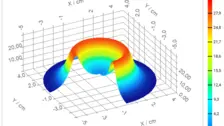
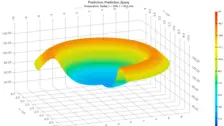
In small samples, curing looks perfect. But inside a real part, heat builds up, reaction fronts move, and vitrification can freeze the reaction long before completion. NETZSCH Termica Neo exposes that invisible world. It transforms kinetic data into 3D maps of temperature, conversion, and reaction rate.
Now, you can see your resin curing in both space and time rather than just along a line.
From Laboratory Curves to Spatial Reality
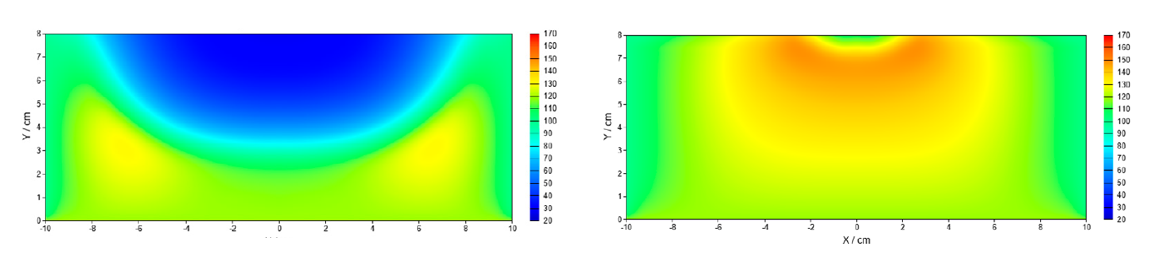
In the lab, you measure kinetics for small samples with the same temperature. In production, you have sample geometry with temperature gradients inside. The challenge lies between them: how to predict when the center of a laminate, mold, or adhesive layer catches up with its surface without hot spots with too high temperatures leading to material damage.
The Termica Neo software closes that gap by importing Kinetics Neo data – model-free or model-based, single- or multi-step, autocatalytic or diffusion-controlled – and applying it to real component shapes.
Define:
- Material parameters: specific heat capacity, density, thermal conductivity
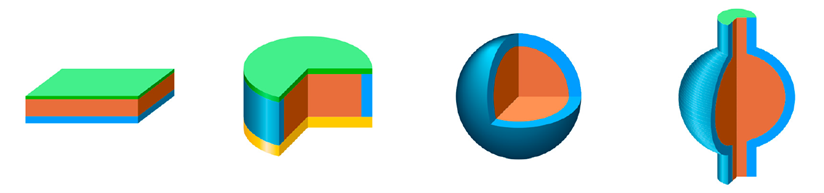
- Geometry: plate, cylinder, sphere, or custom rotational body
- Boundary conditions: heat transfer, convection, emissivity
- Temperature program: isothermal, dynamic, step-isothermal, modulated
What Happens During Curing?
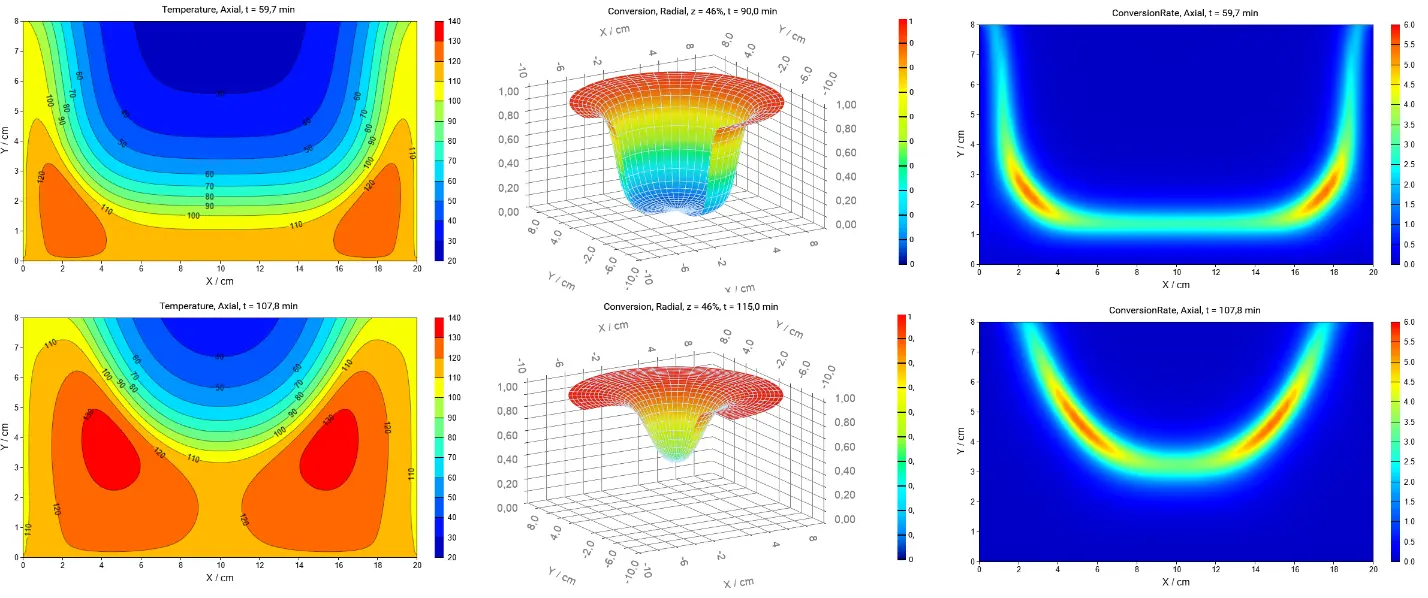
As the crosslinking reaction starts, the exothermic heat generated raises the local temperature.
The outer layers heat up faster to surrounding temperature, while the interior firstly remains colder and is then heated by the accelerating reaction and creates hotspots. The glass-transition temperature, Tg, increases above the sample temperature, molecular mobility declines and diffusion control slows the process.
Termica Neo captures these coupled effects simultaneously: temperature ↔ reaction under chemical control↔ reaction under diffusion control.
The result is a living model of the curing front moving through your part.
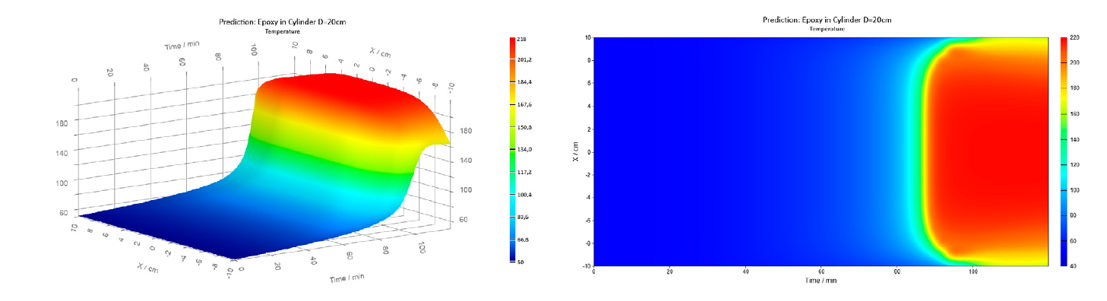
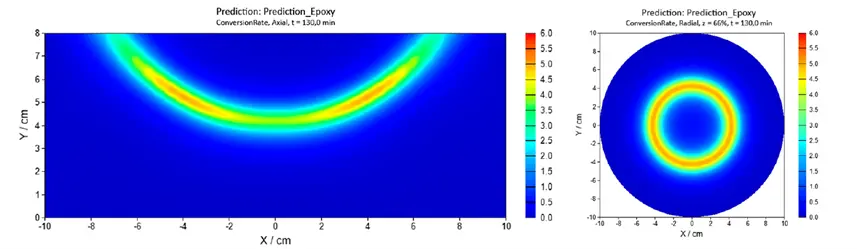
Case Study: Epoxy Cylinder Curing with Bottom Heating
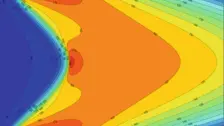
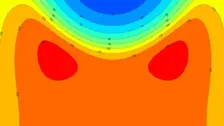
Simulation of the curing of a simple epoxy cylinder reveals information that cannot be obtained through measurement alone:
- A reaction front travels upwards through the height.
- The axis region lags in conversion and cools slowly.
- Over-curing at the surface and under-curing inside occur in parallel.
By adjusting temperature ramps or hold times on each side of the cylinder in Termica Neo, engineers can eliminate these gradients before the first real molding trial.
From Reactive Guesswork to Predictive Control
Curing is no longer a blind spot. With the NETZSCH Termica Neo software, you can simulate scenarios from lab scale to industrial scale, testing new resin systems, curing cycles, and variations in geometry and volume to accurately predict curing behavior for the prediction of:
- Hotspot location and temperature
- Degree of cure (α) distribution
- Presence of diffusion-controlled reaction depending on the local glass transition temperature, Tg
- Optimized process windows with minimal energy input
You achieve efficient processes and high product quality, backed by minimal energy use instead of trial and error.
Benefits of Termica Neo
- Direct kinetic import from Kinetics Neo
- Full 2D/3D visualization of temperature, conversion, and reaction rate
- Simulation of autocatalytic and diffusion-controlled curing
- Geometry-specific optimization for composites, adhesives and coatings
- Reduced trial cycles | Higher process reliability | Lower energy cost
About This Blog Series
This article continues the NETZSCH series: “The New Dimension of Thermal Analysis with Termica Neo: Software for the Thermal Simulation of Chemical Reactions on an Industrial Scale.”
Already published articles: (see links below)
- From Kinetic Model to Real-World Application — turning 1-D data into 3-D insight.
- Scale-up & Safety — predicting runaways before they happen.
- Polymer Curing — How Termica Neo Makes Curing Visible
These articles come next: Thermoplastic Crystallization (PA12) and Ceramic Sintering: Applying the same 3D vision to cooling and densification. Stay tuned!
See Your Curing Process Come to Life. Explore NETZSCH Termica Neo and watch how curing really happens inside your component, not just in your data.
--------------------------
Useful Links:
Get your free demo version:Request Demo Version of Temica Form - NETZSCH Termica Neo
Download the new brochure to learn more:Termica Neo Brochure
Direct contact:Feature Request - NETZSCH Kinetics Neo
Learn even more:Termica Neo - NETZSCH Termica Neo