Introduction
Epoxy resins (EP) are among the most important polymeric materials used in electronics, lightweight construction, coatings, and fibre-reinforced composites. They are characterized by excellent mechanical properties, high chemical resistance, and good processability. However, their inherently low Thermal ConductivityThermal conductivity (λ with the unit W/(m•K)) describes the transport of energy – in the form of heat – through a body of mass as the result of a temperature gradient (see fig. 1). According to the second law of thermodynamics, heat always flows in the direction of the lower temperature.thermal conductivity can limit their use in applications that require effective thermal management.
Adding thermally conductive fillers such as boron nitride (BN) can significantly enhance Thermal ConductivityThermal conductivity (λ with the unit W/(m•K)) describes the transport of energy – in the form of heat – through a body of mass as the result of a temperature gradient (see fig. 1). According to the second law of thermodynamics, heat always flows in the direction of the lower temperature.thermal conductivity. This is particularly important for electronic components, potting compounds, thermal management systems, and composites exposed to high thermal loads. The reliable determination of Thermal ConductivityThermal conductivity (λ with the unit W/(m•K)) describes the transport of energy – in the form of heat – through a body of mass as the result of a temperature gradient (see fig. 1). According to the second law of thermodynamics, heat always flows in the direction of the lower temperature.thermal conductivity is therefore essential for the development and optimization of such materials.
Measurement with the TCT 716 Lambda Using the GHFM Method
The NETZSCH TCT 716 Lambda was used to characterize the Thermal ConductivityThermal conductivity (λ with the unit W/(m•K)) describes the transport of energy – in the form of heat – through a body of mass as the result of a temperature gradient (see fig. 1). According to the second law of thermodynamics, heat always flows in the direction of the lower temperature.thermal conductivity of the materials. The instrument enables precise, direct measurement of Thermal ConductivityThermal conductivity (λ with the unit W/(m•K)) describes the transport of energy – in the form of heat – through a body of mass as the result of a temperature gradient (see fig. 1). According to the second law of thermodynamics, heat always flows in the direction of the lower temperature.thermal conductivity in polymers, composites, and other solids over a broad temperature range.
The measurement principle is based on the Guarded Heat Flow Meter (GHFM) method. A defined heat flux is passed through the sample, and the resulting temperature difference is measured. An additional controlled guard heater minimizes lateral heat loss, helping to ensure high measurement accuracy and excellent reproducibility. The measurement parameters are summarized in Table 1.
Table 1: Measurement conditions
| Measuring instrument | TCT 716 Lambda |
|---|---|
| Method | GHFM |
| Samples | Unfilled epoxy resin and epoxy resin filled with BN |
| Sample sizes | Ø approx. 51 mm; thickness 2 to 6 mm; plane parallel |
| Temperature range | 50°C to 80°C in steps of 10 K |
| Calibration | Fused silica |
Measurement Results
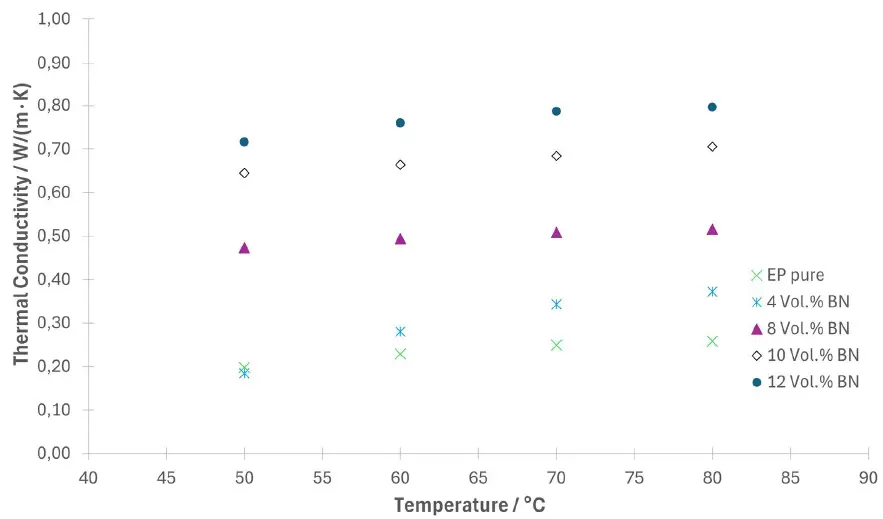
As shown in Figure 1, the Thermal ConductivityThermal conductivity (λ with the unit W/(m•K)) describes the transport of energy – in the form of heat – through a body of mass as the result of a temperature gradient (see fig. 1). According to the second law of thermodynamics, heat always flows in the direction of the lower temperature.thermal conductivity of the epoxy resin increases significantly with increasing boron nitride content. While the unfilled material exhibits values of approximately 0.20 to 0.26 W/(m·K), the addition of 8 vol.% BN increases Thermal ConductivityThermal conductivity (λ with the unit W/(m•K)) describes the transport of energy – in the form of heat – through a body of mass as the result of a temperature gradient (see fig. 1). According to the second law of thermodynamics, heat always flows in the direction of the lower temperature.thermal conductivity by up to 140%. At 10 vol.% BN, the increase reaches up to 230%, while 12 vol.% BN yields an improvement of up to 280% compared with the unfilled reference material. In addition, all compositions show a slight increase in Thermal ConductivityThermal conductivity (λ with the unit W/(m•K)) describes the transport of energy – in the form of heat – through a body of mass as the result of a temperature gradient (see fig. 1). According to the second law of thermodynamics, heat always flows in the direction of the lower temperature.thermal conductivity with increasing temperature. These results demonstrate the effectiveness of boron nitride as a filler for enhancing the Thermal ConductivityThermal conductivity (λ with the unit W/(m•K)) describes the transport of energy – in the form of heat – through a body of mass as the result of a temperature gradient (see fig. 1). According to the second law of thermodynamics, heat always flows in the direction of the lower temperature.thermal conductivity of epoxy resins.
Summary
The measurements clearly demonstrate that the Thermal ConductivityThermal conductivity (λ with the unit W/(m•K)) describes the transport of energy – in the form of heat – through a body of mass as the result of a temperature gradient (see fig. 1). According to the second law of thermodynamics, heat always flows in the direction of the lower temperature.thermal conductivity of epoxy resins can be systematically tailored and significantly increased by adding boron nitride. Even moderate concentrations of the filler lead to a substantial improvement in thermal conductivity, opening up new possibilities for thermally demanding applications.
In this context, the NETZSCH TCT 716 Lambda provides a reliable solution for material characterization. Its precise GHFM technology enables the precise and reproducible determination of thermal conductivity, even for low-conductivity polymers and filled composites. Consequently, the TCT 716 Lambda is a powerful tool for the research, development and quality control of modern thermal management materials.