Introduction
Testosterone is a steroidal active substance whose thermal behavior is highly relevant for drying, storage, formulation, and thermal processing. Even small amounts of residual moisture or residual solvent can influence Crystallinity / Degree of CrystallinityCrystallinity refers to the degree of structural order of a solid. In a crystal, the arrangement of atoms or molecules is consistent and repetitive. Many materials such as glass ceramics and some polymers can be prepared in such a way as to produce a mixture of crystalline and amorphous regions.crystallinity, melting behavior, powder handling, and Thermal StabilityA material is thermally stable if it does not decompose under the influence of temperature. One way to determine the thermal stability of a substance is to use a TGA (thermogravimetric analyzer). thermal stability. Therefore, a combined TGA-DSC measurement with simultaneous mass spectrometric analysis of the gases evolved is particularly suitable for comprehensive characterization. This approach makes it possible to distinguish between volatile release, melting, and chemical Decomposition reactionA decomposition reaction is a thermally induced reaction of a chemical compound forming solid and/or gaseous products. decomposition and thus provides valuable information for process optimization and quality control.
Measurement Conditions
The measurement conditions are detailed in Table 1.
Table 1: Measurement conditions for STA
| Instrument | STA Aёolos |
| Sample | Testosterone |
| Sample mass | 10 mg |
| Temperature range | 30°C to 500°C |
| Heating rate | 20 K/min |
| Atmosphere | Nitrogen, 70 ml/min |
| Crucible | Pt with pierced lid |
Results and Discussion
Figure 1 shows the TGA, DTG, and DSC curves of testosterone.
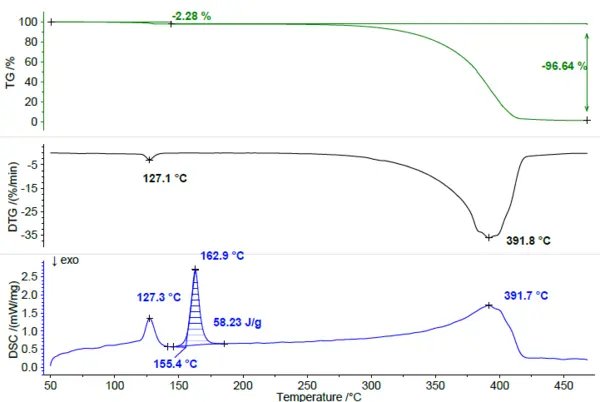
In the low-temperature range between room temperature and approximately 130°C, a small mass loss of 2.3% with a DTG peak at 127°C is observed. This behavior can be attributed to the release of residual humidity and weakly bound volatile species. The DSC signal simultaneously exhibits an EndothermicA sample transition or a reaction is endothermic if heat is needed for the conversion.endothermic effect with a peak temperature of 127°C. These events indicate desorption or dehydration-related processes prior to the main Phase TransitionsThe term phase transition (or phase change) is most commonly used to describe transitions between the solid, liquid and gaseous states.phase transition. Such information is important because even small amounts of residual humidity may influence storage stability, powder flow, and the reproducibility of downstream processing.
A pronounced EndothermicA sample transition or a reaction is endothermic if heat is needed for the conversion.endothermic DSC peak appears with an extrapolated onset temperature of 155°C, which corresponds well to the Melting Temperatures and EnthalpiesThe enthalpy of fusion of a substance, also known as latent heat, is a measure of the energy input, typically heat, which is necessary to convert a substance from solid to liquid state. The melting point of a substance is the temperature at which it changes state from solid (crystalline) to liquid (isotropic melt).melting point reported in literature. The melting enthalpy amounted to 58 J/g. This signal is assigned to the melting of testosterone and represents the main physical Phase TransitionsThe term phase transition (or phase change) is most commonly used to describe transitions between the solid, liquid and gaseous states.phase transition of the substance. The well-defined peak shape indicates a distinct melting process. Knowledge of the Melting Temperatures and EnthalpiesThe enthalpy of fusion of a substance, also known as latent heat, is a measure of the energy input, typically heat, which is necessary to convert a substance from solid to liquid state. The melting point of a substance is the temperature at which it changes state from solid (crystalline) to liquid (isotropic melt).melting temperature is essential for the design of thermal processing steps. Thermal degradation started above 250 °C and was complete at about 450°C. The DTG peak was found at 392°C.
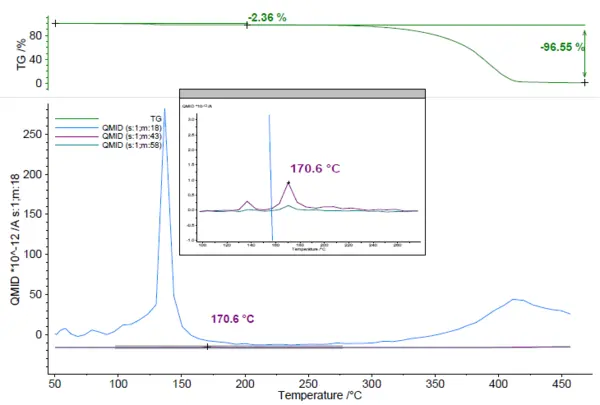
The evolved gas analysis shown in Figure 2 provides important additional information on the nature of the mass-loss events. The ion trace of m/z 18 shows a clear signal with a maximum at about 137°C, which is assigned to the release of water. This confirms that the low-temperature mass loss seen in the TGA curve is at least partly caused by residual humidity. In addition, the ion traces of m/z 43 and m/z 58 exhibit a distinct maximum at around 171°C, indicating the release of traces of acetone as soon as the sample is molten. This suggests the presence of residual solvent, likely originating from synthesis, purification, or CrystallizationCrystallization is the physical process of hardening during the formation and growth of crystals. During this process, heat of crystallization is released.crystallization.
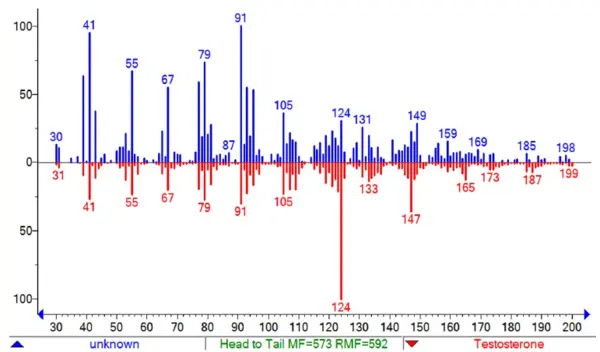
The measured MS spectrum at 374°C is depicted in Figure 3 and shows some similarities to the library spectrum of testosterone. This finding suggests partial Decomposition reactionA decomposition reaction is a thermally induced reaction of a chemical compound forming solid and/or gaseous products. decomposition and partial evaporation of testosterone during thermal treatment. Upon PyrolysisPyrolysis is the thermal decomposition of organic compounds in an inert atmosphere.pyrolysis, probably several different Decomposition reactionA decomposition reaction is a thermally induced reaction of a chemical compound forming solid and/or gaseous products. decomposition products are simultaneously released as a mixture.
Conclusion
The measurement demonstrates that a combined TGA-DSC approach, ideally supplemented by evolved gas analysis, is essential for reliable assessment of the material’s thermal behavior. Only this combination allows the clear differentiation between physical transitions such as drying and melting and chemical degradation processes. Without MS coupling, these low-level mass loss events could be detected by TGA, but their chemical origin could not be identified with the same level of confidence. These results provide an important basis for optimizing drying, storage, and thermal processing conditions for testosterone.
This thermal characterization of the melting behavior of testosterone provides valuable information for assessing its physical stability in transdermal dosage forms. The data obtained support the development of robust formulations and enable the evaluation of potential recrystallization processes that may impair drug release and, consequently, product efficacy. Preventing CrystallizationCrystallization is the physical process of hardening during the formation and growth of crystals. During this process, heat of crystallization is released.crystallization is essential to ensure both bioavailability of the active pharmaceutical ingredient and long-term adhesion performance of transdermal patches during storage and use.