Introduction
Polyvinyl alcohol (PVA) hydrogel, as a high-performance soft polymer material, exhibits broad application prospects in fields such as biomedicine, flexible electronics, and tissue engineering, owing to its excellent biocompatibility, tunable mechanical properties, and unique three-dimensional network structure. When this kind of soft and slippery PVA hydrogel is used as a potential artificial cartilage, a critical question arises: How does it perform under friction? Traditionally, there are many specialized friction testing machines on the market for tribology tests. However, it is less well known that the rheometer which we usually use to evaluate viscoelasticity can easily be transformed into a powerful tribological testing platform with the corresponding accessory. This Application Note will introduce how to conduct tribological testing of PVA hydrogels using our Kinexus rotational rheometer and discuss the unique advantages of this method.
In tribological testing of PVA hydrogels, the contact geometry should be selected so that the real tribosystem is represented as accurately as possible on a model scale. For the application described here, the real tribosystem is inherently spatially distributed and multipoint, like the contact between the femoral head and the acetabulum in human joints. Therefore, a multipoint contact model is more appropriate than a single-point contact model. For this purpose, the three ball-plate method (three balls positioned on the same disk in an equilateral triangle arrangement, with the hydrogel fixed on the lower plate) effectively avoids this problem. The normal force is evenly distributed onto the three balls, significantly reducing the local concentration of the StressStress is defined as a level of force applied on a sample with a well-defined cross section. (Stress = force/area). Samples having a circular or rectangular cross section can be compressed or stretched. Elastic materials like rubber can be stretched up to 5 to 10 times their original length.stress. The three-point contact allows for stable storage and ensures good contact. For example, in human joints, the contact between the femoral head and the acetabulum is, by its very nature, spatially distributed and multipoint. Therefore, three-point contact more closely approximates the actual physiological state than single-point contact.
In combination with the rheometer, the coefficient of friction (CoF) can be calculated using the following formula:
where τ is the torque, R is the radius of the circle defined by the position of three balls, and Fn is the normal force. Then, we obtain the friction coefficient curve which is commonly known as the Stribeck curve when the coefficient of friction (CoF) is plotted as a function of sliding velocity (by varying the rotational speed, which represents the sliding velocity). The Stribeck curve reveals the lubrication regime and allows us to determine the lubrication mechanism of the material at different velocities and evaluate its adaptability under real operating conditions (such as variations in joint movement speed). Notably, a sweep test can also be performed in a back-and-forth manner, i.e., continuously ramping the velocity from low to high and then immediately back from high to low. This approach can reveal whether the lubrication state of the material is reversible and whether a lubrication memory characteristic [1, 2] exists, which is of great value for simulating the variable-speed motion of human joints (such as starting, accelerating, decelerating, and stopping).
The Kinexus rotational rheometer allows for simply expanding to a tribological setup for a tribological model system. The core advantage of the rheometer lies in its precision speed and normal force control, as detailed in Table 1. Typically, the bearing of specialized friction test machines is always mechanical bearings, while the rotational rheometer utilizes air-bearing technology, allowing extremely low rotational speeds which enable more accurate simulation of friction under static and low-speed motion conditions. Additionally, the high-precision sensors of the rheometer offer higher torque resolution, which means we can observe more small transient changes during the friction process. The temperature control used on a rheometer is always the Peltier technology with a temperature accuracy of ±0.01°C, which can simulate the 37°C physiological environment.
Table 1: Comparison of a specialized friction test machine and a rheometer
| Parameter | Example of a commercial specialized friction test machine | NETZSCH Kinexus Rotational Rheometer |
|---|---|---|
| Normal force accuracy | ±0.1 N | ±0.01 N |
| Torque resolution | 0.1 mNm (100000 nNm) | 0.1 nMm |
| Speed range | 0.1 - 2000 rpm | 10-7 - 4700 rpm |
| Data rate | 10 - 100 Hz | 5000 Hz |
| Temperature accuray | ±0.5°C | ±0.1°C |
Measurements and Results
Preparation of a PVA Hydrogel Used for Tribology Test
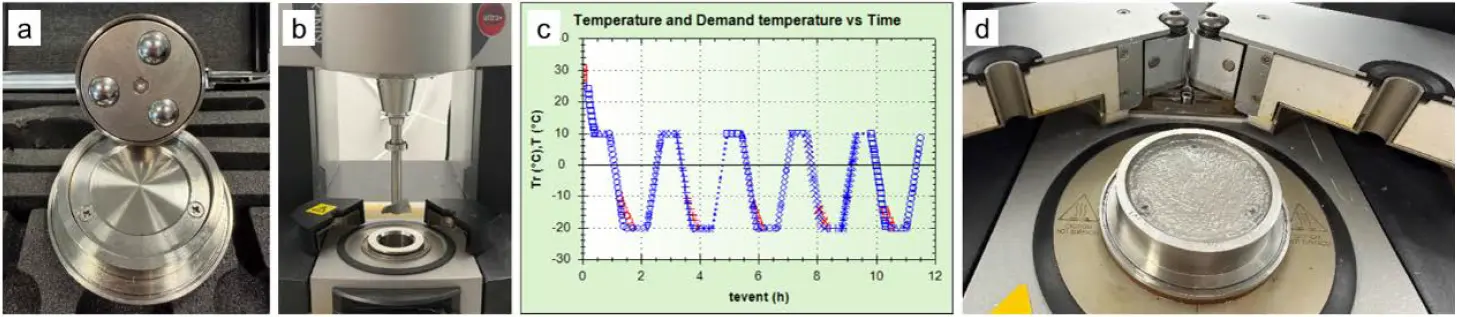
Figure 1a shows our tribology testing accessory. The upper geometry consists of three stainless steel balls arranged in an equilateral triangle, while the lower geometry is a plate with a fixing ring. We need to secure the test sample onto the lower plate using the fixing ring and screws. However, for PVA hydrogel, this kind of fragile sample – this fixation is limited, and it may cause significant deformation or even rupture on the gel – ultimately affects the test results. Therefore, we prepared the PVA hydrogel directly on the lower plate, ensuring it adheres tightly to the plate and becomes integrated with it.
The rheometer was used for the entire preparation process of the PVA hydrogel. The specific preparation method was introduced in AN 421. A homogeneous PVA solution is prepared using a stirring blade upper geometry and a 34-mm cup system (figure 1b). Then, the prepared PVA solution was poured onto the lower plate of the tribology set shown in figure 1a. Subsequently, a bulk PVA hydrogel is fabricated using a physical freeze-thaw method employing a cyclic heating and cooling sequence (figure 1c). Ultimately, a hydrogel tightly bonded and integrated with the lower plate is formed (figure 1d). The tibological tests can then be conducted on the PVA hydrogel.
Tribological Test on a PVA Hydrogel
The tribological evaluation was conducted on our NETZSCH Kinexus rotational rheometer equipped with a tribology set. A three-ball-plate method was used, with specific test conditions detailed in Table 2. The normal load was set to 0.5 N, and the sliding speed was applied in a continuous ramp mode, with the angular velocity logarithmically increasing from 0.00001 rad/s to 5 rad/s within a ramp time of 1 minute. This speed range covered the entire spectrum from static to medium-speed sliding motion. A back-and-forth sweep mode (with changing rotation speed: low → high → low) was adopted. Two repeated tests were conducted on the same sample to systematically evaluate the reliability of the testing method.
Table 2: Three balls tribology test conditions
| Test method | rSolution_0032 Assessing the lubricating properties and coefficient of friction using tribology for 3 ball setups |
|---|---|
| Geometry | Three balls (stainless steel) on plate tribology cell KNX2282 |
| Temperature | 25°C |
| Normal force | 0.5 N |
| Velocity range | 0.00001~5 rad/s |
| Velocity ramp time | 1 min |
Figure 2 shows the Stribeck curves of the PVA hydrogel. The test employed a back-and-forth sweep mode, continuously accelerating from an extremely low speed of 10-7 m/s to 0.1 m/s, and then immediately decelerating back from 0.1 m/s to 10-7 m/s. The curves from two repeated tests on the same sample almost completely overlapped, indicating excellent repeatability and sample stability.
According to conventional tribological speed classification, the highest speed of 0.1 m/s corresponds to the joint sliding speed during normal human walking, in the medium-speed range, and does not reach the true high-speed range (e.g., running or jumping, corresponding to speeds above 0.1 to 0.3 m/s) [3]. Therefore, this test was actually focused on the low-speed and medium-speed regions, particularly the extremely low-speed region like 10-7 to 10-3 m/s, where the densest data points were collected. This region represents the critical physiological states during initiation and micro-adjustment of human joints, offering unique value for application analysis.
The curves exhibit a clear dependence on the direction of the velocity ramp. The upward curve from low to high velocity (blue) starts in the extremely low-speed region with a CoF value near 0, and then rapidly increases with speed, reaches a peak about 0.4 at approximately 10-3 m/s, and then decreases to almost 0.1 as the speed continues to increase to 0.1 m/s.
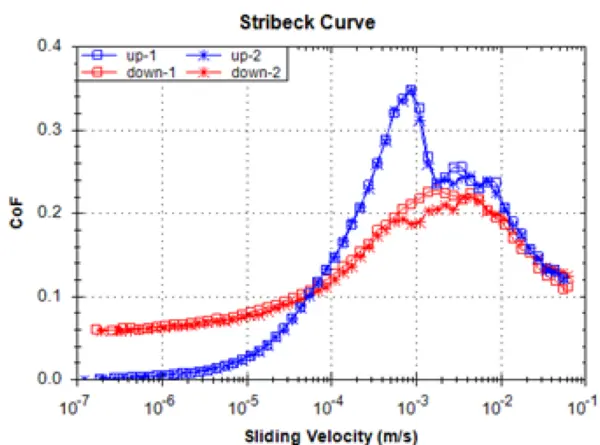
The downward curve from high to low speed starts at 0.1 m/s with a CoF of about 0.1. As the speed decreases, the CoF value shows a certain increase, reaches a peak of about 0.2 at approximately 10-3 m/s, and then drops to about 0.05 upon further deceleration to the extremely low-speed region. The peaks for both upward and downward curves appear near 10-3 m/s, but the peak value of the forward curve is significantly higher than that of the backward curve. This characteristic reveals the lubrication behavior mechanism of the PVA hydrogel during variable speed motion. The upward ramp represents the initiation from an unsheared initial state. As speed increases, the hydrogel surface undergoes the complete process from solid contact to the gradual establishment of a hydrated lubrication layer. There exists a high CoF value window at the initial startup. Although the surface is extremely smooth in the static state, significant starting resistance must be overcome once the motion begins. The peak at 10-3 m/s, followed by fluctuations on the curve, indicates that this is the critical transition point from boundary lubrication to mixed lubrication, where the lubricating film has not yet been effectively formed, resulting in a high and unstable CoF. Beyond this critical speed point, the hydration layer is gradually established, and the CoF decreases accordingly. The backward ramp represents deceleration from a fully lubricated state. At this point, the hydrogel surface has already undergone high-speed shear, and the hydration layer has been fully activated and remains stable. Even when the speed decreased, this lubricating film wouldn’t disappear immediately, and it maintains an extremely low CoF of 0.05 even in the extremely low speed region. This reveals the lubrication memory characteristics of the material. Once motion has been experienced and a stable hydrated lubrication layer has been established, the lubrication performance can be maintained even when the speed drops to extremely low levels, and there is no need to re-film during the continuous start and stop process. This is particularly important for patients with intermittent activities such as alternate sitting and standing.
Notably, the abundant data in the extremely low speed region of this test provides insights for evaluating the material’s performance in early postoperative rehabilitation and daily intermittent activities. The significant difference between the upward and downward ramp curves indicates that the lubrication performance of this PVA hydrogel exhibits a distinct start-up and activation characteristic. There is a starting resistance during initial initiation, but once activated, the lubrication performance is significantly enhanced and can be maintained persistently. Althouth this PVA hydrogel ist not an implant material, this characteristic provides clear guidance for clinical applications. In postoperative rehabilitation, the lubrication layer between joints can be quickly activated through simple pre-activity such as simple joint flexion and extension, avoiding high friction during the start-up. At the same time, the lubrication memory characteristics of the material enables to maintain a good lubrication state during intermittent activities, benefiting the patient’s daily activity experience and the life-span of the material. This kind of extremely low speed test can be limited with a conventional tribometer.
Conclusion
With the precise control capabilities and expansion capability of a rheometer, we can achieve comprehensive characterization from the rheological behavior to the tribological performance on one platform. The core advantages of a rheometer lie in its air-bearing technology and high-precision torque sensing system, which enable stable measurements at extremely low speeds, which is difficult to attain with conventional mechanical bearing friction test machines. In this test, the frictional behavior of PVA hydrogel in the extremely low speed regime precisely simulates the critical physiological states such as static initiation and micro-adjustment of human joints, and the data provides the guide for evaluating material performance in early postoperative rehabilitation and intermittent activities. The forward ramp curve revealed a high CoF start-up window, and the backward ramp curve showed a lubrication memory characteristics of the PVA hydrogel. Both rely on the rheometer’s precise control and data acquisition capabilities at extremely low speeds. By establishing a relationship between test speeds and physiological activities, the rheometer not only validates the lubrication potential of PVA hydrogels as cartilage substitute materials but also provides quantitative guidance for material optimization and clinical applications. The rheometer shows many new possibilities for tribological tests.