Learn, Apply, Achieve.
Basic Course
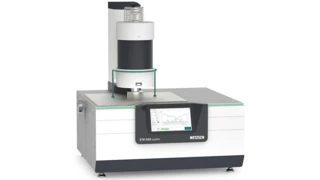
STA 509 Jupiter® Select
Language: English - Duration: 163 Min.
This Online course explains the
- theory behind the STA
- theory behind a DSC Signal,
- which factors have an influence to your DSC Signal
- how to evaluate melting, Glass Transition TemperatureThe glass transition is one of the most important properties of amorphous and semi-crystalline materials, e.g., inorganic glasses, amorphous metals, polymers, pharmaceuticals and food ingredients, etc., and describes the temperature region where the mechanical properties of the materials change from hard and brittle to more soft, deformable or rubbery.glass transition and CrystallizationCrystallization is the physical process of hardening during the formation and growth of crystals. During this process, heat of crystallization is released.crystallization effects
- theory behind a TG Signal,
- which factors have an influence on your TG Signal
- how to evaluate mass loss steps, residual mass and characteristic Decomposition reactionA decomposition reaction is a thermally induced reaction of a chemical compound forming solid and/or gaseous products. decomposition temperature
- how to start a measurement
- how to prepare your samples
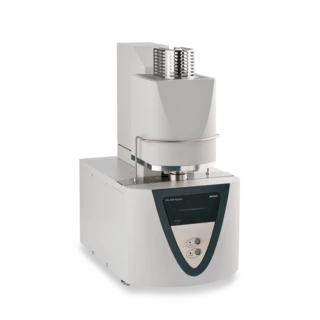
- and your STA 509 Jupiter® Select instrument itself.
Syllabus
- Introduction of the speaker and the agenda
- Introduction on the theory
- Theory of Thermogravimetry (TGA)
- Theory of Differential Thermal Analysis (DTA)
- Theory of Differential Scanning Calorimetry (DSC)
- Theory of Simultaneous Thermal Analysis (STA)
- Summary of the theory
- Introduction on influential factors
- Influence of the the Buoyancy Effect
- Influence of the sample
- Influence of the crucible material & lid
- Influence of the heating rate
- Influence of the atmosphere
- Summary of influential factors
- Introduction on starting a measurement
- Correction Measurements
- Sample Temperature Control (STC)
- Start a measurement using the NETZSCH Proteus® Software
- Create a method using the NETZSCH Proteus® Software
- How to program the Automatic Sample Changer (ASC)
- Introduction and thermal effects
- Manual evaluation of a STA measurement
- Automatic evaluation of a STA measurement
- Export of measurement data
- Export of measurement graphic
- Introduction to Calibration
- Temperature Calibration - Theory
- Temperature Calibration - TGA-DSC
- Temperature Calibration - TGA-cDTA
- Temperature Calibration - Curie Standards
- Heat-Flow Calibration - Theory
- Heat-Flow Calibration - Melting Temperatures and EnthalpiesThe enthalpy of fusion of a substance, also known as latent heat, is a measure of the energy input, typically heat, which is necessary to convert a substance from solid to liquid state. The melting point of a substance is the temperature at which it changes state from solid (crystalline) to liquid (isotropic melt).Melting Standards
- Heat-Flow Calibration - Cp with Sapphire
- Balance Calibration
- Summary of Calibration
- Introduction on the Product Guide of the NETZSCH STA 509 Jupiter® Select
- Instrument overview
- LED status bar
- Open the furnace
- Variety of Sample Holders
- Sample Holder Change
- Accessories and Equipment
- Introduction on Sample Preparation
- Sample Preparation of a granules
- Sample Preparation of samples in powder form
- Sample Preparation of foils
- Sample Preparation of liquids
- Sample extraction from a bigger component
Explore the range of NETZSCH STA instruments