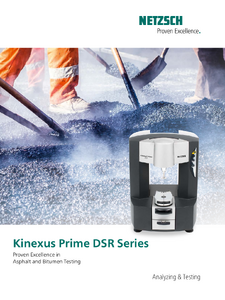
Kinexus Prime DSR+
Redefining Rheometer Capabilities for Asphalt Binder and Bitumen Testing
Highlights
The world's most sensitive DSR for all construction and petro chemicals testing
The Kinexus Prime DSR+ is a dynamic shear rheometer specifically designed for research and development requirements in the asphalt industry. With its true "plug and play" functionality for all measurement systems and environmental control units, it offers ease of use. The Kinexus DSR+ enables innovative standard operating procedure (SOP)-based testing while providing access to a comprehensive range of standard rheological tests with complete flexibility in test design and set-up.
The device offers precise torque control thanks to an ultra-light, electronically commutated motor. This enables rapid changes in torque and speed as well as access to higher oscillation frequencies without extensive adjustments. The wide torque range allows measurements from low-viscosity liquids to solids without changing test conditions or measurement geometries. Intelligent motor cooling regulates the operating temperature according to torque and power requirements.
Provideing frictionless support between moving parts through sintered, porous carbon for even air distribution and enables torques below 1 nNm. High axial and radial stiffness increases robustness and reduces compliance.
Precision measurement of rotor position and speed:
- Optical encoder with nanometer resolution measures smallest radial displacements and speeds.
- Sample placed close to the measuring point for optimized sample reaction.
- High-speed digital signal processor (DSP) enables fast and accurate control of StrainStrain describes a deformation of a material, which is loaded mechanically by an external force or stress. Rubber compounds show creep properties, if a static load is applied.strain and velocity.
Connection and alignment of the measuring system with the motor and bearing unit:
- Quick connection mechanism enables easy insertion and removal of the measuring systems while maintaining micrometer alignment.
- Automatic recognition by RFID (Radio Frequency Identification) records measuring systems, calibration constants and operating settings and ensures that a zero position is reached before measurement.
Transmission of torque or movement from the motor unit to the specimen:
- Versatile measuring systems such as plates, cones, cylinders and vanes in various sizes, materials and surfaces.
- Precision mechanics for exact rheological measurements with high shaft stiffness and low mass to minimize compliance and inertia.
- Quick connection system and integrated RFID recognition shorten the preparation time and ensure the correct use of the measuring system and calibration constants.
Enables measurement and control of the normal force:
- Innovative StrainStrain describes a deformation of a material, which is loaded mechanically by an external force or stress. Rubber compounds show creep properties, if a static load is applied.strain gauge with fast transient response, independent of rotor position and speed.
- Works in all operating modes of the device for measurement and control.
- Measuring range from 0.001 N to 50 N for uniform specimen loading and precise control during axial tests.
Controlled vertical profiles for sample loading and axial testing
- Enables full range of vertical profiles including linear, exponential and normal force over a working range of 230 mm (0.1 μm resolution) and speed range of 0.1 μm/s to 35 mm/s for controlled sample loading or dedicated axial testing
Contains all electronic components for controlling the rheometer:
- Microelectronics in close proximity to the measurement improves quality and reliability.
- Integrated control and measurement functions with fast digital signal processor (DSP) for intelligent device function.
Enables quick lower geometry replacement and temperature/ambient control through:
- Unique plug-and-play cartridge system with automatic detection for all connections with a single handle.
- Various cartridge options including asphalt peltier plate, universal cylinder and high temperature design.
- Geometries available in various sizes, materials and finishes.
- Simple mounting and removal mechanism for the lower measuring system with micrometer alignment maintained.
- Use of Peltier elements to heat/cool the top and bottom plates for improved efficiency.
- Optimally placed temperature sensors (PT100) for fast and accurate sample temperature measurement.
Enables direct control of rheometer functions from the device through:
- Control panel functionality linked to user instructions in test sequences for easy interaction without a keypad.
- Warning lights for rheometer errors, software communication errors or low air bearing pressure.
- Robust, solvent-free design for glove operation and easy cleaning.


Our Quality Promise:
NETZSCH’s Unlimited Warranty
At NETZSCH, our commitment to quality goes beyond the instruments themselves. We understand that your investment in advanced technology is a long-term one, and and that’s why we offer something truly unique – our Unlimited Warranty.
Method
The rotational rheology is a measurement method for determining the flow and deformation properties of materials using rotational movements. A sample is placed between two plates or in a cylindrical measuring system (e.g. a cone-plate system) and subjected to a rotating shear force. By analyzing the resulting shear StressStress is defined as a level of force applied on a sample with a well-defined cross section. (Stress = force/area). Samples having a circular or rectangular cross section can be compressed or stretched. Elastic materials like rubber can be stretched up to 5 to 10 times their original length.stress and shear rate, important rheological parameters such as viscosity, elasticity and yield point can be determined. This method is particularly useful for the characterization of liquids, gels, pastes and soft solids in various scientific and industrial applications.

- Exceptional 230 mm vertical travel for maximum user access and setup flexibility
- Vertical speed range from 0.1 μm/s to 35 mm/s
- Controllable speed and normal force profiles, including linear, exponential, and limited profiles
- Gap resolution of 0.1 μm over full range
- Optimal sample loading for all material types, from sensitive structures to rapid Curing (Crosslinking Reactions)Literally translated, the term “crosslinking“ means “cross networking”. In the chemical context, it is used for reactions in which molecules are linked together by introducing covalent bonds and forming three-dimensional networks.curing systems
- High sensitivity and rapid response from novel StrainStrain describes a deformation of a material, which is loaded mechanically by an external force or stress. Rubber compounds show creep properties, if a static load is applied.strain gauge design for normal force
- Ultra-fast 5 kHz data update rate for all variables, synchronized with rotational and temperature data
Specifications
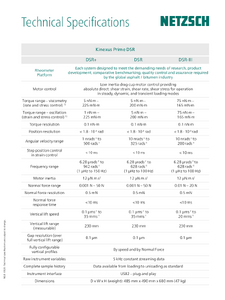
| Kinexus Prime DSR+ | |
|---|---|
| Torque range – viscometry | 5 nNm – 225 mNm |
| Torque resolution | 0.1 nNm |
| Angular velocity range | 1 nrads-1 to 500 rads-1 |
| Frequency range | 6.28 μrads-1 to 942 rads-1 (1 μHz to 150 Hz) |
| Normal force range | 0.001 N - 50 N |
| Vertical lift speed | 0.1 μms-1 to 35 mms-1 |
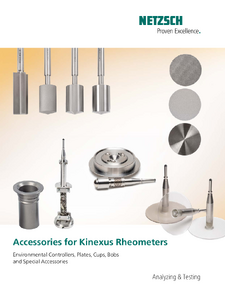
Measuring Systems and Accessories



Proven Excellence in Service
At NETZSCH Analyzing & Testing, we offer a comprehensive range of services globally to ensure the optimal performance and longevity of your thermoanalytical equipment. With a track record of proven excellence, our services are designed to maximize the effectiveness of your devices, extend their lifespan, and minimize downtime.
Unlock the full potential of your equipment with our tailored solutions, backed by years of industry expertise and innovation.
Software
rSpace can be used for simple QC operationor for advanced rheological testing
- Constant feedback and user guidance
- Guarantee of optimal rheological processes
- Integration of specific test controls relevant to your samples
- Development of standard test methods for your samples
- Available for company-wide use
- Standardizes consistent, operator-independent tests
- Application of time-temperature superposition to create master curves
- Automatic scoring as "pass" or "fail" based on the appropriate test criteria
- Report design with automatic print and PDF creation options

E-Learning
Related Devices