Introduction
Biodegradable nonwoven materials have demonstrated considerable potential in the field of biomedical engineering, particularly in the application of tissue engineering. The objective of tissue engineering is to facilitate the regeneration of damaged tissue by integrating cells with temporary three-dimensional support structures (scaffolds). Biodegradable scaffolds play a pivotal role in this process by providing temporary structural support for cells. Fiber-based nonwoven materials are particularly well-suited for this purpose, as their fiber-like structure resembles the natural extracellular matrix. This architecture enables high porosity and a specific surface area, thereby promoting cell adhesion, migration and proliferation.
Polycaprolactone (PCL) is a widely utilized material in the fabrication of degradable fiber-based scaffolds. PCL is a semi-crystalline, aliphatic polyester characterized by its good biocompatibility, controllable and comparatively slow hydrolytic degradation and good processability. Electrospinning or melt electrospinning can be used to generate fiber nonwovens from PCL, resulting in precise control over fiber geometry, porosity and mechanical properties.
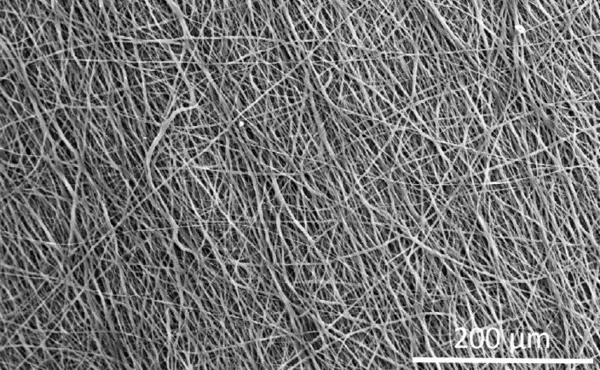
PCL scaffolds are often used in tissue engineering of load-bearing structures such as tendons and muscles [1,2]. A notable issue that emerges in this context is the substantial CreepCreep describes a time and temperature dependent plastic deformation under a constant force. When a constant force is applied to a rubber compound, the initial deformation obtained due to the application of the force is not fixed. The deformation will increase with time.creep behavior exhibited by the fiber nonwovens when subjected to repeated deformations. The microstructure of the material (Figure 1) leads to additional deformation mechanisms. When subjected to external forces, the fibers may undergo reorientation and alignment in the direction of the applied load. The contact points between the fibers are susceptible to rupture. Macroscopically, this results in increased plastic deformation or CreepCreep describes a time and temperature dependent plastic deformation under a constant force. When a constant force is applied to a rubber compound, the initial deformation obtained due to the application of the force is not fixed. The deformation will increase with time.creep compared to densely packed materials. In an implantation scenario, the nonwoven is repeatedly subjected to deformation, for instance, through contraction of the surrounding muscle tissue.
As the plastic deformation of the nonwoven increases, there is a risk that it will lose contact with the surrounding tissue due to loosening. Therefore, it is crucial to characterize this dynamic CreepCreep describes a time and temperature dependent plastic deformation under a constant force. When a constant force is applied to a rubber compound, the initial deformation obtained due to the application of the force is not fixed. The deformation will increase with time.creep behavior of fiber-based implants.
Tensile and Creep Recovery Measurements on PCL Nonwovens
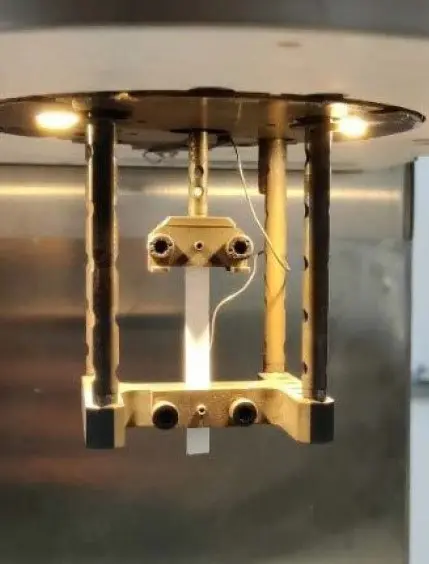
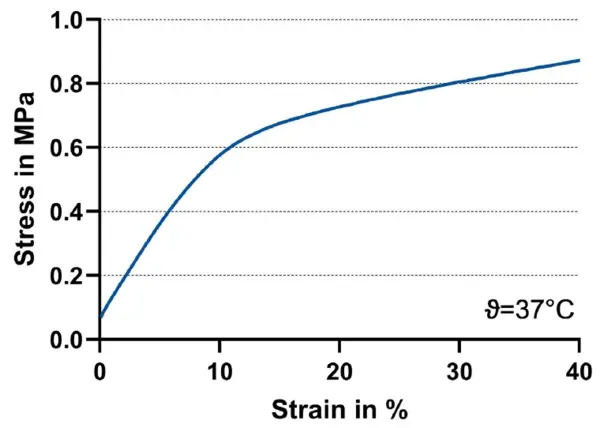
Tensile and Creep RecoveryCreep recovery is the ratio of the recoverable creep compliance to initial creep compliance given in percent. Often in MSCR (multiple stress creep recovery) testing, creep recovery is considered a performance indicator with more recovery indicating a binder less prone to rutting.creep recovery measurements were conducted at 37°C using a NETZSCH DMA 303 Eplexor® in tensile mode. Rectangular samples measuring 20 mm in length, 5 mm in width, and 0.3 mm in thickness were harvested from the PCL nonwovens (Figure 2). The material was initially characterized conducting a quasi-static tensile test. An elongation rate of 0.5 %/s and a preload of 0.1 N were applied. The tensile test results are displayed in Figure 3. The observations suggest that an elastic stress-strain relationship can be identified up to an approximate StrainStrain describes a deformation of a material, which is loaded mechanically by an external force or stress. Rubber compounds show creep properties, if a static load is applied.strain of 8 %.
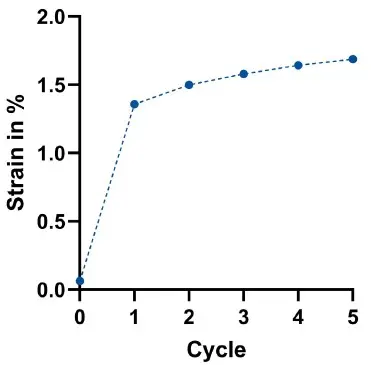
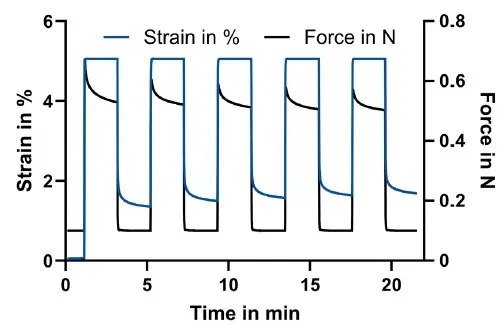
CreepCreep describes a time and temperature dependent plastic deformation under a constant force. When a constant force is applied to a rubber compound, the initial deformation obtained due to the application of the force is not fixed. The deformation will increase with time.Creep recovery measurements were performed in five cycles, with a fixed displacement of 5% employed in each cycle. These measurement results are presented in Figure 4. The residual StrainStrain describes a deformation of a material, which is loaded mechanically by an external force or stress. Rubber compounds show creep properties, if a static load is applied.strain was determined for each measurement cycle at the end of the recovery phase, as illustrated in Figure 5. It is evident that the residual StrainStrain describes a deformation of a material, which is loaded mechanically by an external force or stress. Rubber compounds show creep properties, if a static load is applied.strain is most pronounced after the initial cycle and subsequently continues to decrease. The measurement results indicate a consistent decrease in residual StrainStrain describes a deformation of a material, which is loaded mechanically by an external force or stress. Rubber compounds show creep properties, if a static load is applied.strain across all cycles, suggesting an approach to a limit value. This finding indicates that the observed CreepCreep describes a time and temperature dependent plastic deformation under a constant force. When a constant force is applied to a rubber compound, the initial deformation obtained due to the application of the force is not fixed. The deformation will increase with time.creep behavior can predominantly be attributed to structural reorganization within the fiber network rather than to molecular viscoelastic or viscoplastic mechanisms.
Conclusion
Applying static tensile tests as a predominant method for the characterization of fiber-based scaffolds in tissue engineering remains a prevalent practice. However, following implantation, repeated deformation can result in macroscopic CreepCreep describes a time and temperature dependent plastic deformation under a constant force. When a constant force is applied to a rubber compound, the initial deformation obtained due to the application of the force is not fixed. The deformation will increase with time.creep due to the reorganization of the fiber network. This effect is not evident in static tensile tests. The results of the tensile test indicate that a StrainStrain describes a deformation of a material, which is loaded mechanically by an external force or stress. Rubber compounds show creep properties, if a static load is applied.strain of 5% falls within the elastic region. However, Creep RecoveryCreep recovery is the ratio of the recoverable creep compliance to initial creep compliance given in percent. Often in MSCR (multiple stress creep recovery) testing, creep recovery is considered a performance indicator with more recovery indicating a binder less prone to rutting.creep recovery experiments have shown that residual StrainStrain describes a deformation of a material, which is loaded mechanically by an external force or stress. Rubber compounds show creep properties, if a static load is applied.strain occurs even at these levels of StrainStrain describes a deformation of a material, which is loaded mechanically by an external force or stress. Rubber compounds show creep properties, if a static load is applied.strain. Therefore, Creep RecoveryCreep recovery is the ratio of the recoverable creep compliance to initial creep compliance given in percent. Often in MSCR (multiple stress creep recovery) testing, creep recovery is considered a performance indicator with more recovery indicating a binder less prone to rutting.creep recovery experiments with the NETZSCH DMA 303 Eplexor® provide important information on the mechanical behavior of fiber-based scaffolds under dynamic load.