methods
Laser Flash Technique (LFA)
based on, e.g., ASTM E1461, DIN EN 821-2, DIN 30905, ISO 22007-4, ISO 18755
Principle of the LFA Method
The laser or light flash method is used for measurement of the Thermal DiffusivityThermal diffusivity (a with the unit mm2/s) is a material-specific property for characterizing unsteady heat conduction. This value describes how quickly a material reacts to a change in temperature.thermal diffusivity of a variety of different materials.
The front surface of a plane-parallel sample is heated by a light pulse and the resulting temperature rise at the sample’s rear face is recorded as a function of time. The higher the Thermal DiffusivityThermal diffusivity (a with the unit mm2/s) is a material-specific property for characterizing unsteady heat conduction. This value describes how quickly a material reacts to a change in temperature.thermal diffusivity, the faster the temperature rise reaches the rear face.
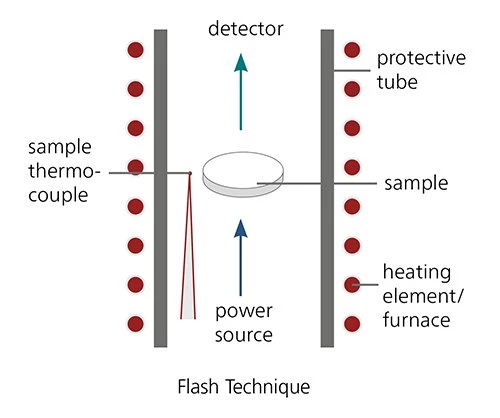
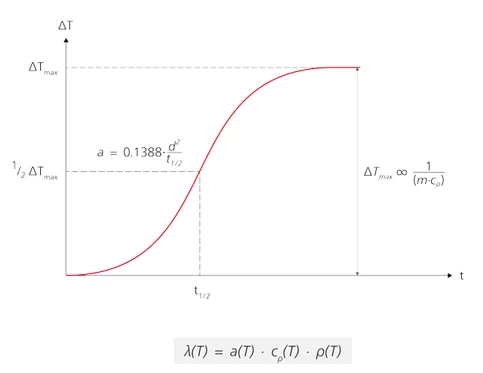
In a one-dimensional, the Thermal DiffusivityThermal diffusivity (a with the unit mm2/s) is a material-specific property for characterizing unsteady heat conduction. This value describes how quickly a material reacts to a change in temperature.thermal diffusivity rise is calculated from this temperature rise as follows:
a = 0.1388 ⋅ d² / t0.5 with
a – Thermal DiffusivityThermal diffusivity (a with the unit mm2/s) is a material-specific property for characterizing unsteady heat conduction. This value describes how quickly a material reacts to a change in temperature.Thermal diffusivity in cm²/s
d – Thickness of the sample in cm
t0.5 – Time to half minimum in s
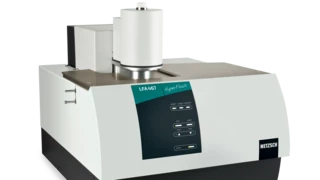
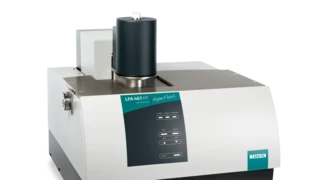
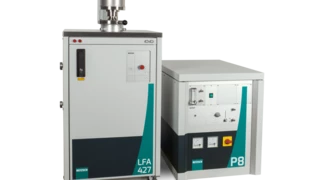
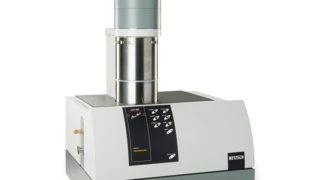
With all NETZSCH laser flash apparatuses (LFAs), the Thermal DiffusivityThermal diffusivity (a with the unit mm2/s) is a material-specific property for characterizing unsteady heat conduction. This value describes how quickly a material reacts to a change in temperature.thermal diffusivity and Specific Heat Capacity (cp)Heat capacity is a material-specific physical quantity, determined by the amount of heat supplied to specimen, divided by the resulting temperature increase. The specific heat capacity is related to a unit mass of the specimen.specific heat capacity can be determined. This data is then used for calculation of the Thermal ConductivityThermal conductivity (λ with the unit W/(m•K)) describes the transport of energy – in the form of heat – through a body of mass as the result of a temperature gradient (see fig. 1). According to the second law of thermodynamics, heat always flows in the direction of the lower temperature.thermal conductivity.